The knowledge library

Find the next useful step.

Browse Bermuda care by topic, from mowing and fertilizer to soil, water, weeds, and seasonal decisions.

Start with the Bermuda grass guide, follow the seasonal calendar, or check local conditions in LawnWeather.

Browse the library

All guides

45 guides ready to explore.

01
Lawn Problems & Troubleshooting · 8 min read

Yellow Bermuda Grass: How to Find the Real Cause

Yellow Bermuda grass isn't a diagnosis. It's a symptom, and the important part is figuring out what caused it before you start treating it. When Bermuda turns yellow, I like to work through the simple possibilities first: water, insects, disease, nutrients, mowing or chemical damage, and a few weird environmental problems that are surprisingly easy to miss. The shape of the yellow area, what the individual grass blades look like, what's happening below the soil, and when the problem appeared can usually narrow things down pretty quickly. The goal isn't to become a turf pathologist every time your lawn changes color. It's to slow down long enough to collect a few clues. In this guide, I'll walk through a simple diagnostic process you can use before you start buying products or applying treatments.

02
Weed Control · 8 min read

Spring Pre-Emergent for Bermuda Grass in Texas

Time spring pre-emergent for an established Texas Bermuda lawn using target weeds, local conditions, product labels, calibration, and renovation restrictions.

03
Getting Started · 9 min read

How to Measure Your Lawn for Fertilizer and Watering

Knowing your lawn's square footage is one of those basic measurements that makes almost everything else easier. Fertilizer rates are commonly expressed per 1,000 square feet, product bags list coverage in square feet, and knowing the size of individual lawn sections helps you stop guessing about how much product you're actually applying. You can measure a simple lawn with a tape measure, break an irregular lawn into smaller shapes, or use satellite imagery from Google Maps or Google Earth to trace the turf from above. Then, when it comes to irrigation, pair that lawn map with a catch-can test to find out how much water your sprinklers are actually delivering. Once those numbers are known, fertilizer and watering become much more repeatable.

04
Weed Control · 8 min read

How to Control Spurge in Bermuda Grass

Spurge can go from a few little plants in Bermuda grass to a frustrating summer infestation surprisingly fast. The problem isn't just killing the plant—it's stopping the next generation. Spotted and prostrate spurges grow low enough to survive mowing, develop a taproot, and can begin producing seed only weeks after germination. Those tiny seeds can also move around on shoes, equipment, and mower tires. My approach is to think about spurge control in layers: pull isolated plants before they seed, selectively treat larger infestations with a herbicide labeled for Bermuda grass and spurge, use pre-emergent herbicides to reduce future germination, and keep the Bermuda dense enough to leave fewer openings for spurge in the first place. The goal isn't just to make today's weeds disappear. It's to keep today's spurge from becoming next summer's problem.

05
Growth Regulation · 8 min read

How to Use a PGR on Bermuda Grass: An Advanced Technique

Plant growth regulator is one of my favorite advanced tools for maintaining a low-cut Bermuda lawn. A trinexapac-ethyl PGR doesn't simply stop the grass from growing—it suppresses vertical growth, which can reduce mowing and help produce that tight, dense appearance we're chasing. But this isn't a product I'd grab, eyeball into a sprayer, and start experimenting with. Your exact Bermuda cultivar matters. Application rate matters. Spray coverage matters. Temperature matters. And once you begin making repeat applications, the interval between them matters a lot. I like starting conservatively, applying PGR as a foliar spray with plenty of carrier water, and pairing it with light nitrogen and iron. Then I track growing degree days instead of blindly spraying every couple of weeks. Get it dialed in and PGR can completely change how you maintain Bermuda. Get too aggressive, and you can bring growth almost to a halt.

06
Aeration & Compaction · 8 min read

Should You Aerate Bermuda Grass?

Core aeration can be one of the most useful things you do for a compacted Bermuda lawn, but I don't look at it as something that automatically belongs on the calendar every year. I want a reason to punch thousands of holes in otherwise healthy turf. For me, that usually means I'm dealing with suspected compaction or I'm already planning to topdress and want to work material deeper into the rootzone. Just as important is timing. I aerate when my Bermuda is actively growing and capable of repairing the damage quickly—not heading into fall dormancy. I also like the soil moist enough for good tine penetration without being so wet that the aerator, my footsteps, and eventually my mower create another compaction problem. Here's how I decide whether aeration is worth doing and how I fit it into the rest of my lawn work.

07
Lawn Problems & Troubleshooting · 8 min read

How to Revive Bermuda Grass After Drought or Heat Stress

Bermuda grass can look absolutely cooked after a stretch of extreme heat and drought, but brown turf doesn't necessarily mean dead turf. Bermuda is remarkably heat- and drought-tolerant, spreads through stolons and rhizomes, and can recover aggressively once favorable growing conditions return. The trick is giving the surviving grass what it needs to start moving again. My approach to severe summer stress is pretty straightforward: restore moisture first, remove enough dead material to give surviving Bermuda room and light, correct compaction when necessary, then use fertilizer to support growth once the turf is hydrated and actively responding. On my lawn, I've watched ugly, seemingly bare areas produce noticeable green growth within about a week and dramatically improve in roughly 12 days, with stubborn spots filling over the following weeks. The key is understanding that water starts the recovery, but active Bermuda still has to reclaim the lawn.

08
Weed Control · 8 min read

How to Identify and Control Goosegrass in Bermuda Grass

Goosegrass is one of those weeds that's much easier to deal with once you know exactly what you're looking at. Its flattened, whitish center and low, wagon-wheel growth habit make mature plants fairly distinctive in Bermuda. My approach isn't just to find the strongest herbicide I can spray. I want to prevent new plants, physically remove isolated goosegrass when that makes sense, selectively treat what remains when conditions are right, and keep the Bermuda growing aggressively enough to reclaim the space. Summer heat complicates chemical control, so I personally don't like spraying when we're living in the 90s and the turf is already stressed. Sometimes the best weed killer in July is a Grandpa's weeder, a bucket, and healthy Bermuda ready to fill the hole.

09
Leveling & Renovation · 8 min read

How to Fix Bare Spots in Bermuda Grass

Bare spots in a Bermuda lawn don't automatically mean you need seed or new sod. Bermuda has one major advantage when it comes to lawn repair: it spreads aggressively through above-ground stolons and below-ground rhizomes. Once you've corrected whatever caused the damage—whether that's insects, disease, drought, traffic, or another problem—healthy Bermuda around the spot can often grow back into it. The goal is to help that natural recovery process along. Make sure the lawn has adequate nitrogen, keep the repair area supplied with water, and consider moving plugs from healthy turf into larger bare areas. Plugging effectively shortens the distance the Bermuda has to travel. Just make sure you know whether you have seeded common Bermuda or a vegetatively propagated hybrid before reaching for a bag of seed.

10
Weed Control · 8 min read

Common Weeds in Bermuda Grass Lawns: Identification and Control

Weeds in a Bermuda lawn get much easier to manage once you stop treating every weed like the same problem. I basically put them into three buckets: broadleaf weeds, sedges, and grassy weeds. Broadleaf weeds are usually the easiest to clean up with a Bermuda-safe post-emergent. Sedges need a more specialized product and some patience. Grassy weeds like crabgrass and goosegrass can be the frustrating ones, especially once they're established in actively growing Bermuda. My approach is pretty simple: use the right post-emergent where it makes sense, spot-treat sedges when they appear, physically pull grassy weeds when that's the better option, and rely heavily on a good pre-emergent program so fewer weeds ever make it into the lawn. The best weed to kill is still the one that never shows up.

11
Grass Types · 8 min read

Common vs. Hybrid Bermuda Grass: Which Type Do You Have?

If you have a Bermuda lawn that was installed as sod, there's a good chance you're dealing with a vegetatively propagated cultivar rather than the seeded common Bermuda most homeowners picture. The distinction matters because hybrid Bermuda doesn't rely on viable seed to repair itself. It spreads aggressively through stolons above the soil and rhizomes below it, which is why a healthy Bermuda lawn can fill damaged areas surprisingly well. Common Bermuda can also spread vegetatively, but unlike typical sterile hybrids, it produces viable seed. And here's where people get tripped up: hybrid Bermuda can still produce seedheads. Seeing those little seedheads doesn't automatically mean your lawn is common Bermuda, and seeding a thin hybrid lawn with common Bermuda can create a mixed stand you may regret later.

12
Grass Types · 8 min read

Bermuda Grass Seed vs. Sod: Which Should a Homeowner Choose?

Seed and sod can both produce a good Bermuda lawn, but they are not interchangeable ways to get the same result. Seed is usually cheaper and gives homeowners access to common and improved seeded Bermuda cultivars, but it requires warmer planting conditions, more careful irrigation, more patience, and more weed management while the lawn fills in. Sod costs more, but it provides immediate coverage, reduces erosion and mud, and is the normal path to many fine-textured hybrid Bermudas that cannot be established from seed. The decision really comes down to four things: what type of Bermuda you want, how quickly you need coverage, how reliably you can water during establishment, and how much maintenance you realistically want to provide after the lawn is established. The best lawn is not automatically the most expensive cultivar. It is the grass you can establish correctly and keep maintained the way that cultivar wants to be maintained.

13
Fertilization · 8 min read

Bermuda Grass Fertilizer Schedule for Texas Lawns

A good Texas Bermuda fertilizer schedule isn't really a list of dates. It's a plan built around when the grass is actively growing, what the soil actually needs, how much nitrogen you're willing to support with mowing and irrigation, and whether the lawn is under stress. For most Texas Bermuda lawns, that means waiting until full spring green-up before feeding nitrogen, making most fertilizer applications during active late-spring and summer growth, and backing off when drought or heat stress limits growth. Soil testing should drive phosphorus, potassium, and other nutrient decisions instead of automatically applying whatever happens to be in a lawn fertilizer bag.

14
Leveling & Renovation · 8 min read

Dethatching vs. Verticutting Bermuda Grass

Bermuda grass naturally produces stems, stolons, rhizomes, and roots that contribute to a thatch layer. Some of that material is completely normal. The problem starts when thatch accumulates faster than it decomposes and turns into a thick, spongy layer between the green turf and the soil. Dethatching and verticutting can both help, but I don't look at them as interchangeable jobs. A homeowner-style electric dethatcher can be a useful, economical tool for pulling loose material out of the canopy and grooming Bermuda. Verticutting uses vertical blades to cut into the turf canopy and, depending on depth, the thatch layer itself. Before getting aggressive with either one, I want to know what problem I'm actually trying to solve—and make sure the Bermuda is growing strongly enough to recover.

15
Disease & Fungus · 8 min read

Bermuda Grass Disease Guide: Fungus, Stress, and Common Lookalikes

Brown spots in a Bermuda lawn don't automatically mean fungus. Disease is definitely on the list, especially when you've had prolonged moisture, humidity, heavy dew, or other weather that keeps the turf wet. But insects, irrigation problems, mowing stress, fertility issues, and even chemical damage can create surprisingly similar symptoms. I've dealt with disease issues in my own lawn, and I've learned to start by looking at the entire situation instead of immediately reaching for a fungicide. What's the weather been doing? How wet has the lawn stayed? Is the damage spreading in a recognizable pattern? Could something be feeding on the roots? This guide walks through how I narrow it down, when preventative disease control makes sense, how a shovel can help confirm grub activity, and why I sometimes use Syngenta Caravan G when disease and insects are both legitimate possibilities.

16
Fertilization · 9 min read

Ammonium Sulfate vs. Urea for Bermuda Grass

Compare ammonium sulfate and urea by nitrogen concentration, sulfur contribution, product calculations, cost, handling, and their limited effects in alkaline soil.

17
Lawn Problems & Troubleshooting · 8 min read

Bermuda Grass Heat Stress, Dormancy, or Disease? How to Tell What Your Lawn Is Actually Doing

Bermuda grass is incredibly resilient, but that can make a struggling lawn surprisingly difficult to diagnose. Brown or thinning Bermuda might be responding to drought and extreme summer conditions, entering normal winter dormancy, or dealing with a turfgrass disease—and those problems don't call for the same response. This guide explains how Bermuda survives stress through its crowns, stolons, rhizomes, roots, and stored energy reserves; what temperature and moisture conditions affect dormancy and green-up; and why prolonged leaf wetness can turn a stressed lawn into a better environment for disease. We'll also look at irrigation, morning dew removal, cultural disease prevention, fungicides, and the visual clues that help separate environmental stress from an actual pathogen.

18
Lawn Problems & Troubleshooting · 8 min read

Can Bermuda Grass Grow in Shade?

Bermudagrass loves sunlight, and shade is one of the hardest limitations to overcome if you're trying to build a thick Bermuda lawn. Instead of thinking only in terms of “hours of sun,” Daily Light Integral (DLI) gives us a better way to understand how much usable light the grass actually receives throughout the day. Research on several hybrid Bermuda cultivars found minimum summer DLI requirements around 24–26 mol/m²/day for acceptable turf quality under the conditions studied, while ultradwarf Bermuda maintained at putting-green heights can require even more. That doesn't mean Bermuda immediately dies below those numbers. It means density and quality become increasingly difficult to maintain as light becomes limiting. Sometimes pruning helps. Sometimes the better lawn decision is admitting that the tree won—and expanding the landscape bed.

19
Getting Started · 8 min read

How to Establish New Bermuda Sod Successfully

New Bermuda sod looks like an instant lawn, but those first few weeks are really a race to get roots out of the sod layer and into your soil. The goal isn't to keep it soaking wet forever. It's to maintain enough moisture for new roots to develop, then gradually make the grass rely on the soil underneath it. Start with a properly prepared, smooth soil bed and tight sod-to-soil contact. Keep the sod and underlying soil consistently moist during initial establishment, begin checking for new roots after about a week, and gradually increase the time between irrigation cycles as those roots develop. Don't mow simply because the grass looks tall, and don't rush to bury uneven seams under sand or soil.

20
Weed Control · 8 min read

How to Kill Crabgrass in Bermuda Grass

Crabgrass is one of those weeds that makes you appreciate pre-emergent herbicide after you've tried dealing with it in the middle of summer. Bermuda gives us some selective post-emergent options, particularly products containing quinclorac, but controlling established crabgrass isn't nearly as simple as preventing it from showing up.

21
Weed Control · 8 min read

How to Control Nutsedge and Kyllinga in Bermuda Grass

Nutsedge and kyllinga can drive you crazy in an otherwise clean Bermuda lawn because they grow differently from normal grassy weeds and can keep coming back from underground structures. My approach isn't to treat the entire lawn every time I see one. I keep sedge herbicide and a dedicated sprayer available so I can spot treat plants as they emerge. SedgeHammer is one of my go-to options, along with IMAGE Nutsedge Killer. The biggest thing I've learned is to be patient. These aren't necessarily spray-today, brown-tomorrow herbicides. Depending on the product, visible symptoms may take a week or two, and complete control can take longer. Identify what you're dealing with, follow the exact label for the product in your hand, make a targeted application, and give the chemistry time to work.

22
Weed Control · 8 min read

Fall Pre-Emergent for Bermuda Grass

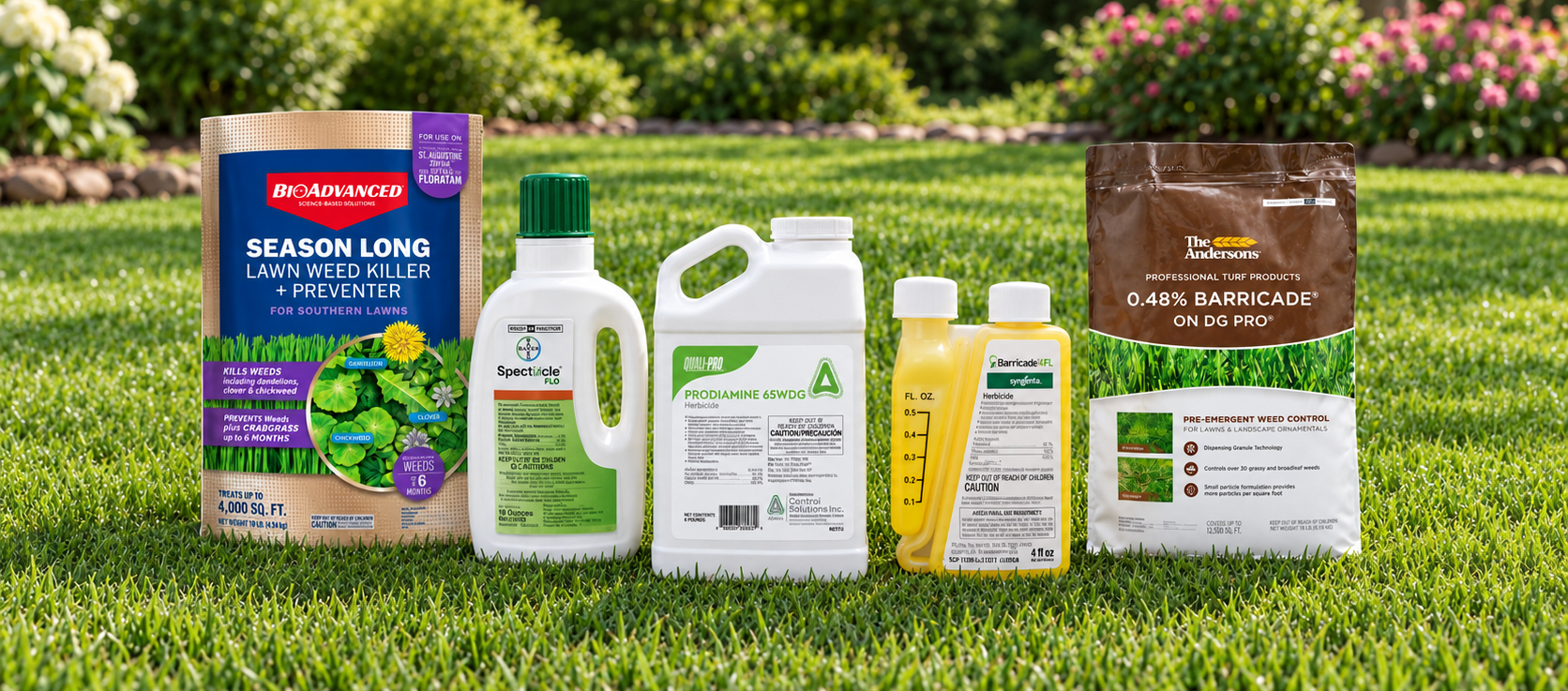
Fall pre-emergent is about stopping winter weeds before they ever become a problem. For established Bermuda grass, the two active ingredients I focus on most are **prodiamine** and **indaziflam**. Prodiamine is my economical workhorse and makes a lot of sense if you already have a sprayer. **Specticle FLO**, which contains indaziflam, is the premium professional option with strong residual control but a much higher upfront cost. For the average homeowner, there is also a shortcut I really like: **BioAdvanced Season Long Lawn Weed Killer + Preventer for Southern Lawns**. It contains indaziflam in an easy-to-apply granular product. At its labeled rate, it delivers an amount of indaziflam remarkably close to Specticle FLO applied at 6 fl oz per acre, making it one of the easiest ways for a homeowner to incorporate this active ingredient without buying professional-sized product. I recommend 2500-3000 SF max from a 10lb bag as a good barrier.

23
Soil & Soil Testing · 10 min read

Soil Testing Your Lawn

A soil test is the best starting point for building a smarter lawn care plan. It shows you what nutrients your soil actually needs, helps prevent unnecessary fertilizer applications, and gives you a baseline for improving your lawn over time. By understanding nitrogen, phosphorus, potassium, pH, and micronutrients, you can choose fertilizers more intentionally and make gradual corrections while keeping the grass healthy and actively growing.

24
Watering · 7 min read

Best Time of Day to Water a Lawn

Water Bermuda in the early morning when possible to limit evaporative loss, reduce wind interference, and let leaves dry after irrigation.

25
Irrigation · 9 min read

Cycle and Soak Irrigation

Split irrigation run time into measured cycles and soak periods so slow-intake soils and slopes can absorb the target depth with less runoff. Deep and infrequent watering means applying enough water to wet the Bermuda grass root zone, then allowing the soil to partially dry before watering again. Instead of giving the lawn a small amount every day, you apply a larger amount less frequently. This encourages deeper rooting and helps the turf tolerate periods between irrigation.

26
Watering · 8 min read

Deep and Infrequent Watering Explained

Deep and infrequent watering means applying enough water to wet the Bermuda grass root zone, then allowing the soil to partially dry before watering again. Instead of giving the lawn a small amount every day, you apply a larger amount less frequently. This encourages deeper rooting and helps the turf tolerate periods between irrigation.

27
Watering · 9 min read

How Much Water Does Bermuda Grass Need?

Estimate Bermuda irrigation from rainfall, weather, soil, rooting, and visible stress, then verify the amount with catch cans and root-zone moisture.

28
Watering · 8 min read

Inches of Water vs Gallons of Water

Convert irrigation depth into gallons for a measured lawn while keeping application uniformity, rainfall, and system efficiency separate from the basic geometry.

29
Fertilization · 9 min read

Understanding Phosphorus for Bermuda

Use soil testing and fertilizer-label math to decide whether an established or newly planted Bermuda lawn actually needs phosphorus.

30
Fertilization · 9 min read

Understanding Potassium for Bermuda

Use a soil test, fertilizer-label math, soil texture, and seasonal context to supply Bermuda with potassium without treating potash as an unlimited stress cure.

31
Fertilization · 9 min read

Fertilizing Bermuda in High-pH Soil

Manage Bermuda in alkaline soil by confirming pH, diagnosing nutrient availability, choosing fertilizer deliberately, and treating soil acidification as a measured long-term project.

32
Soil & Soil Testing · 9 min read

How Soil Testing Should Change Your Fertilizer Program

Turn a representative soil-test report into specific Bermuda fertilizer decisions while separating measured soil conditions from seasonal nitrogen planning.

33
Fertilization · 9 min read

How to Read a Fertilizer Label

Translate the fertilizer grade, guaranteed analysis, release sources, application directions, and warnings into a safe amount for a measured Bermuda lawn.

34
Fertilization · 8 min read

Spoon Feeding Bermuda Grass

Split a Bermuda nitrogen budget into smaller, measured applications to manage growth and color without losing track of the seasonal total.

35
Fertilization · 8 min read

Using Urea on Bermuda Grass

Use 46-0-0 urea safely by calculating actual nitrogen, applying it only to actively growing Bermuda, calibrating carefully, and following the label's watering directions.

36
Fertilization · 8 min read

How to Calculate Pounds of Nitrogen per 1,000 Square Feet

Convert a target nitrogen rate, fertilizer analysis, and measured lawn area into the exact pounds of product needed—then calibrate the applicator before treating the lawn.

37
Mowing · 7 min read

How Often Should You Mow Bermuda Grass?

Bermuda grass usually needs mowing about once or twice per week during active growth, but a tightly maintained lawn may need to be cut even more often. The better approach isn't to mow on a fixed day every week. Choose your mowing height, watch how quickly the grass grows, and mow frequently enough that you aren't removing more than about one-third of the leaf blade at once. That means mowing frequency changes throughout the season. Temperature, sunlight, irrigation, fertilizer, cultivar, and mowing height all affect how quickly Bermuda reaches its next cut. The lower you maintain the lawn, the more frequently you'll generally need to mow it.

38
Mowing · 9 min read

Spring Scalping Bermuda Grass

Spring scalping can remove a dormant canopy and reset mowing height, but it is optional—not a universal requirement—and timing determines whether Bermuda recovers cleanly.

39
Mowing · 8 min read

Why Frequent Mowing Makes Bermuda Denser

Frequent mowing can help Bermuda hold a compact, uniform canopy—but density comes from the whole system: sunlight, growth, moisture, nutrition, surface, and cut quality.

40
Watering · 6 min

How Much Should You Water Bermuda?

A practical way to set irrigation from measured output, weather, and what the turf is telling you.

41
Mowing · 7 min

How Short Should You Mow Bermuda?

Choose a sustainable height based on mower type, lawn smoothness, and how often you can actually cut.

42
Irrigation · 5 min

How to Measure Irrigation Output

Turn sprinkler runtime into real measurements with a simple catch-cup audit.

43
Renovations · 5 min

When Should You Scalp?

Use scalping as a timed reset for warm-season turf—not as a reaction to every brown patch.

44
Troubleshooting · 6 min

Why Isn’t My Lawn Dark Green?

Look beyond fertilizer and diagnose light, water, mowing, soil, and growth rate first.

45
Fertilizing · 7 min

How to Get a Thicker Lawn

A system for improving density through light, mowing, water, soil, and time.

Follow the sequence

Seven steps. One complete lawn system.

Use the Lawn Playbook to connect seasonal wake-up, feeding, water, mowing, growth control, prevention, and maintenance.

Open the playbook