
QUICK ANSWER
Yes, Bermuda grass can benefit from core aeration—but that doesn't mean every Bermuda lawn needs to be aerated every year.
I look at aeration as a tool for solving a problem, primarily soil compaction, rather than another box I automatically check on my lawn calendar. Compaction reduces pore space in the soil and can restrict the movement of air and water while making root growth more difficult. Core aeration helps by physically removing plugs and creating openings through that compacted zone.
Timing matters just as much as deciding to aerate.
I save it for when my Bermuda is actively growing in spring or early summer and has plenty of growing season ahead of it. If I'm applying soil or another appropriate topdressing material, I'll usually aerate first so some of that material can work into the holes instead of sitting entirely at the surface.
What I don't do is intentionally beat up the lawn with aeration heading into dormancy. I want Bermuda growing aggressively enough that the evidence disappears quickly.
Aeration is really about the soil underneath your Bermuda
A healthy soil isn't supposed to be a solid block.
There are spaces between soil particles that hold both air and water. Roots grow through those spaces, water infiltrates through them, and oxygen reaches the rootzone through them. When soil becomes compacted, that pore space decreases. Texas A&M notes that compaction can reduce aeration and water infiltration, and heavy traffic is one of the obvious contributors.
That's the problem core aeration is trying to address.
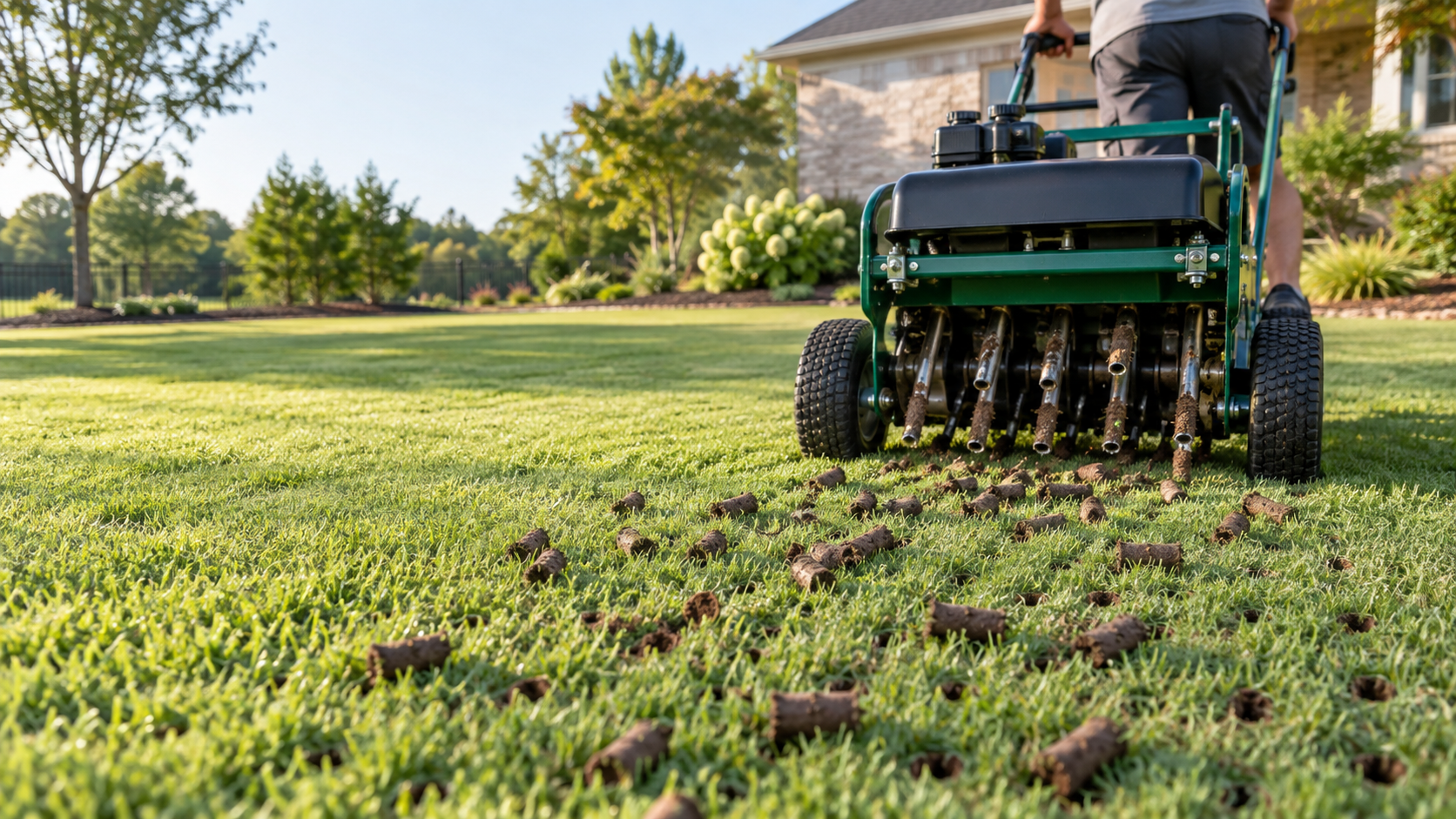
A core aerator uses hollow tines or spoons to physically remove plugs of soil. Common homeowner rental machines may penetrate roughly 3–4 inches, although actual depth depends on the machine and soil conditions. Those holes create temporary channels for air and water movement and space for root expansion.
Core aeration vs. punching holes
I specifically prefer core aeration when compaction is the reason I'm doing the job.
That's different from simply pushing a solid spike into the ground. Texas A&M notes that removing cores can offer more benefit for relieving compaction, particularly in higher-clay soils, while Clemson points out that solid tines can actually compress soil immediately around the hole they create.
NUMBERS / COMPARISON
Method
What happens
Compaction value
Core aeration
Removes an actual soil plug
My choice for addressing compaction
Solid tine/spike
Pushes into soil without removing a core
Can compact soil around the tine
Verticutting
Cuts vertically through turf/thatch
Useful for other jobs, but not a substitute for deeper compaction relief
That's why I don't use "aeration" as a catch-all term for anything that pokes a hole in the lawn.
Don't aerate just because somebody says Bermuda needs it every year
This is where I think homeowners can save themselves some unnecessary work.
If the lawn is growing aggressively, rooting well, accepting irrigation normally, and isn't receiving enough traffic to create a compaction problem, I'm not looking for an excuse to rent an aerator.
Texas A&M specifically recommends aeration to relieve soil compaction, particularly in newer lawns and lawns receiving moderate to heavy use. Compaction can also show itself through poorer infiltration, thinning turf, traffic paths, or water that doesn't seem to enter the soil as readily as it should.
None of those symptoms alone proves compaction, though.
A Bermuda lawn can thin because of shade. It can struggle because of irrigation problems, fertility, disease, insects, excessive thatch, or other rootzone issues. Bermuda in particular is poorly adapted to shade, so punching holes in the soil isn't going to fix a lawn that's disappearing underneath a tree canopy.
WATCH OUT
Aeration isn't a universal cure for a struggling lawn. If the actual limitation is inadequate sunlight, bad irrigation coverage, poor fertility, disease, or another problem, you can aerate beautifully and still have the same lawn problem afterward.
That's why my first question isn't When should I aerate?
It's What problem am I trying to solve?
I want Bermuda growing hard before I deliberately damage it
Core aeration is beneficial when it's needed, but we're still intentionally injuring the turf.
You're pulling thousands of plugs through the canopy, cutting some roots, rhizomes, and stolons, and temporarily leaving the surface looking like somebody attacked it with a machine.
Bermuda happens to be exceptionally well equipped to recover from that treatment. It spreads through both stolons above ground and rhizomes below ground and has strong recuperative potential.
I want to take advantage of that.
For warm-season grasses, Extension recommendations consistently put aeration during the active growing period. Clemson recommends late spring and summer, while UGA advises waiting until warm-season turf has fully greened up. NC State similarly recommends late spring or early summer while warm-season grass is actively growing.
MY TAKE
I don't aerate my Bermuda in the fall when it's running out of growing season. I save it for spring once soil temperatures and weather have my grass actively growing.
The exact calendar date isn't important to me.
The condition of the Bermuda is.
I want a green, growing lawn with enough warmth and growing season ahead that it can immediately start repairing everything I just did to it. That's also why I don't rush aeration just because we've had a couple of warm spring afternoons.
If the Bermuda isn't really growing yet, I'm not ready to tear holes through it.
Moist soil helps the aerator do the job—but wet soil creates another problem
The other thing that changes aeration dramatically is soil moisture.
Trying to drive hollow tines into hard, dry ground can result in lousy penetration. Texas A&M recommends aerating when the soil is adequately moist so the tines can effectively remove a core, and Clemson similarly recommends moderately moist soil.
This is why I like timing aeration after rain.
Not during a swamp.
After enough moisture has gotten into the profile that the machine can pull a good plug.
There's an important distinction there because wet soil is also more susceptible to compaction. Texas A&M specifically cautions that traffic on wet soil can increase compaction damage.
PRO TIP
Don't judge the timing only by whether the grass blades are dry. What matters for the aerator is moisture in the soil profile. I want enough moisture for good tine penetration without leaving the surface so saturated that a heavy machine is rutting or smearing the soil.
There's some trial and error here.
Pulling a few beautiful cores tells me a lot more than simply looking at the weather app and seeing that it rained yesterday.
Aeration and topdressing make a lot of sense together
This is one of the main reasons aeration shows up in my own lawn program.
If I'm going to apply dirt or an appropriate topdressing material, I want to do more than sprinkle it across the grass blades. Aeration creates thousands of openings where some of that material can work down into the existing rootzone.
Texas A&M specifically notes that aerification can be combined with topdressing or compost to incorporate material into the rootzone, and UGA also describes following cultivation with topdressing as part of turf management.
That doesn't mean one topdressing magically replaces your existing soil.
Most core aerifiers only affect a fraction of the lawn surface during a single pass, so this is still an incremental process rather than instant soil reconstruction.
But if I'm already going through the effort of spreading material, I like having those holes open.
MY TAKE
I always aerate when I'm applying dirt because I'm trying to address more than the surface appearance of the lawn. I want some of that material getting down into the rootzone.
That's different from aerating because I think every Bermuda lawn simply "needs air."
I want the machine there for a specific job.
The lawn looks wrecked for about five minutes longer than you'd like
Freshly aerated Bermuda isn't exactly Instagram material.
You'll have holes everywhere and soil cores scattered across a lawn that might have looked pretty dialed-in the day before.
Don't panic.
Those cores contain the same soil you just pulled out of the ground, and Extension recommendations commonly suggest leaving them on the lawn to break down rather than removing them.
My approach is simple.
I give the cores a day or two to air-dry. Once they're dry enough and the ground itself isn't wet, I mow over them.
That breaks them apart surprisingly well.
I'm also careful about the second part of that sentence: the ground isn't wet. I don't want to do a good job relieving compaction and then immediately drive a mower all over saturated soil.
When the Bermuda is actively growing, the recovery can be pretty impressive. In my lawn, within a few days it's difficult to tell that I did anything.
That's exactly the recovery window I'm trying to create by choosing the right time of year.
Here's how I decide whether to aerate my Bermuda
I don't start with the calendar.
I start with the lawn.
If I have reason to suspect compaction—particularly in trafficked areas—or I'm planning a topdressing project where I want better interaction with the rootzone, core aeration gets my attention.
Then I ask whether the Bermuda is actually ready for it.
If the lawn isn't fully active yet, I wait. If I'm getting close to dormancy, I wait until the next growing season. If the ground is bone dry, I'll wait for rain or irrigate appropriately ahead of the job. If it's saturated, I let it drain.
There is also one scheduling conflict worth remembering: pre-emergent herbicides. Clemson's Bermuda maintenance guidance recommends postponing soil-disturbing cultivation after a pre-emergent application until near the next scheduled pre-emergent application because cultivation can interfere with the treated soil zone.
So aeration shouldn't be scheduled in isolation.
Think of it as part of the entire lawn program.
MY PROCESS
- Decide why I'm aerating. Usually suspected compaction, a topdressing project, or both.
- Wait for active Bermuda growth. I want the lawn fully awake and capable of aggressive recovery.
- Watch soil moisture. I like aerating after rain when the soil is moist enough for good core penetration but isn't saturated.
- Mark irrigation components and other shallow obstacles. Hollow tines and sprinkler heads are not friends.
- Core aerate the lawn. If I'm trying to relieve compaction, I want actual plugs removed.
- Topdress when that's part of the project. The open holes give the material an opportunity to work below the immediate surface.
- Let the cores dry. I normally give them a day or two.
- Mow them back in once conditions are dry enough. The plugs break apart, the Bermuda recovers, and the lawn starts looking normal surprisingly quickly.