
QUICK ANSWER
A plant growth regulator, or PGR, is one of those products that can take a really dialed-in Bermuda lawn to another level. I use it primarily to suppress vertical growth so a low-cut lawn stays tighter longer and doesn't require quite as much mowing.
But I consider this an advanced technique.
The PGR I'm talking about here is trinexapac-ethyl, the active ingredient found in products such as T-Nex and Primo-type PGRs. It's absorbed through the foliage and suppresses the plant's normal vertical elongation.
The biggest mistake is treating "Bermuda" as one application rate. It isn't. Common Bermuda, Tifway 419, Tifgreen, Tifdwarf and other hybrids can have dramatically different labeled rates.
I start conservatively. I want healthy, actively growing Bermuda, good foliar coverage and enough water to distribute the product evenly. I also like pairing my application with a light spoon-feeding of urea and iron.
Then I track growing degree days, not just calendar days, before deciding when the lawn is ready for another application.
This is not a product to guess with.
But once you understand it, PGR is pretty magical.
PGR doesn't stop Bermuda from growing—it changes how it grows
Trinexapac-ethyl is a foliar-absorbed plant growth regulator that interferes with gibberellin production. Gibberellins are plant hormones involved in cell elongation.
In plain English, we're putting the brakes on vertical growth.
That's an important distinction.
I'm not applying PGR because I want unhealthy Bermuda that barely grows. I want an actively growing plant that spends less of its energy shooting upward between cuts.
That's where the tighter appearance comes from.
The current trinexapac-ethyl label describes reduced mowing frequency and clipping production as the primary effects, while increased turf density, color and overall quality are frequently observed. Full growth regulation generally develops around three to five days after application.
There can be a tradeoff, though.
The Bermuda Bible points out that growth regulators can shorten stolon internodes, and some PGR chemistry can interfere with lateral regrowth. That's worth remembering if you're trying to make Bermuda aggressively cover large bare areas.
A PGR makes a lot more sense to me when the lawn is already established, healthy and growing aggressively and I'm trying to manage that growth rather than maximize recovery or fill-in.
That's also why this isn't where I'd start with a struggling Bermuda lawn.
Get the fundamentals right first.
Mowing. Sunlight. Nitrogen. Irrigation. Healthy growing conditions.
Then start playing with the fun stuff.
"Bermuda" is not specific enough to choose your rate
This is probably the most important part of this entire guide.
You need to know what Bermuda you're spraying.
The current EPA trinexapac-ethyl 1ME label demonstrates just how different the rates can be for residential and commercial turf:
NUMBERS / COMPARISON
Tifdwarf and ultradwarfs - 0.20 fl. oz. Labeled rate per 1,000 sq. ft.*
Tifgreen 328 - 0.25 fl. oz. Labeled rate per 1,000 sq. ft.*
Tifway 419 - 0.38 fl. oz. Labeled rate per 1,000 sq. ft.*
Common Bermuda - 0.75 fl. oz. Labeled rate per 1,000 sq. ft.*
*Rates shown are from the current EPA trinexapac-ethyl 1ME label for residential/commercial turf. Your actual product label controls. Different formulations, sites, cultivars and products can have different directions.
Look at that difference.
Common Bermuda is labeled at almost four times the Tifdwarf/ultradwarf rate in that table.
So somebody telling you, "I put X ounces of PGR on my Bermuda" hasn't given you enough information to safely copy the application.
Which Bermuda?
Which product?
What concentration?
What site?
What mowing height?
The label also notes that lower mowing heights generally produce greater suppression. Fertility, moisture, plant vigor and mowing practices can all influence how the turf responds.
WATCH OUT
Do not take somebody else's Bermuda PGR rate from a forum, Facebook group or YouTube video and assume it applies to your lawn. Identify your turf and your exact product, then read that product's current label.
For a first application, I'm a fan of caution.
Interestingly, the current trinexapac-ethyl label takes a similar approach for frequent programs: when applications are going to be made weekly or biweekly, it directs users to reduce the lowest table rate by at least 50% for the first application and monitor turf response before adjusting the rate.
You can always learn how your lawn responds and adjust within the label.
You can't unspray the yard.
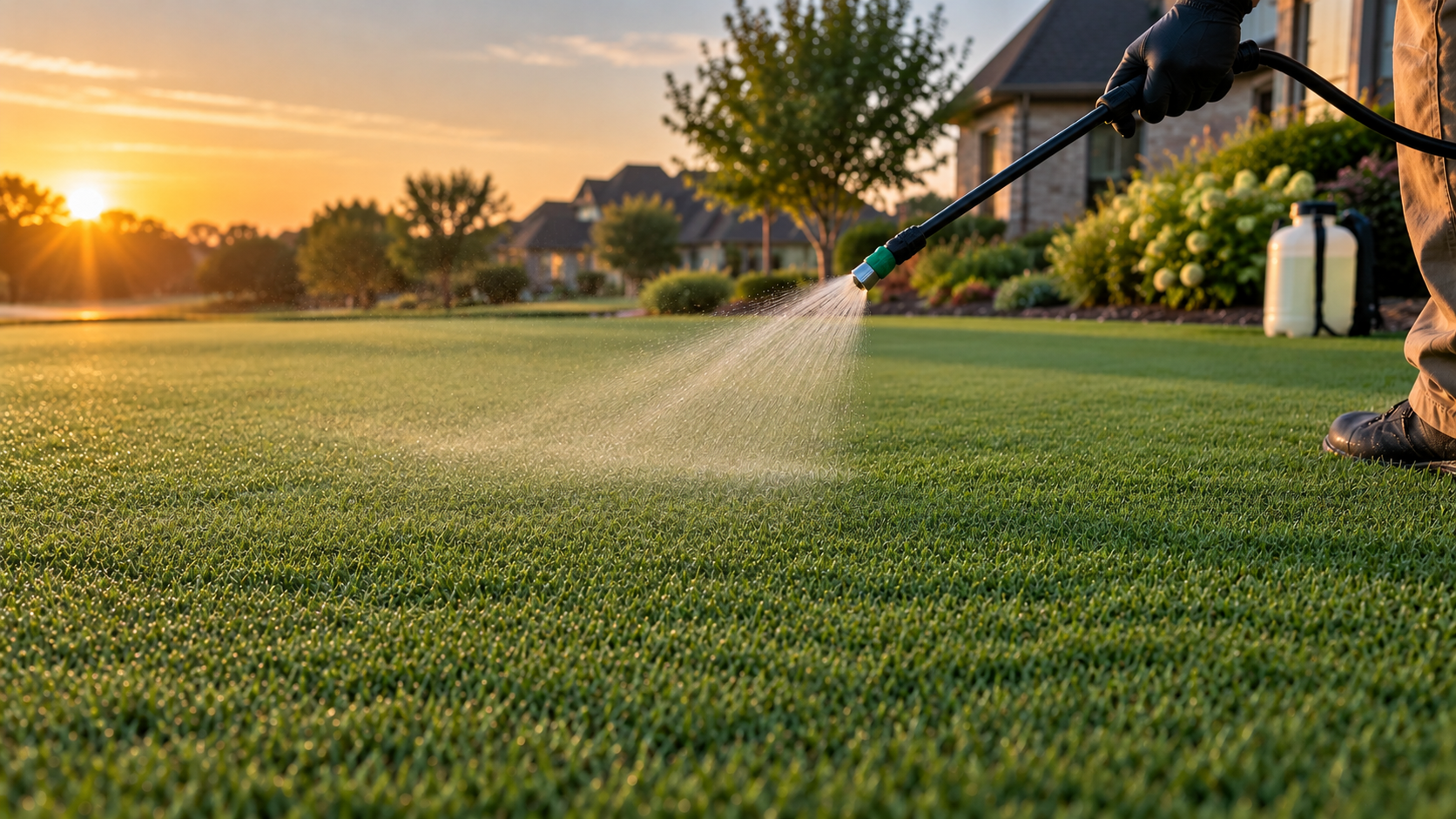
My spray setup is all about getting even foliar coverage
This is a foliar product, so I care a lot about what's happening at the spray tip.
I like a foliar spray nozzle, good pressure and a fine, consistent pattern that gives me uniform coverage across that short Bermuda canopy. I'm also intentional about having enough carrier water in the tank.
More chemical isn't the answer to bad coverage.
Better coverage is.
The current label calls for enough carrier to produce uniform, thorough coverage and gives 0.5 to 4 gallons of water per 1,000 square feet as an example range. That doesn't mean everyone needs four gallons. It means this isn't something I want coming out of an uncalibrated sprayer with no idea how much area I'm actually covering.
Calibration matters.
PRO TIP
Calibrate your sprayer with plain water before messing with PGR. Know how much water you apply per 1,000 square feet at your normal walking speed, pressure and nozzle setup. Once you know that number, mixing becomes dramatically easier.
I particularly like early morning applications. A little dew can make my footprints visible, which gives me a surprisingly useful visual reference for where I've walked and helps me maintain consistent passes.
Dusk can also work well when conditions cooperate.
My goal is to put the application onto the foliage and give it time to sit there.
The current trinexapac-ethyl label says the product reaches the growing point through foliar uptake and is rainfast after one hour, so watering it in isn't required.
Personally, I give it considerably more room than that. I like holding irrigation for at least eight hours when conditions allow and I generally leave the mower parked for the rest of the day.
The label itself allows mowing four hours after application, or mowing first and waiting at least one hour before spraying. My longer window is simply my conservative application routine—not a label requirement.
I like a little nitrogen and iron riding along
Here's another part of my process that has become important to me.
I don't want to hammer healthy Bermuda with a growth regulator and then wonder why the color looks a little off.
I generally add a light, spoon-fed nitrogen source—usually urea—and try to include iron micronutrients. I've used chelated iron as well as a non-staining iron product such as Feature 6-0-0.
There's some legitimate agronomic reasoning behind that practice.
Temporary yellowing can occur after trinexapac-ethyl applications. The current label specifically says readily available nitrogen can be used to minimize yellowing and enhance green color, and it also allows iron to be used for that purpose.
The label's nitrogen guidance is 0.2–0.5 pound of actual nitrogen per 1,000 square feet. I tend to think on the lighter, spoon-feeding side rather than using the PGR application as an excuse to hammer the lawn with nitrogen.
With 46-0-0 urea, for example:
0.10 lb N ÷ 0.46 = 0.217 lb urea per 1,000 sq. ft.
That's about 3.5 ounces of urea by weight per 1,000 square feet.
That's an example of what I mean by spoon-feeding—not a universal prescription. Your fertility program still needs to make sense as a whole, and every tank-mix partner needs to permit the intended use.
MY TAKE
I'm trying to create controlled growth, not a lawn that looks like I chemically punched it in the face. My preference is healthy Bermuda going into the application, an accurate PGR dose, light nitrogen and some iron. I want the plant to take the regulator in and transition into that tighter growth habit without making the application unnecessarily harsh.
Whenever you're combining products, compatibility matters too. Follow every tank-mix partner's label and use the most restrictive directions. A jar test before making a new combination is cheap insurance.
This is where GDD becomes more useful than counting days
You can apply PGR once and see what happens.
But repeat applications are where this gets interesting—and where you can get yourself into trouble.
Temperature influences how quickly trinexapac-ethyl regulation runs its course. That means "spray every two weeks" doesn't necessarily represent the same physiological interval in May that it does during a blazing-hot stretch of July.
That's why serious PGR programs use growing degree days (GDD).
Research on ultradwarf Bermuda putting greens supports this idea. Auburn research found GDD predicted maximum suppression better than calendar days, and subsequent work showed that appropriately timed GDD-based applications maintained more consistent suppression.
The Bermuda Bible uses a practical target of approximately 230–250 GDD with a 10°C base for Bermuda PGR scheduling. It gives Arlington, Texas, in July and August as an example: roughly 22 GDD can accumulate per day, putting that interval around 10–11 days.
That is a useful field reference—not a universal label interval for every Bermuda lawn.
Different research uses different base temperatures, turf types, rates and mowing environments. Auburn's work, for example, was conducted on ultradwarf putting-green Bermuda. Don't grab a GDD number from a research paper without also knowing the base temperature and turf system behind it.
The bigger lesson is what matters:
Temperature changes the interval.
Hotter weather can move you through the regulation cycle faster.
So once I apply, I want to start tracking accumulated GDD rather than blindly circling a date on the calendar.
Stacking applications too tightly is where PGR gets scary
There is another side to maintaining continuous regulation.
You can overdo it.
PGR applications can have cumulative effects. If you're spraying again before understanding where the previous application has taken the plant, you can end up with more suppression than you intended.
I've seen what happens when growth gets stalled too hard. Eventually the Bermuda begins growing again, but watching a lawn that normally wants to grow like crazy suddenly sit there can get your attention.
Research backs up the need for caution. Auburn work with ultradwarf Bermuda found stronger suppression at the higher trinexapac-ethyl rate, and phytotoxicity occurred following initial applications with greater severity at the higher rate. Purdue also cautions that excessive PGR rates and over-regulation can reduce turf recovery and quality.
This is exactly why I'm so cautious with a first application.
WATCH OUT
Don't interpret GDD tracking as permission to stack aggressive applications. Your product label remains the authority for rates, frequency and annual maximums. GDD is a management tool for understanding plant response—not a replacement for the label.
I also don't want to regulate Bermuda that's already struggling.
The label calls for applications to actively growing turf. When growth is limited by temperature or moisture, it directs users toward lower rates, and rates may also need to be reduced when low fertility, compaction or other factors are stressing the turf.
PGR is the finishing tool.
It isn't life support.
This is how I'd start a Bermuda PGR program
If you've reached the point where you're reel mowing or maintaining Bermuda low, measuring fertilizer, calibrating sprayers and generally spending an unreasonable amount of time staring at grass, you're probably the person this technique is for.
And there's one application I especially love: vacation planning.
Low-cut Bermuda can put you on a pretty demanding mowing schedule during peak summer growth. Miss enough cuts and you're coming home to a lawn that's blown past your intended height of cut.
PGR gives you another tool.
By suppressing vertical growth before the trip, you can reduce how quickly the lawn gets away from you. You're not freezing it in time, but you're slowing the machine down.
That same effect is what I like all season.
Less vertical growth.
Fewer clippings.
A tighter canopy.
More breathing room between cuts.
And that immaculate Bermuda-carpet appearance gets easier to maintain.
PGR isn't where I'd tell the average homeowner to begin.
But once you've learned your Bermuda, dialed in your mowing, figured out your sprayer and started paying attention to actual application rates, this is one of those techniques that opens another door.
The first time you watch an aggressively growing Bermuda lawn stay short, dense and controlled instead of immediately trying to outrun the mower, you'll understand why people get hooked on this stuff.
Do the research. Read the label. Start cautiously.
Then welcome to the rabbit hole.
You'll probably never look at your mowing schedule the same way again.


