
QUICK ANSWER
Yellow Bermuda grass can come from drought stress, insects, disease, nutrient problems, mowing or chemical injury, shade, soil problems, or even concentrated sunlight reflecting off a window.
That's why I wouldn't start by asking, "What should I spray?"
I'd start with, "What clues is the lawn giving me?"
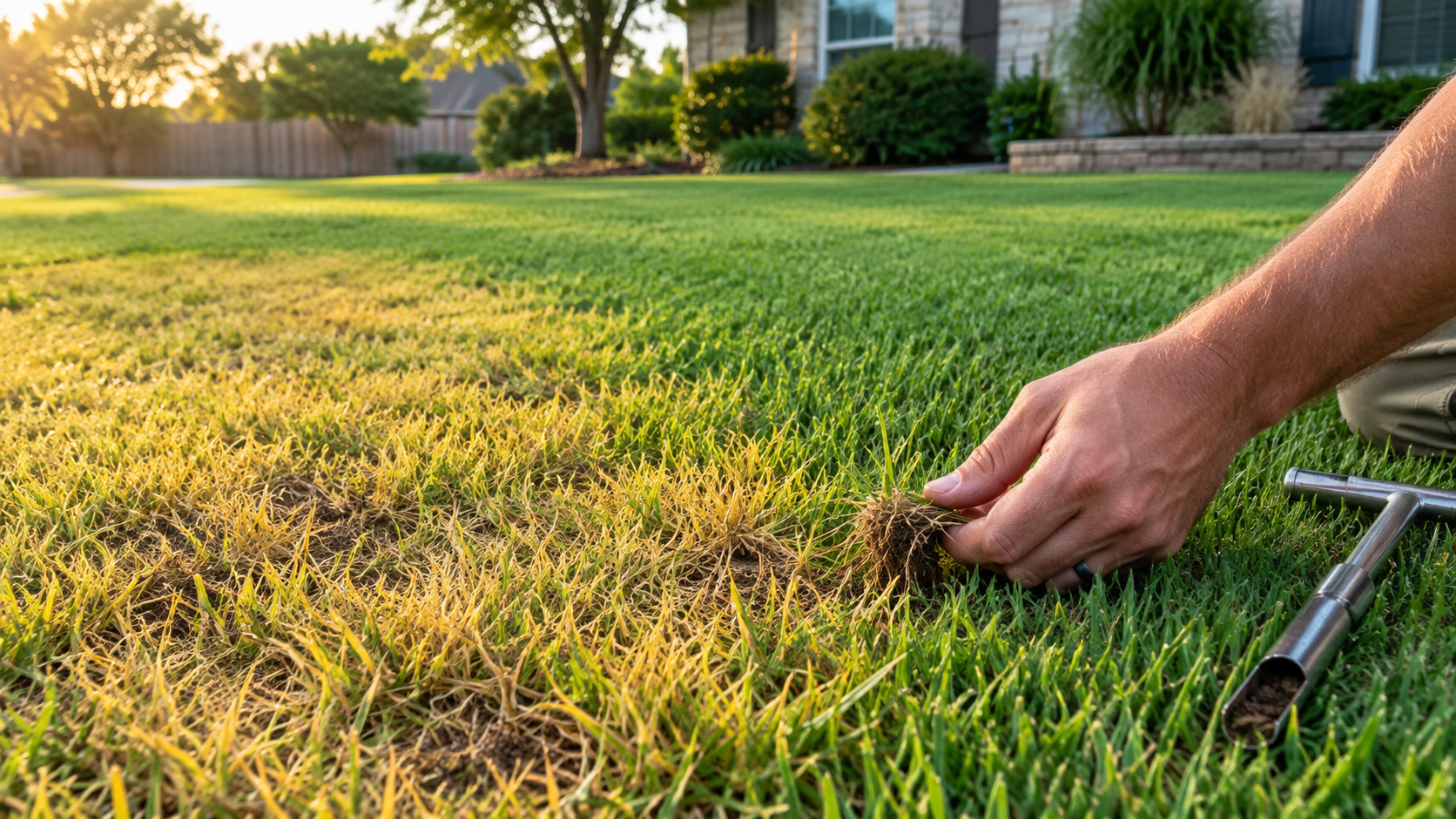
Look at the shape of the damage. Check whether the soil is actually wet or dry. Get down and inspect individual blades. Tug on the turf and look underneath it. Think about what changed recently. And if the pattern is really strange, don't ignore the house itself.
Most importantly, don't treat yellow grass as proof that the lawn needs fertilizer. Yellowing is a symptom shared by a lot of completely different problems.
The fastest way to solve it is usually to eliminate the simple causes one at a time.
Start with the pattern before you touch anything
Before I dig, spray, fertilize, or water, I'd stand back and look at the lawn.
The shape of the problem can tell you a surprising amount.
Is the whole lawn getting pale? Is there one dry-looking area? Are there circles? Random patches? A straight stripe? Does the yellowing follow a sprinkler zone, mower pass, property edge, drainage area, or the side of the house?
University turf diagnostic guidance recommends looking at patterns in the landscape and considering irrigation, soil, topography, management history, and environmental factors before settling on a cause.
That makes sense because biological problems don't always create the same patterns as mechanical or environmental ones.
A strange straight line makes me think differently than dozens of little spots. A uniformly pale lawn makes me think differently than one crispy patch next to a window.
PRO TIP
Take pictures before doing anything.
Get one from ground level, one close enough to see individual blades, and one from as high as you reasonably can. An upstairs window can be surprisingly useful.
You can also put an overhead photo into an AI image-analysis tool or use photo search to compare the pattern with documented turf diseases. I consider that a way to generate possibilities—not a final diagnosis.
Different diseases and environmental stresses can look remarkably similar from above.
Once you understand the pattern, start eliminating the easy stuff.
Work through these causes one at a time
I wouldn't try to diagnose ten things simultaneously.
I'd run through this list and move on whenever the evidence doesn't fit.
NUMBERS / COMPARISON
Possible cause
Simple tell
Quick test
Dry soil / irrigation
Dull, wilted, blue-green turf that eventually turns yellow or brown. The pattern may correspond with sprinkler coverage.
Push a screwdriver or soil probe into the ground and physically check moisture. Compare the yellow area with healthy turf.
Grubs / root-feeding insects
Irregular yellow or brown turf that can resemble drought stress. Severe root damage can leave turf loose.
Cut and peel back about 1 square foot near the transition between damaged and healthy turf. Inspect the root zone for white, C-shaped grubs.
Fungal disease
Circular, arc-shaped, spotted, or irregular patches depending on the disease. Individual blades may have distinctive lesions.
Photograph both the overall pattern and individual blades. Compare them with university disease references.
Nutrient / pH problem
Broader pale or yellow growth is more suspicious than one isolated dead patch.
Get a soil test rather than repeatedly adding fertilizer or iron because the grass "looks hungry."
Mowing / chemical / mechanical injury
Damage may correspond with mower passes, spills, spray overlaps, application boundaries, scalping, or traffic.
Think about what happened immediately before the symptoms appeared and see whether the pattern matches.
Reflected window heat
Strange, sometimes sharply defined damage near a house that doesn't make sense based on irrigation or soil.
Inspect the area during the hottest, brightest part of the day and see whether a window reflection crosses it.
Shade / poor growing conditions
Bermuda becomes thin, weak, and less competitive in areas receiving insufficient sunlight.
Watch the area through the day and determine how much direct sunlight it actually receives.
The point isn't that these clues prove the diagnosis.
They tell you where to investigate next.
Is the lawn simply dry?
This is probably the easiest thing to eliminate, but don't diagnose moisture from the surface alone.
Drought-stressed turf can become dull or bluish-green, the leaves may fold or roll, and footprints can remain visible after you walk across it. As the stress becomes more severe, turf can yellow and eventually brown.
Now check the soil.
Stick a screwdriver, soil probe, or small shovel into the yellow area. Then do the same thing in healthy green turf nearby.
You're looking for a meaningful difference in soil moisture and how easily you can penetrate the soil.
If you have irrigation, run that zone and actually watch it.
A clogged nozzle, crooked head, poor overlap, blocked sprinkler, runoff problem, shallow soil, compaction, or buried construction debris can create a localized dry spot even though you're technically "watering the lawn."
If soil moisture doesn't explain the pattern, move on.
Dig before you blame grubs
Grubs are another problem where five minutes with a shovel can save you from applying something the lawn never needed.
White grubs feed on turf roots, so aboveground damage can resemble drought stress. With severe infestations, roots can be damaged enough that turf becomes loose and can peel back almost like carpet.
Don't just tug on the lawn and declare that you've got grubs.
Cut back roughly a 1-square-foot section near the boundary between healthy and damaged turf and inspect the soil around the roots.
White grubs are typically C-shaped with a white body and brown head. Count what you actually find.
Extension recommendations use grub counts per square foot because finding one grub isn't automatically the same thing as having a damaging population. Thresholds also differ by grub species.
If you don't find meaningful grub activity, put the turf back and keep diagnosing.
If it looks like disease, zoom in
This is where photos become particularly useful.
Don't only photograph the big yellow patch. Get close enough to inspect individual blades.
For example, dollar spot can create small straw-colored spots that merge into larger irregular areas, while infected leaves can develop pale-to-straw-colored lesions with darker margins.
Spring dead spot is very different. It becomes obvious as Bermuda comes out of dormancy and often creates circular, semicircular, or arc-shaped dead areas. Affected crowns, roots, stolons, and rhizomes can also be dark and rotted.
Those details matter.
Use AI image analysis or photo search to help identify possible matches, then compare those possibilities with pictures and descriptions from a university turf program.
WATCH OUT
A photograph isn't a laboratory diagnosis.
Different turf diseases can resemble one another, and environmental stress can sometimes look like disease too.
If the answer matters enough that you're considering a fungicide program, sending a good turf sample to a university plant diagnostic lab can be worth the effort.
Don't overlook what happened to the lawn
Sometimes the grass isn't sick at all.
It got injured.
If you've eliminated obvious water, insect, and disease issues, think backward.
Did you recently fertilize? Spray herbicide? Change products? Spill something while filling a spreader? Mow lower than normal? Let the lawn get tall and then cut it aggressively? Have construction, heavy traffic, or equipment in the area?
Look at whether the pattern matches the event.
Sprayer overlaps can leave patterns. A fertilizer spill can leave patterns. Scalping follows high spots and mowing patterns. Compacted soil and buried construction material can create localized dry areas.
Then there's nutrition.
If Bermuda is broadly pale or yellow rather than failing in one isolated patch, fertility or nutrient availability becomes more interesting.
High-pH soil can reduce the availability of nutrients including iron, manganese, zinc, and phosphorus. Iron chlorosis can show up as yellowing even when iron exists in the soil because chemistry is limiting its availability.
That's when I'd rather have a soil test than start throwing products at yellow grass.
A soil test turns "maybe it's deficient" into something you can actually make a decision from.
The weird one: your window can actually cook the lawn
This one gets its own section because I've had it happen.
Window reflections can create some bizarre patterns in a lawn, and they're easy to misdiagnose because the damaged area may not resemble a sprinkler problem, disease, or anything happening below the soil.
In my case, the evidence became pretty undeniable once I went outside during the hot part of the day and stood where the damage was occurring.
I could literally feel the concentrated heat coming off the window reflection.
That's the test I'd recommend.
If you have a strange patch near the house, don't inspect it only at 8:00 in the morning. Go back when the sun is hitting the house hardest.
Look at the windows and watch for a bright reflected area moving across the turf.
Energy-efficient Low-E windows can reflect substantial solar energy outward, and under certain conditions the glass geometry can concentrate that reflection.
The shape can be especially confusing because the reflection moves as the sun moves. That can leave a curved, elongated, or otherwise strange-looking area instead of the round patch people might associate with a lawn problem.
MY TAKE
This is one of those problems I probably wouldn't have believed was significant until I experienced it.
When you catch the reflection at the right time of day and can physically feel how much hotter that little area is, the pattern in the lawn suddenly makes sense.
The best solutions I've seen address the reflection at the window instead of repeatedly trying to repair the grass underneath it.
Exterior solar screens can diffuse or intercept incoming sunlight, and specialized window films can also be used to change the reflection.
I'd verify any film with the window manufacturer or a qualified installer first because insulated and Low-E glass assemblies can have compatibility and warranty requirements.
Fix the source of the concentrated heat and then let the Bermuda recover.
My diagnostic process for yellow Bermuda
MY PROCESS
- Step back and study the shape. Before treating anything, look at the entire affected area. Take overhead and close-up photos.
- Check moisture. Probe or dig into both yellow and healthy turf. If the yellow area is noticeably drier, investigate sprinkler coverage, soil depth, compaction, runoff, or other reasons water isn't reaching the roots.
- Inspect the grass itself. Look closely at individual blades, stolons, crowns, and roots. Spots and lesions can point you toward disease. Damaged or missing roots can send you in another direction.
- Dig for insects. Peel back a section near the green/yellow boundary and actually look for grubs or other pests. Don't treat an insect you haven't established is there.
- Compare the pattern. Use good photographs with AI or image search to generate possible disease matches, then verify those possibilities against university turf resources.
- Think backward. What changed before the lawn turned yellow? Fertilizer, herbicide, mowing, irrigation, weather, construction, traffic, or another event may explain the pattern.
- Check the environment. Look for shade, drainage, shallow soil, compacted areas, buried debris, and—especially with a bizarre pattern near the house—window reflections.
- Test instead of guessing. If you're leaning toward a nutrient problem, get a soil test. If you're leaning toward a difficult disease diagnosis, consider sending a sample to a turf diagnostic laboratory.