
QUICK ANSWER
If your Bermuda lawn was originally installed as sod, there's a good chance you're dealing with a vegetatively propagated cultivar, and many of the premium Bermuda grasses used for residential sod are hybrids.
But sod by itself isn't enough to prove that.
The more useful distinction is how the grass reproduces. Common and seeded-type Bermuda can produce viable seed. Typical hybrid Bermuda cannot. It has to be propagated vegetatively through sod, sprigs, or plugs.
That does not mean hybrid Bermuda can't produce seedheads. It absolutely can. Those seedheads just aren't a useful source of viable seed.
That's an important distinction because if a hybrid Bermuda lawn gets thin or damaged, my first move wouldn't be throwing Bermuda seed over it. I'd work on getting the existing turf healthy enough to spread back into the area.
Common and hybrid Bermuda aren't just two versions of the same lawn
Common bermudagrass is Cynodon dactylon. Traditional common Bermuda and a number of improved common-type cultivars can be grown from viable seed.
Hybrid bermudagrasses are generally crosses between Cynodon dactylon and Cynodon transvaalensis. Many of the premium fine-textured Bermuda cultivars people recognize from sod farms, golf courses, athletic fields, and higher-end residential lawns fall into this category.
The difference becomes pretty obvious when you look at how they're propagated.
NUMBERS / COMPARISON
Characteristic
Common / Seeded-Type Bermuda
Hybrid Bermuda
Can be established from viable seed?
Yes, depending on cultivar
No
Spreads by stolons
Yes
Yes
Spreads by rhizomes
Yes
Yes
Can produce seedheads
Yes
Yes
Seed typically viable
Yes
No
Typical texture
Generally coarser
Generally finer and denser
Common establishment
Seed or vegetatively
Sod, sprigs, or plugs
This is also why I wouldn't identify a lawn from one characteristic alone.
Fine texture points you in one direction. A lot of seedheads might point you in another. Knowing the lawn was sodded is another clue.
None of those by themselves gives you a genetic test.
There's even a good example of why these labels get messy: Celebration Bermuda is genetically a common bermudagrass, but it's commercially propagated vegetatively rather than sold as seed.
So instead of obsessing over the label immediately, I think the more useful question for a homeowner is: How does the grass I already have repair itself?
Your Bermuda lawn has its own repair system
This is one of my favorite things about Bermuda.
It wants to move.
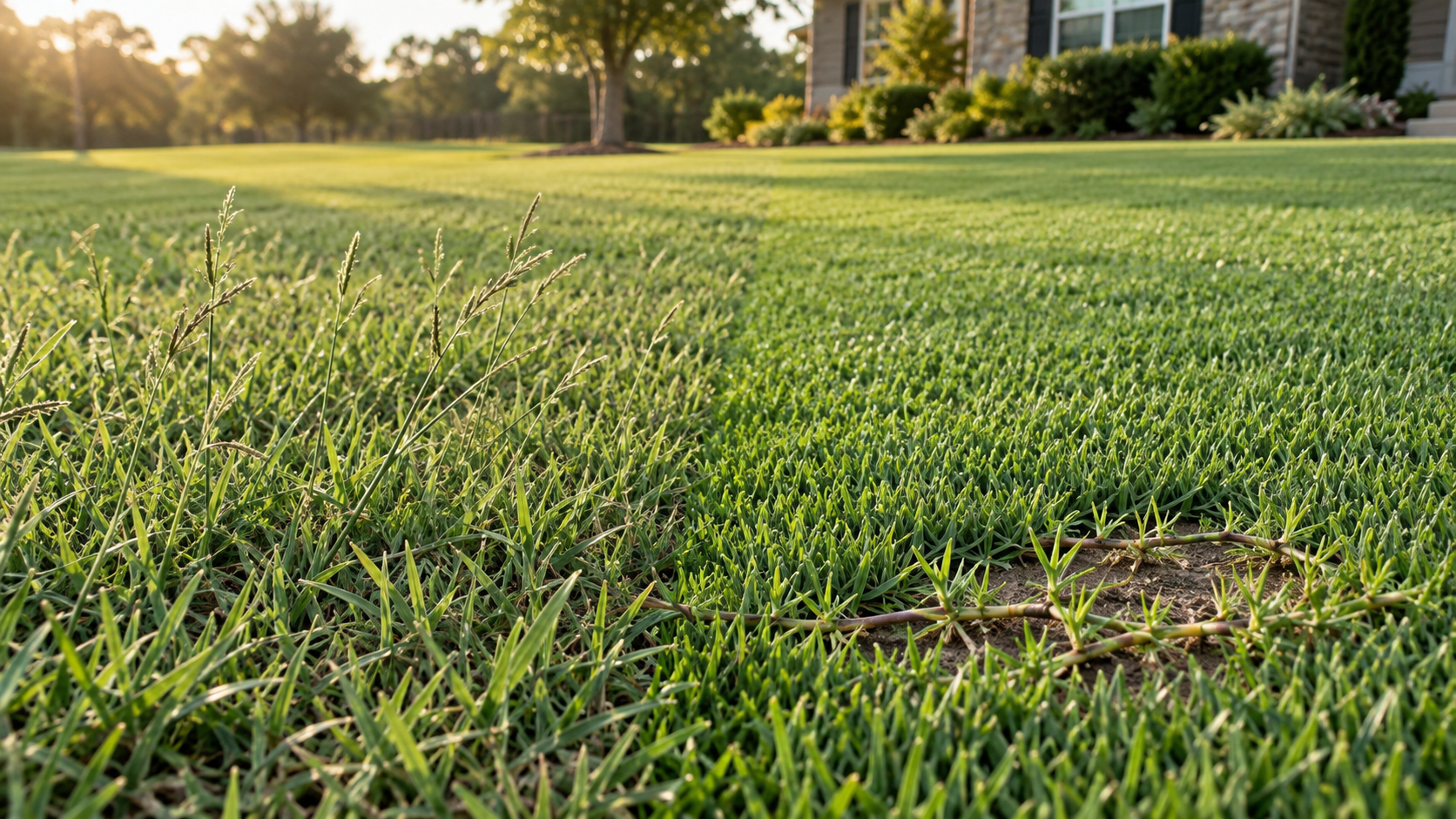
Bermudagrass spreads with stolons, which are the runners you can see traveling across the soil surface, and rhizomes, which are stems growing below the surface. New shoots can develop from nodes along that vegetative network.
That's why a healthy Bermuda lawn can be so good at repairing itself.
Give actively growing Bermuda adequate sunlight, water, nutrition, and decent growing conditions, and those runners can start moving into damaged or thin areas. Relieving significant soil compaction can also improve the growing environment when compaction is actually part of the problem.
That doesn't mean fertilizer and water magically fix every bare spot. Shade, disease, insects, drainage problems, herbicide injury, severe compaction, or actual loss of the stand can all require a different solution.
But if viable Bermuda is still surrounding a manageable thin area, I want to give that grass a chance to recover before introducing another Bermuda cultivar into it.
MY TAKE
This is the part I think homeowners underestimate. Bermuda can look absolutely terrible and still have a lot of living infrastructure underneath and around that damaged area.
Before deciding the lawn needs seed, I'd figure out why it's thin and work on the health of the Bermuda that's already there. During active growth, that existing turf has a tremendous ability to move laterally when the conditions are right.
Those seedheads don't necessarily mean you have common Bermuda
Here's where identification gets confusing.
Common Bermuda is capable of producing viable seed, and seeded bermudagrasses tend to produce more seedheads than newer vegetatively propagated cultivars.
Hybrid Bermuda can produce seedheads too.
The critical difference is that the seed produced by the typical interspecific hybrid Bermuda used for turf is sterile or nonviable. The plant can go through the process of putting up a seedhead without giving you seed capable of establishing new plants.
Seedheads can also become more noticeable under stress. Drought stress in particular is one reason turf-management recommendations for reducing Bermuda seedheads include maintaining adequate moisture, along with mowing practices and cultivar selection.
So don't look across a hybrid lawn, see seedheads, and assume:
My hybrid Bermuda is reseeding itself.
It isn't.
The plant's real recovery mechanism is vegetative growth through its stolons and rhizomes.
WATCH OUT
A seedhead is not proof that you have common Bermuda. Hybrid cultivars can produce them too. And on hybrid Bermuda, those seedheads shouldn't be viewed as a source of new plants.
Don't repair a hybrid Bermuda lawn by throwing common Bermuda seed into it
This is the mistake I'd really like homeowners to avoid.
You have a beautiful, uniform hybrid Bermuda lawn. A section gets thin from stress, irrigation trouble, traffic, or another problem. You walk into the lawn-and-garden aisle, see a bag of Bermuda seed, and think:
Perfect. I'll just seed the bare spots.
I wouldn't.
If your existing lawn is a fine-textured hybrid and the bag contains a seeded common-type Bermuda, you're not putting your original cultivar back into the lawn. You're introducing genetically different Bermuda.
Now you can end up with differences in leaf texture, density, color, seedhead production, growth habit, and potentially management response.
In other words, common Bermuda can effectively become a weed inside the uniform hybrid Bermuda lawn you're trying to preserve.
And because Bermuda spreads so aggressively through both stolons and rhizomes, undoing that decision isn't necessarily simple.
PRO TIP
If you know the cultivar of your sod, write it down somewhere. Keep the invoice, sod-farm information, builder documentation, or even a note in your phone. Years later, knowing exactly what was installed can make repairs a whole lot easier.
If my hybrid lawn gets thin, I'd help the existing Bermuda recover first
The first thing I'd do is determine why the area thinned.
If the problem is shade, adding fertilizer isn't going to create sunlight. If irrigation coverage is poor, I need to fix the water distribution. If the soil is badly compacted, aeration may make sense. If disease, insects, or chemical injury caused the damage, that needs to be addressed.
Once the underlying problem is handled, the goal is to create good growing conditions for the Bermuda that's still there.
That generally means adequate moisture without keeping the soil constantly saturated, appropriate fertility based on the lawn's needs, proper mowing, plenty of sunlight, and correcting significant compaction when necessary.
Bermuda's aggressive lateral growth can do a surprising amount of the repair work for you during active growth.
If an area is too large or truly dead, I'd rather repair a known hybrid lawn with matching sod or vegetative material from the same cultivar than deliberately introduce common Bermuda seed.
There is one overseeding situation I look at completely differently: temporary winter color.
Perennial ryegrass is sometimes overseeded into dormant Bermuda for winter green. That's intentionally temporary. The ryegrass is a cool-season grass that is supposed to transition out as conditions favor the Bermuda again.
That's fundamentally different from adding another perennial Bermuda genotype to a hybrid lawn.
Here's how I'd figure out what Bermuda I have
MY PROCESS
- Find out how the lawn was established. If you know it was seeded with Bermuda, you're dealing with a seeded/common-type cultivar. If it was sodded, a vegetatively propagated cultivar becomes much more likely—but sod alone doesn't prove it's an interspecific hybrid.
- Look for the original paperwork. Sod-farm receipts, builder specifications, landscape invoices, neighborhood documentation, or the installer may identify the actual cultivar.
- Look at texture and density. Fine, extremely dense turf is consistent with many hybrid cultivars, while older common Bermuda is generally coarser and less dense. Treat this as evidence, not proof.
- Don't use seedheads as the deciding test. Both types can produce them. Seeded Bermuda generally produces more, but hybrid Bermuda can absolutely throw seedheads.
- Watch how it spreads. Stolons and rhizomes are normal Bermuda behavior in both groups, so aggressive lateral growth doesn't identify one versus the other.
- Protect a known hybrid stand. If I know I have a uniform hybrid cultivar, I'm not introducing a bag of common Bermuda seed just because an area gets thin.