Quick answer: Stop guessing how long your sprinklers should run
About 1 inch of total water per week is a useful warm-season starting reference for Bermuda, but it should not be treated as a fixed prescription. Rainfall, heat, wind, humidity, soil depth, slope, shade, root depth, mowing height, and the appearance you are trying to maintain can all change demand.
The bigger goal is simple: figure out how much water your zone is actually delivering, then adjust frequency based on your lawn and soil.
There are two good ways to do that.
The digital water meter trick: Calculate your zone without catch cans
If your home has a digital water meter, you may already have one of the easiest irrigation measuring tools available.
Turn on one sprinkler zone and watch the meter. Many digital meters will show the current flow rate in gallons per minute (GPM).
Now you know exactly how much water that entire zone is pulling from your water line.
That is the trick.
Once you estimate the square footage being watered by that zone, you can work backward and calculate approximately how long the zone needs to run.
One inch of water over 1,000 square feet is approximately 623 gallons.
For example, if a zone covers 1,000 square feet and your goal is 0.5 inch:
623 × 0.5 = about 312 gallons
If your meter shows the zone flowing at 12 GPM:
312 ÷ 12 = about 26 minutes
You have now turned your sprinkler runtime into an actual water-volume calculation instead of simply guessing at controller minutes.
The part most people miss: Not every gallon reaches the grass
The math above represents water leaving your water line, not necessarily water successfully making it into the lawn.
Some water is lost to:
- wind drift
- evaporation
- overspray
- sidewalks and driveways
- poor head spacing
- uneven nozzle distribution
Depending on the heads and nozzles, I generally allow for roughly 25–30% irrigation inefficiency when estimating what actually reaches the usable turf area.
That makes the water-meter method an excellent starting calculation, but it should still be compared with what you see happening in the lawn.
High GPM on a small zone? Split the runtime before it runs down the street
A zone that moves a lot of water over a small area can apply water faster than the soil can absorb it.
If your flow rate is above roughly 10 GPM and the zone is watering less than about 800 square feet, watch the area carefully for runoff.
Instead of running the entire calculated runtime at once, split it into multiple cycles.
For example:
30-minute total runtime
can become:
15 minutes on
soak period
15 minutes on
This gives the first application time to move into the soil before more water is added.
Sloped areas may need even more cycles because gravity starts moving the water downhill before the soil has enough time to absorb it.
Compacted clay can have the same problem.
The best rule is simple: if water starts leaving the lawn, the cycle is too long.
No digital meter? Use the tuna-can test
The traditional method still works extremely well.
Place several straight-sided containers, tuna cans, or irrigation catch cups throughout the sprinkler zone.
Spread them around the coverage area rather than placing all of them directly beside sprinkler heads.
Run the zone for a known amount of time, such as 15 minutes.
Measure the depth collected in each container and calculate the average.
If your zone averages 0.25 inch in 15 minutes, your measured precipitation rate is approximately:
1 inch per hour
That means:
0.5 inch = about 30 minutes
0.75 inch = about 45 minutes
1 inch = about 60 minutes
This method tells you exactly what is landing on the lawn instead of what is simply flowing through the irrigation line.
Uneven catch cans tell you something more important than runtime
The catch-can method has another major advantage: it exposes bad sprinkler distribution.
If one container catches 0.40 inch while another catches only 0.10 inch, running the sprinklers longer is probably not the real solution.
You may have:
- incorrect nozzle sizes
- poor head-to-head coverage
- pressure differences
- blocked heads
- damaged sprinklers
- poor spacing
A longer runtime makes the wet areas wetter while the dry areas may still remain under-watered.
Fixing distribution can sometimes improve a lawn more than simply adding watering time.
Let the grass tell you when it is thirsty
Once you know how much water a zone applies, frequency becomes easier to manage.
A drying Bermuda lawn may develop:
- a blue-gray appearance
- folded or rolled leaves
- footprints that stay visible
- blades that recover slowly after being walked on
Look for these symptoms across a broad area.
One isolated dry spot may not mean the entire lawn needs water. It could be caused by poor coverage, compacted soil, shallow soil, tree roots, reflected heat, or a sprinkler issue.
The screwdriver test: Check what is happening below the surface
A screwdriver or soil probe can be useful for comparing different areas of the lawn.
After irrigation, push it into the soil and see how easily it penetrates.
Repeat the test as the lawn dries.
It is not a calibrated moisture sensor, but it can quickly show you differences between a properly watered area and a dry one.
This becomes especially helpful when determining whether the root zone actually received the water you calculated.
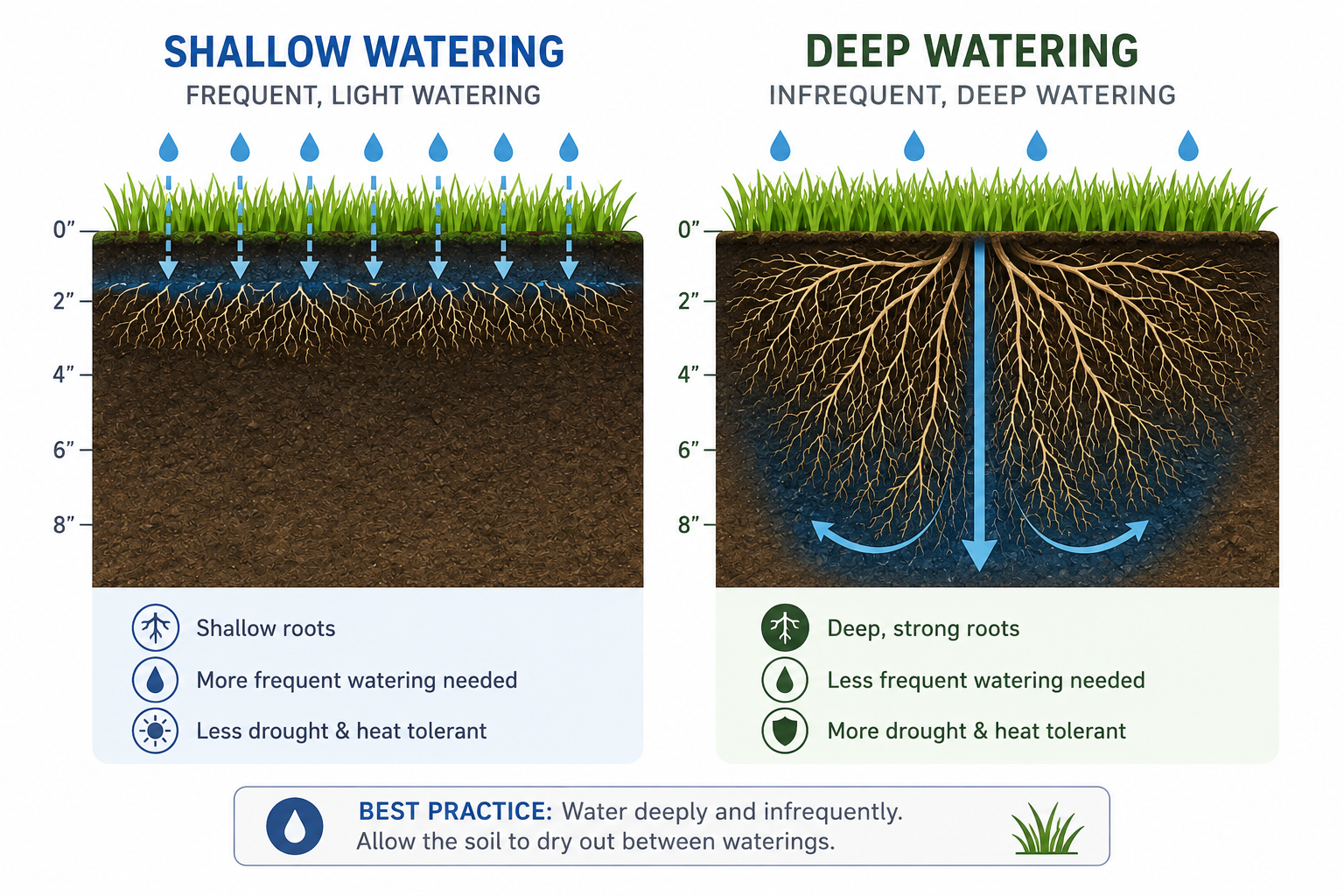
“Water deep and infrequent” only works if you actually have deep soil
One of the most common lawn recommendations is to water deeply and less frequently.
That is generally good advice when the lawn has enough usable soil depth to store that water.
But not every lawn does.
In areas with shallow, rocky clay soil, I have found that extremely long intervals between irrigation can actually perform worse during intense summer heat.
If your lawn only has a shallow layer of usable soil before hitting rock or extremely dense material, there simply may not be enough deep root-zone storage available.
The shallow soil heats quickly.
It also loses moisture quickly.
In those conditions, putting down a huge amount of water and then waiting several days may not give the lawn the moisture reserve you expect.
Shallow soil may need more frequent watering, not necessarily more water
This is an important distinction.
A shallow-root-zone lawn may perform better with moderate irrigation amounts applied somewhat more frequently.
That does not mean keeping the lawn constantly soaked.
It means matching irrigation frequency to the amount of water the soil can realistically hold.
A deep soil profile can act like a large water reservoir.
A shallow rocky profile acts more like a small reservoir.
Once that small reservoir dries out, the grass has nowhere else to pull moisture from.
That is why soil depth can matter just as much as soil type.
Clay lawn? Cycle and soak can be more important than total runtime
Clay soil can store a large amount of water, but it may absorb water slowly.
That creates a situation where the lawn may eventually need plenty of water, but the sprinklers are delivering it faster than the soil can accept it.
Breaking one irrigation event into several smaller cycles allows water to infiltrate instead of running into the street.
The same principle becomes even more important on slopes.
Rainfall only counts if it actually soaked into the lawn
Subtract useful rainfall from your irrigation needs.
A rain gauge on your own property is better than assuming a nearby weather station received the same amount.
Also remember that measured rainfall does not always equal usable rainfall.
A fast one-inch thunderstorm that sends water rushing into the street may contribute less usable moisture than a slower one-inch rainfall that gradually infiltrates the soil.
Use 1 inch per week as a starting point, not a commandment
Bermuda does not know what your irrigation controller says.
Hot, dry, windy weeks may require more water.
Cooler, cloudy weeks may require considerably less.
Shade, mowing height, soil depth, root depth, and the appearance you want from the lawn can all change demand.
Use the common 1 inch per week recommendation as a starting reference, then adjust it based on the lawn in front of you.
My preferred weekly watering process
- Start with roughly 1 inch per week as a reference.
- Subtract useful rainfall.
- Watch the Bermuda for broad moisture-stress symptoms.
- Check moisture in the actual root zone.
- Use the digital water meter trick or the catch-can test to determine zone output.
- Calculate the total runtime needed.
- Split that runtime into cycles anywhere runoff begins.
- Use additional cycles on slopes and slow-infiltrating clay.
- Consider usable soil depth when deciding how long to wait between watering days.
- Keep adjusting based on what your grass and soil actually tell you.
The goal is not to find the perfect sprinkler-controller number.
The goal is to know how much water is leaving your line, how much is reaching your lawn, and how long your soil can realistically hold it.