Quick answer
Deep and infrequent watering is a great goal for established Bermuda, but I don't believe every lawn can be forced into the exact same watering strategy.
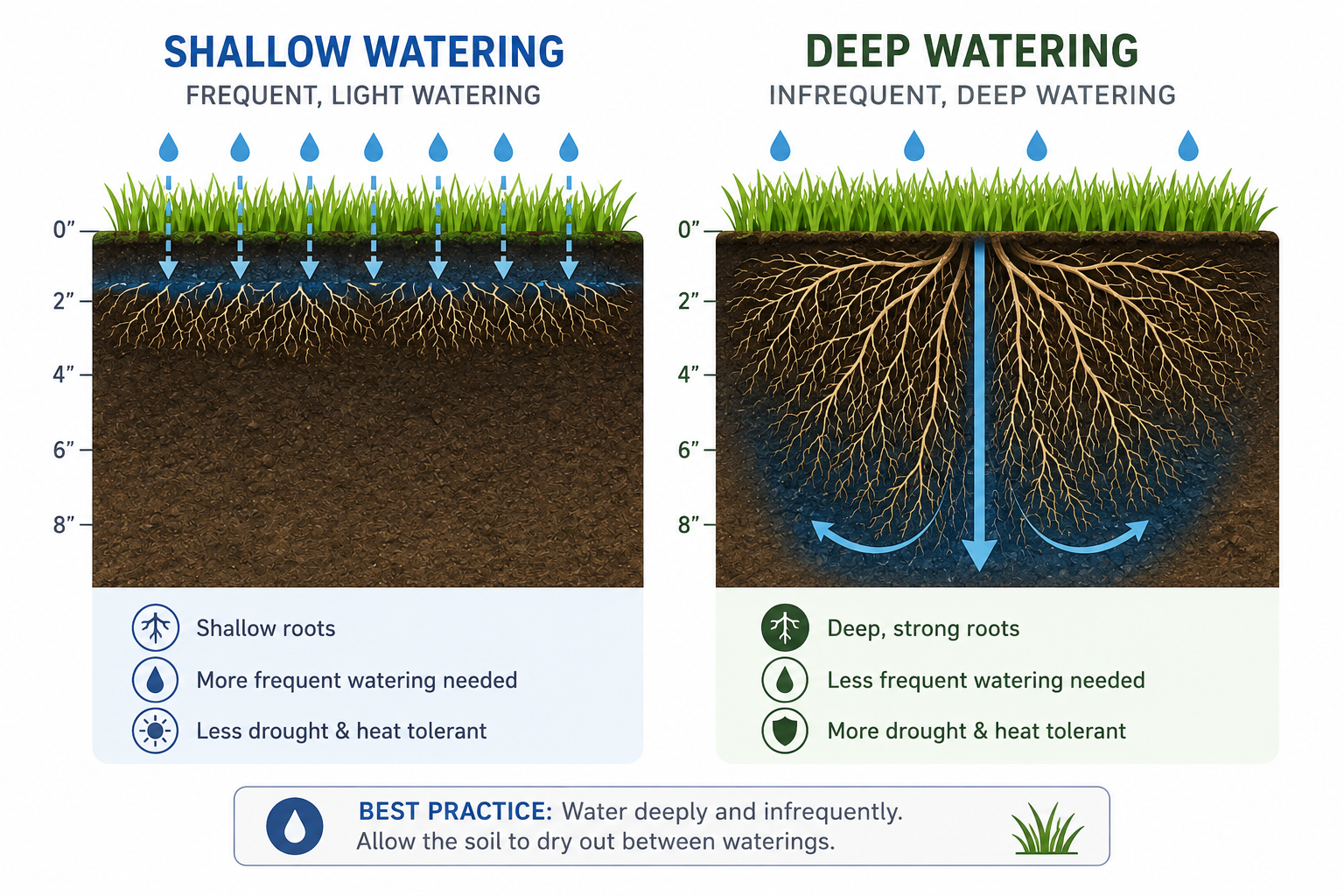
The idea is to apply enough water to reach the active root zone, then allow the soil to dry down before watering again. This encourages the lawn to make better use of deeper moisture instead of becoming dependent on constantly wet surface soil.
Shallow, frequent watering
Small amounts applied often keep moisture near the surface and can encourage shallow rooting.
Deep, infrequent watering
Larger irrigation events wet more of the root zone and allow the surface to dry between cycles.
But soil depth matters.
If you have several inches of good soil beneath your lawn, deep watering can help train the turf to rely less on frequent irrigation. If your soil profile is shallow, rocky, compacted, or sitting over construction material, the lawn may simply not have enough soil volume to store several days' worth of usable water. In that situation, more frequent watering may be as good as it gets until the root zone itself improves.
Deep watering only works if you have somewhere for the water to go
This is one of the biggest things I've learned with irrigation.
You can apply a large amount of water, but that doesn't automatically mean your lawn has a large reservoir available to it. If the active soil profile is only 3 or 4 inches deep, trying to water for an 8-inch root zone doesn't accomplish much. Water may move below the useful soil, hit rock or compacted material, or simply run off.
A deeper soil profile gives you more storage capacity.
That is where the traditional deep-and-infrequent approach really shines. You can thoroughly recharge the root zone and then allow the lawn to gradually use that stored moisture over the following days.
The lawn becomes less dependent on getting water every day because moisture is still available deeper in the profile.
Sometimes frequent watering is the better answer
I don't automatically consider frequent watering a bad practice.
If your soil profile is shallow, the roots may never have enough stored water available to comfortably make it through long periods of summer heat. Once that limited reservoir is depleted, the grass needs water again.
That may mean watering more frequently but applying less each time.
The important distinction is understanding why you're doing it.
There's a difference between watering every day because you've never measured anything and watering more frequently because you've tested your soil depth, moisture retention, and root zone and determined that your lawn simply doesn't have much storage capacity.
Surface moisture and deep moisture are two different things
When I'm thinking about soil moisture, I like to separate it into two areas.
There is the surface moisture in roughly the top inch or two of soil, and then there is the deeper moisture stored farther down in the root zone.
Surface moisture disappears quickly.
Sun, wind, and hot temperatures can dry the top couple inches surprisingly fast even when there is still moisture deeper in the profile.
That is why looking at the surface alone can be misleading.
Deep watering is valuable because it creates a moisture reserve below that rapidly drying surface layer. A healthy root system can continue using that deeper moisture even after the surface starts drying.
But again, that only works if your lawn actually has enough soil depth and roots capable of reaching it.
One of my favorite ways to improve a shallow root zone
I've found that aeration can make a major difference, especially when timing and weather are on your side.
My preferred time to do a deeper aeration is in the spring when Bermuda is actively waking up and we're entering the period where rainfall is generally more dependable.
I like to think of it as the spring shower window.
A good aeration can fracture compacted soil deeper in the profile, improve oxygen movement, and give roots easier pathways to explore.
Then rainfall and irrigation can move farther into those openings.
My goal isn't simply poking holes in the lawn. I'm trying to create an opportunity for the root system to expand before summer stress arrives.
I've skipped this before and noticed the difference later in the season, so I'm a firm believer in doing it when conditions allow.
The stronger and deeper I can get that root system in spring, the better prepared the lawn is when summer heat starts pulling moisture out of the soil every day.
If you have deep soil, take advantage of it
If you have a good deep soil profile, I would absolutely take advantage of that storage capacity.
Apply enough water to recharge the useful root zone, then allow the lawn to work through that moisture before watering again.
Over time, you're encouraging the turf to make use of the entire available soil profile instead of expecting the top inch of soil to be wet every morning.
That's what I mean when I talk about "training" the lawn.
You're not literally teaching the grass a schedule. You're creating conditions that reward deeper rooting and allow those deeper roots to provide value.
If your soil can support this approach, I believe it's one of the healthiest irrigation practices you can use.
Figure out how deep your water is actually going
Don't assume a certain irrigation runtime automatically equals deep watering.
After watering, check it.
A soil probe, screwdriver, small soil core, or moisture sensor can help you see how far the wetting front actually moved.
I like checking several areas because one part of a zone may have 8 inches of soil while another has 4 inches because of rock, construction grading, compaction, or uneven sprinkler coverage.
That information starts telling you what your lawn is actually capable of storing.
Don't outrun your soil's intake rate
Even when the goal is deep watering, you don't necessarily need to deliver all of the water in one continuous sprinkler cycle.
If the sprinkler is applying water faster than the soil can absorb it, you'll start getting runoff long before you've recharged the root zone.
That's where cycle-and-soak watering becomes useful.
Instead of running a zone for 30 minutes straight, you might divide that total runtime into two or three shorter cycles with time between them for the water to infiltrate.
You're still applying the same measured amount of water, but you're giving more of it a chance to actually enter the soil.
Slopes, heavy soils, and high-flow sprinkler zones especially benefit from this.
Let the lawn help determine frequency
Once I know roughly how much water a zone applies and how deep that water penetrates, I start watching how long the lawn can comfortably go before needing irrigation again.
That interval changes throughout the season.
Spring weather might allow several days between watering events. During extreme summer heat, the exact same lawn may need water much sooner.
Watch for broad early signs of moisture stress rather than waiting until the entire lawn looks damaged.
At the same time, don't let one small dry patch convince you that the whole zone needs water. Localized dry spots can come from poor sprinkler distribution, shallow soil, compaction, slopes, or roots competing with trees.
Those areas may need to be corrected or occasionally hand-watered rather than increasing irrigation everywhere.
My process
- Measure how much water the irrigation zone is actually applying.
- Determine approximately how deep the usable soil profile is.
- Water enough to recharge that useful depth without exceeding what the soil can store.
- Split the runtime into cycles if runoff occurs.
- Check both surface moisture and deeper moisture rather than judging the lawn from the top inch alone.
- Watch how many days the lawn comfortably lasts before broad moisture stress begins.
- Adjust watering frequency with weather and soil conditions.
- Use spring aeration and good cultural practices to gradually improve the root zone where possible.
- If the soil is deep enough, push toward deeper and less frequent irrigation.
- If the soil is shallow, accept that smaller and more frequent irrigation may be the most efficient strategy until the soil and rooting depth improve.
The goal isn't to follow a rule that says Bermuda should only be watered a certain number of days per week.
The goal is to understand how much water your soil can store, how deeply your roots can reach, and how quickly the lawn uses that moisture.
Once you understand those three things, your irrigation schedule starts becoming much easier to dial in.