QUICK ANSWER
For a Bermuda lawn in Texas, I wouldn't choose my spring pre-emergent date just because somebody online says, "Put it down February 15."
The better trigger is soil temperature.
Texas A&M says crabgrass germination typically begins when soil temperature at a 2-inch depth reaches about 55°F for at least three days. That usually puts the spring pre-emergent window around mid-February in South Texas, early March in North and Central Texas, and around mid-March in the Panhandle—but the weather gets the final vote.
Your goal is to have the herbicide applied and activated with rainfall or irrigation before germination.
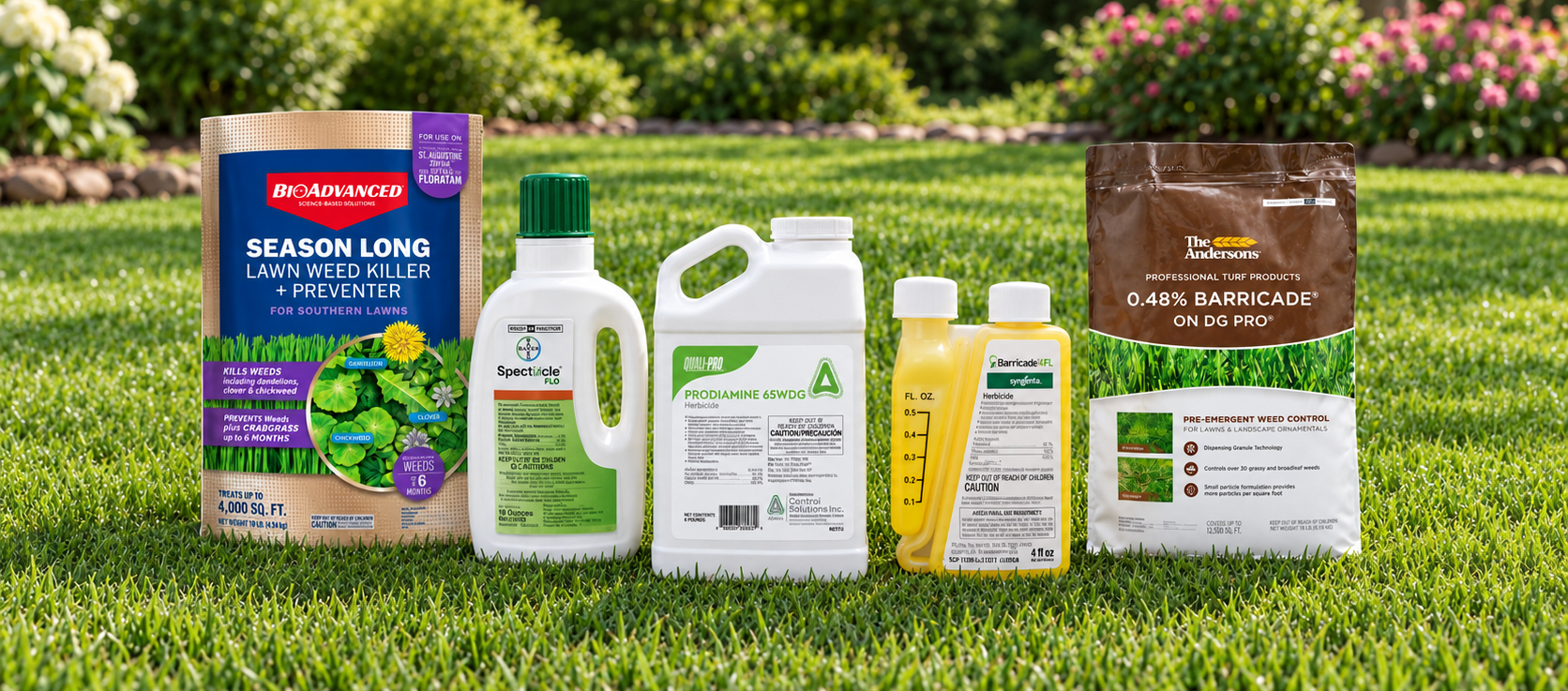
For established Bermuda, common pre-emergent active ingredients include prodiamine, dithiopyr, and pendimethalin. The right choice depends on the weeds you're targeting, the product label, and what you plan to do with the lawn later in the season.
And there's one Bermuda-specific detail I think is easy to miss: dormant Bermuda doesn't need a shot of spring nitrogen just because you're applying pre-emergent.
The calendar gets you close. Soil temperature gets you closer.
The problem with giving Texas homeowners one universal pre-emergent date is pretty obvious once you look at the state on a map.
Spring doesn't arrive in Amarillo at the same time it arrives in San Antonio.
Even within the same part of Texas, a warm February can move weed germination forward compared with a colder year. That's why I think of calendar dates as a reminder to start paying attention—not as the actual trigger.
Texas A&M's Bermuda lawn calendar says crabgrass is generally the first summer annual grass to germinate. Their typical timing is approximately:
NUMBERS / COMPARISON
Texas region
Typical crabgrass timing
South Texas
Mid-February
North Texas
Early March
Central Texas
Early March
Panhandle
Mid-March
Those are useful planning windows, not deadlines carved into stone.
The more useful measurement is soil temperature. Crabgrass germination generally begins around 55°F at a 2-inch soil depth for several days.
So if I'm trying to stay ahead of crabgrass, I want the pre-emergent applied and activated before that point.
That's an important distinction.
I don't want to see crabgrass and then remember that I need pre-emergent. By then, I'm already changing strategies.
PRO TIP
Start monitoring soil temperatures before you expect to apply. A few unusually warm afternoons aren't the same thing as sustained soil temperatures approaching the germination range.
What pre-emergent is actually doing
"Pre-emergent" can make it sound like we're somehow killing dormant weed seeds sitting in the soil.
That's not really what's happening.
These herbicides work during the germination and early development process. Many common turf pre-emergents interfere with cell division or root and shoot development, preventing susceptible seedlings from successfully establishing.
That also explains why coverage matters.
You're trying to establish an effective herbicide zone near the soil surface where those weeds are attempting to germinate. Skipped areas can become openings in that protection.
And once most pre-emergent products are applied, they need rainfall or irrigation to move the herbicide into that zone.
Texas A&M specifically notes that pre-emergent herbicides need to be applied uniformly and watered into the soil by rainfall or irrigation before the target weed emerges.
So I think about a spring application as three separate jobs:
- Choose the right active ingredient for the weeds I'm targeting.
- Apply it uniformly at the labeled rate.
- Activate it according to that product's label.
Miss one of those and simply being "on time" doesn't guarantee good control.
Pre-emergent also isn't a force field against every weed.
Different active ingredients control different weed species, and perennial weeds aren't magically solved because you put down a crabgrass preventer.
Identify the problem first. Then make sure the label actually lists what you're trying to prevent.
Prodiamine, dithiopyr, and the other choices
For an established Bermuda lawn, homeowners have several legitimate pre-emergent active ingredients available.
Texas A&M lists prodiamine, dithiopyr, and pendimethalin among the options for pre-emergence control of annual grasses in Bermuda lawns.
I care more about that active ingredient than whatever marketing name happens to be on the front of the bag.
NUMBERS / COMPARISON
Active ingredient
Why it gets attention
Prodiamine
Widely used for pre-emergence control of annual grasses and some broadleaf weeds
Dithiopyr
Provides pre-emergence control and also has some early post-emergence activity on young crabgrass
Pendimethalin
Another established option for annual grasses and some broadleaf weeds
Isoxaben
Primarily useful for broadleaf weeds rather than grassy weeds such as crabgrass
Indaziflam
Warm-season turf option with broad pre-emergence activity; establishment and rooting restrictions make label review especially important
Dithiopyr is particularly interesting when timing has gotten away from you because it has activity on young crabgrass after germination. Texas A&M notes this early post-emergence capability, and current Dimension technical information also describes both pre- and early post-emergence crabgrass control.
That doesn't mean I'd intentionally wait.
I'd still rather make a true pre-emergence application before crabgrass starts coming up.
Product concentration also matters. Two products containing the same active ingredient can have completely different amounts of active ingredient per pound or gallon.
That's why I don't want to publish one universal "ounces per 1,000" number and pretend it applies to everything containing prodiamine or dithiopyr.
The product label is the rate.
Read the label for your exact formulation, turf species, target weed, application interval, maximum annual amount, watering requirements, PPE, and other restrictions.
Don't fertilize dormant Bermuda just because you're applying pre-emergent
This is probably the most Bermuda-specific part of my spring strategy.
A lot of homeowner pre-emergents are sold as combination fertilizer and herbicide products.
Convenient?
Sure.
But convenience doesn't automatically make the agronomy line up.
Texas A&M recommends applying nitrogen to Bermuda when the grass is green and actively growing. Their Bermuda management guidance specifically cautions that when granular pre-emergents are applied on a fertilizer carrier before spring green-up, homeowners should choose products with little to no nitrogen.
That makes sense.
Your pre-emergent timing is being driven by weed germination.
Your spring nitrogen timing should be driven by Bermuda growth.
Those two clocks don't necessarily strike midnight together.
If my soil temperatures tell me it's time to prevent crabgrass but the Bermuda is still sitting there brown and dormant, I don't need to force those two jobs into the same application.
A standalone pre-emergent—or an appropriate low/no-nitrogen granular carrier—lets you handle weed prevention without pretending the lawn has entered its summer fertility program.
WATCH OUT
Check the analysis on "weed and feed" products before throwing them on dormant Bermuda. You're not just buying herbicide. If that bag contains nitrogen, you're making a fertilizer application too.
The application is where a good plan can fall apart
You can choose the right chemistry and nail the timing, then lose a lot of the benefit with a sloppy application.
Uniform coverage matters.
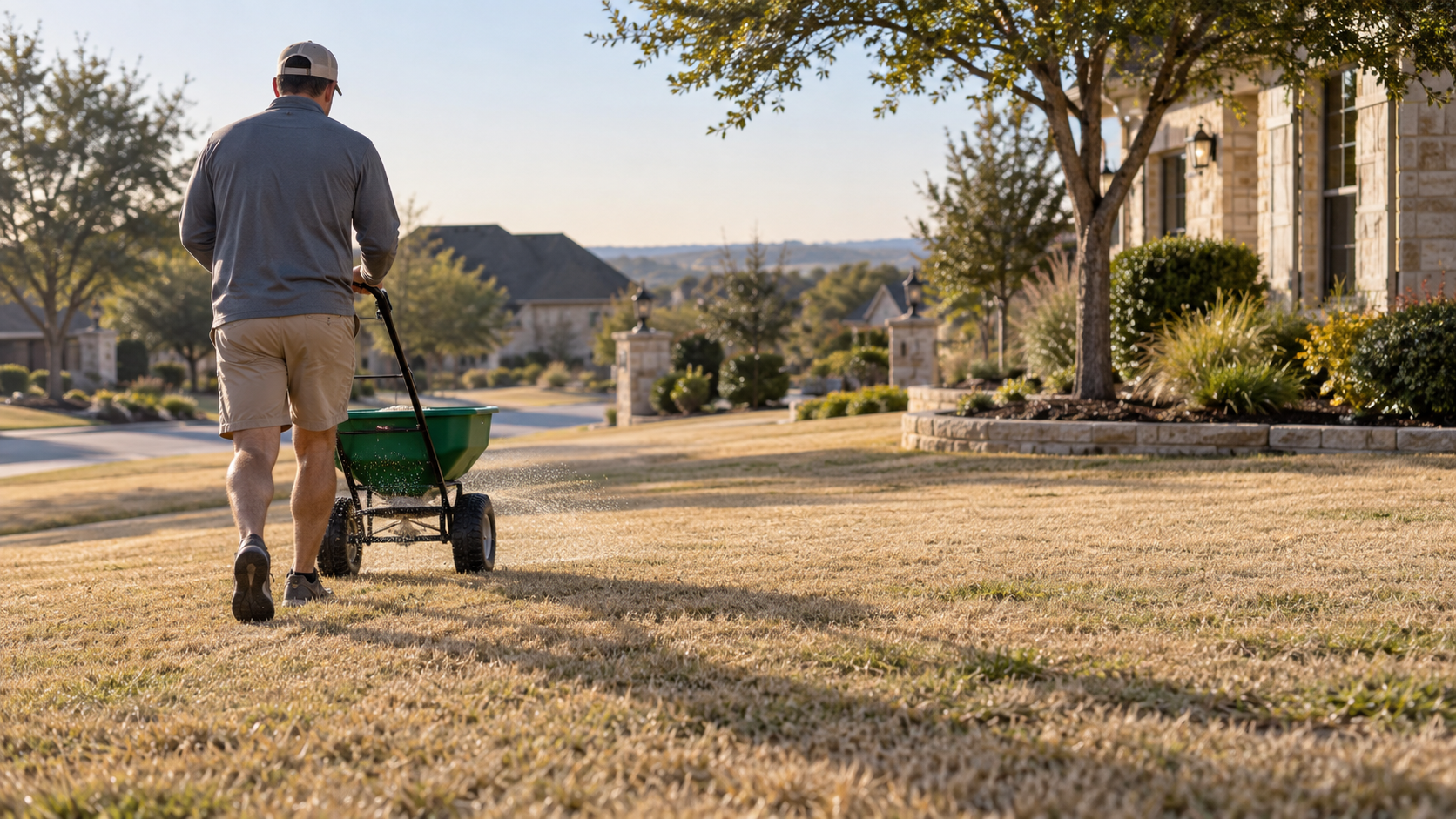
If I'm using a granular product, I want the spreader calibrated well enough that I know approximately how much product is going across a known area.
For a 5,000-square-foot lawn, that means knowing it's actually about 5,000 square feet—not calling it 5,000 because that makes the math easy.
I also like the idea of applying granular products in two perpendicular passes when the equipment and label allow it. Oklahoma State specifically recommends splitting the measured amount into two equal portions and spreading in opposite directions to improve uniformity.
Then I deal with activation.
The exact requirement depends on the product, so this is another place where the label wins. Some labels give a specific rainfall or irrigation amount or activation window.
Don't assume "I spread it" means "I'm done."
The other major consideration is what you're planning to do next.
Pre-emergents can interfere with turf establishment because the same root-development processes we're trying to disrupt in weeds can matter when you're trying to establish grass.
If you're planning to seed Bermuda, plug, sprig, sod, or perform major renovation work, read those establishment restrictions before applying the herbicide.
That's especially important with products that have meaningful residual activity.
WATCH OUT
Don't put down a long-residual pre-emergent and then decide a few weeks later that you want to seed bare spots with Bermuda. Plan the spring lawn calendar before making the herbicide application.
How I'd make the spring pre-emergent decision
I wouldn't make this more complicated than it needs to be.
First, I want to know what weeds I'm actually trying to prevent. For most Bermuda homeowners worried about spring weeds, crabgrass is going to be near the top of that list. Goosegrass, spurge, sandbur and other summer annuals may also matter depending on the lawn.
Then I start watching soil temperature as winter begins loosening its grip.
I'm not trying to hit exactly 55.0°F and race outside with the spreader.
I'm trying to recognize that I'm approaching the biological window when summer annual germination becomes likely and get the application down early enough to be activated beforehand.
Next comes product selection.
For a straightforward established Bermuda lawn with a history of crabgrass, prodiamine or dithiopyr are two of the first active ingredients I'd investigate. That isn't because every lawn needs the same chemical. They're simply well-established options supported by Extension guidance for this job.
If crabgrass has already begun emerging, dithiopyr's early post-emergence activity may change the decision.
If I'm planning Bermuda establishment or renovation, the decision changes again.
And if the Bermuda is still dormant, I don't let pre-emergent timing trick me into thinking it's automatically fertilizer time.
Those are separate decisions.
My spring pre-emergent process
MY PROCESS
- Identify last year's problem weeds. I want to know what I'm actually trying to prevent.
- Start watching 2-inch soil temperatures. As sustained temperatures begin approaching the mid-50s, my application window is getting closer.
- Choose the active ingredient. I match the herbicide to the target weeds and established Bermuda.
- Read the current label. I verify the Bermuda use, exact product rate, annual maximum, activation requirements, establishment restrictions, and safety directions.
- Measure the lawn and product. This isn't a "couple handfuls should do it" application.
- Apply as uniformly as possible. With granular products, two perpendicular half-rate passes can help improve coverage when consistent with the label.
- Activate according to the label. The herbicide needs to reach the soil zone where germination is occurring.
- Keep watching the lawn. Pre-emergent reduces germination of susceptible weeds; it doesn't replace good mowing, irrigation, fertility, weed identification, or the occasional post-emergence treatment.