
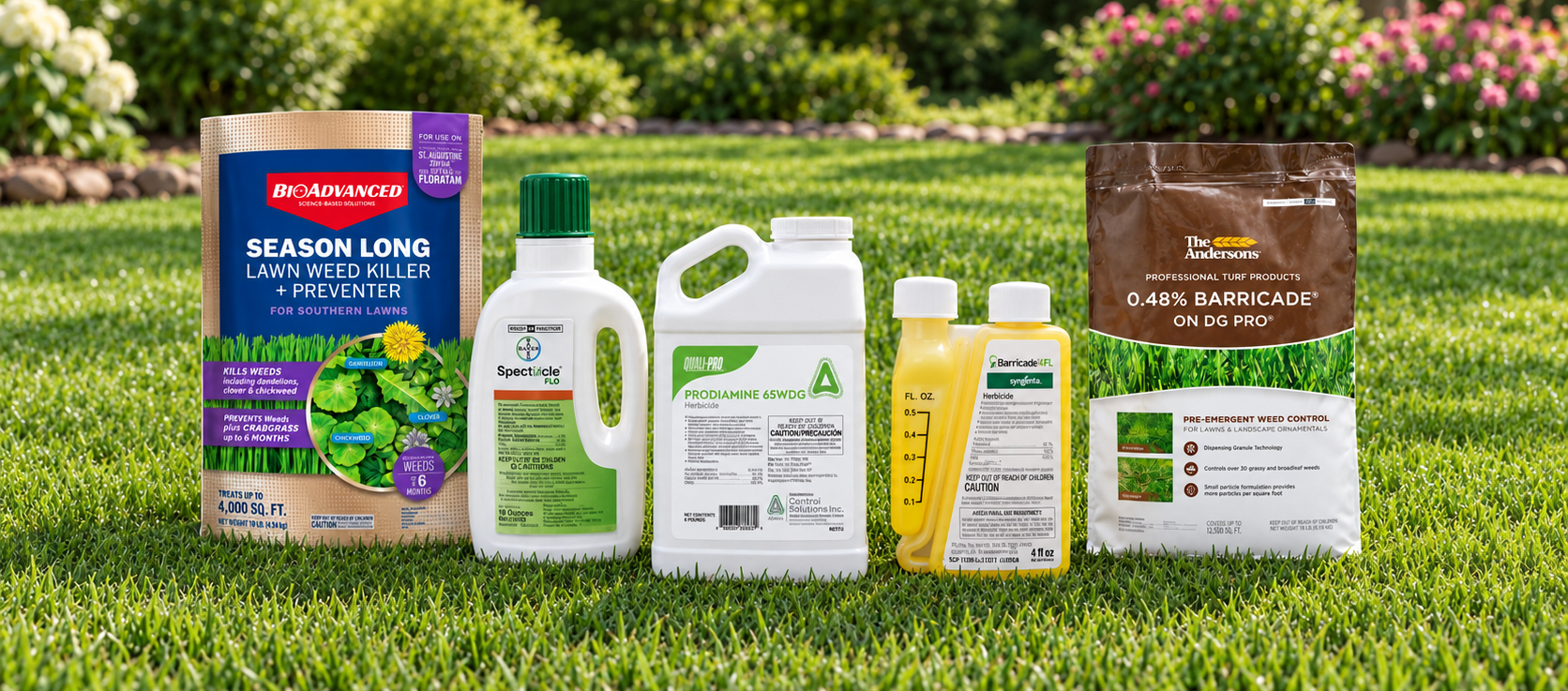
What fall pre-emergent actually does
Fall pre-emergent is one of those applications that can make the next several months of lawn care dramatically easier.
The idea is simple: stop winter annual weeds while they are germinating instead of chasing them after they are growing throughout the lawn.
A pre-emergent creates a treated zone near the soil surface that interferes with susceptible weeds as they begin developing. It is prevention, not a rescue treatment.
For Bermuda lawns, some of the common fall targets include:
- Annual bluegrass, or Poa annua
- Henbit
- Chickweed
- Lawn burweed
- Other winter annual grasses and broadleaf weeds listed on the product label
If weeds are already established, a pre-emergent application normally isn't going to make them disappear. Those weeds require a separately labeled post-emergent strategy.
Timing matters more than the calendar
I don't like giving someone a date and saying, "Apply your pre-emergent every year on this day."
Weather doesn't work that way.
The important thing is getting the herbicide down before your target weeds begin germinating.
For fall Poa annua prevention in Texas, I start paying attention as soil temperatures begin trending down toward roughly 70°F for several consecutive days. That's much earlier than the commonly repeated 55°F number associated with spring crabgrass prevention.
That distinction matters.
If you wait until your soil reaches 55°F in the fall, Poa may have already been germinating for quite a while.
Your exact timing can move depending on:
- Location
- Shade
- Irrigation
- Rainfall
- Soil type
- Microclimates around the property
I would rather be slightly early with an appropriately labeled pre-emergent than wait until I can already see weeds emerging.
The two active ingredients I focus on
There are a lot of pre-emergent products on the market.
For my Bermuda lawn, I keep coming back to two active ingredients:
Prodiamine
Proven, inexpensive and extremely economical when purchased as a concentrated product.
Indaziflam
A premium pre-emergent active ingredient most people in professional turf recognize from Specticle FLO.
They are not identical herbicides and they work differently, but both can have a place in a serious Bermuda weed-prevention program.
The better choice depends on your lawn, budget, equipment and how involved you want to be in the application.
Option 1: Prodiamine — my economical workhorse
If you have a sprayer and don't mind doing some basic measuring and calibration, Prodiamine 65 WDG is difficult to beat for value.
Prodiamine is a Group 3 pre-emergent herbicide labeled for established Bermuda grass and a long list of annual grasses and broadleaf weeds.
This is the route I like when I want control over exactly what I'm applying without paying for fertilizer or a granular carrier I don't necessarily need.
Prodiamine rates for Bermuda
For established Bermuda grass, the Prodiamine 65 WDG label allows up to approximately:
0.36–0.83 oz of product per 1,000 sq ft per calendar year
depending on the application program and total amount used during the year.
That upper amount is an annual maximum, not automatically a single-application recommendation.
A spring/fall program might divide that annual allowance between multiple applications.
For example:
About 0.415 oz per 1,000 sq ft
is equivalent to approximately 1.15 lb of product per acre.
That gives you an idea of just how concentrated this stuff is.
A small amount treats a lot of lawn.
Why Prodiamine is so economical
This is really where Prodiamine shines.
You're not buying bags and bags of carrier material. You're measuring fractions of an ounce and applying it through a calibrated sprayer.
If you have a larger lawn, the economics become especially attractive.
The tradeoff is that you need to be comfortable with:
- Measuring your lawn
- Weighing very small amounts accurately
- Calibrating a sprayer
- Keeping track of annual herbicide totals
- Applying consistently
I don't eyeball Prodiamine.
A small digital scale and an accurately measured lawn make this application much easier.
My take: If you're already spraying your lawn and want the most economical serious pre-emergent program, Prodiamine is where I would start.
Option 2: Specticle FLO — the professional choice
The other product I pay a lot of attention to is Specticle FLO.
Its active ingredient is indaziflam at 7.4%. It is a Group 29 herbicide and is commonly used in professional warm-season turf programs.
The current EPA label lists established Bermuda among its warm-season turf uses, although Bermuda varieties can differ in sensitivity and the label precautions matter.
This is what I think of as the premium or pro-level option.
It can provide excellent residual weed prevention, but there is a big downside for a normal homeowner:
Specticle FLO is expensive.
The bottle size and price make much more sense when you're a lawn-care company or turf manager treating a lot of square footage.
Specticle FLO rates for Bermuda
For a single pre-emergent application, the label includes rates in the neighborhood of:
6–10 fl oz per acre
depending on the target weed, conditions and desired residual control.
For Bermuda grass, the maximum single application is:
10 fl oz per acre
and the label states that total Specticle FLO applied within a 12-month period must not exceed:
18.5 fl oz per acre.
Converted to 1,000 sq ft:
- 6 fl oz/acre = about 0.138 fl oz/1,000 sq ft
- 8 fl oz/acre = about 0.184 fl oz/1,000 sq ft
- 10 fl oz/acre = about 0.230 fl oz/1,000 sq ft
Those are tiny quantities.
That means accurate measurement and spray calibration really matter.
The 6 oz Specticle rate is important
Remember this number:
6 fl oz of Specticle FLO per acre.
There is a homeowner product that makes this number very interesting.
The homeowner cheat code: BioAdvanced with indaziflam
If someone doesn't own a backpack sprayer, doesn't want to measure tiny quantities of herbicide and doesn't want to spend professional-product money, this is probably the option I find most interesting.
BioAdvanced Season Long Lawn Weed Killer + Preventer for Southern Lawns contains:
- 0.088% dicamba
- 0.041% penoxsulam
- 0.027% indaziflam
That last ingredient is the important one.
Indaziflam is also the pre-emergent active ingredient in Specticle FLO.
BioAdvanced currently markets the Southern product for warm-season lawns and lists indaziflam at 0.027% in the formulation.
Why I call this the homeowner cheat code
Specticle gives you indaziflam in a professional liquid concentrate.
The BioAdvanced product puts indaziflam into an easy-to-apply granular homeowner product.
You put it in a broadcast spreader and distribute the labeled amount evenly over the lawn.
No tiny liquid measurements.
No professional-sized bottle.
No backpack sprayer required.
And the active-ingredient math is surprisingly interesting.
BioAdvanced application rate
For the 10 lb Southern Lawn bag, the labeled coverage is approximately:
4,000 sq ft
which works out to:
2.5 lb of product per 1,000 sq ft.
That is the number I would use—not an entire 10-lb bag over only 2,500 or 3,000 sq ft.
Always confirm the current label on the particular bag you purchase before applying.
Here's the interesting part
At 2.5 lb of BioAdvanced per 1,000 sq ft, a product containing 0.027% indaziflam delivers approximately:
0.000675 lb of indaziflam per 1,000 sq ft.
Now compare that with Specticle FLO.
At 6 fl oz of Specticle FLO per acre, the indaziflam loading works out to approximately:
0.00067 lb of indaziflam per 1,000 sq ft.
Those numbers are remarkably close.
That does not mean these are identical products.
BioAdvanced also contains dicamba and penoxsulam. The formulations, labels, approved uses, restrictions and weed-control claims are different.
But from the simple standpoint of how much indaziflam is being delivered over a given area, the labeled BioAdvanced application lands very close to the 6 fl oz/acre Specticle FLO rate.
That's why I consider this product such an interesting homeowner option.
Homeowner cheat code: If you want an easy granular way to incorporate indaziflam into an established southern lawn, BioAdvanced Season Long Lawn Weed Killer + Preventer for Southern Lawns deserves a serious look.
So which one should you use?
I look at the decision like this:
Prodiamine — best bang for the buck
Choose Prodiamine if:
- You have a sprayer
- You know your lawn square footage
- You don't mind weighing product
- You want an inexpensive long-term program
- You want control over exactly what you're applying
For a bigger lawn especially, this is the economical winner.
Specticle FLO — premium professional option
Choose Specticle FLO if:
- You specifically want an indaziflam-based professional product
- You're comfortable calibrating and measuring very small liquid quantities
- Cost is less important
- You're managing a large amount of turf or already have access to the product
It is excellent chemistry, but the economics can be difficult to justify for a small residential lawn.
BioAdvanced — easiest homeowner option
Choose BioAdvanced if:
- You want something simple
- You already own a broadcast spreader
- You don't want to mix a spray tank
- You want indaziflam without buying Specticle FLO
- You're treating a typical residential-sized southern lawn
For the average homeowner, this may be the easiest path of all three.
Quick comparison
Product
Why I use it
Rate reference
Prodiamine 65 WDG
Economical DIY liquid option
About 0.36–0.83 oz/1,000 sq ft annual label allowance on established Bermuda
Specticle FLO
Premium professional indaziflam
6–10 fl oz/acre single-application range; Bermuda max 10 fl oz/acre
BioAdvanced Southern
Easy homeowner indaziflam option
2.5 lb/1,000 sq ft
My fall application workflow
Regardless of which product I choose, I don't start by looking at the spreader or sprayer.
I start with square footage.
1. Measure the lawn
Know how much turf you're actually treating.
Subtract:
- Beds
- Concrete
- Pools
- Driveways
- Patios
- Other areas excluded by the label
A rate doesn't mean anything if the square footage is wrong.
2. Watch soil temperatures
For fall Poa prevention, I start paying attention as Texas soil temperatures begin consistently falling toward approximately 70°F.
I'm trying to get ahead of germination.
I don't wait until I see Poa.
3. Choose the product for the job
This is where the three options separate.
Want cheap and effective?
Prodiamine.
Want professional indaziflam?
Specticle FLO.
Want easy homeowner indaziflam?
BioAdvanced.
4. Calculate the product amount
I calculate exactly how much product my measured square footage requires.
I don't use a neighbor's rate.
I don't copy the amount somebody used in a YouTube video.
And I definitely don't guess based on how full the hopper looks.
5. Calibrate before applying
For liquids, I calibrate the sprayer with plain water first.
For granular products, I would rather begin with a conservative spreader opening and make multiple consistent passes than dump the entire amount too quickly.
The goal is to distribute the calculated amount evenly over the measured area.
6. Water it in
Pre-emergent needs to reach the soil where weed germination is happening.
Follow the particular product label for watering instructions and timing.
7. Write it down
I keep track of:
- Product
- Active ingredient
- Application date
- Product amount
- Square footage
- Rate per 1,000 sq ft
- Soil conditions
- Irrigation
- Previous applications
This becomes especially important when a label has an annual maximum.
Don't combine feeding and weed prevention unless you need both
One mistake I try to avoid is automatically treating pre-emergent and fertilizer like they have to be the same application.
They don't.
The herbicide is controlling weeds.
The fertilizer is feeding the lawn.
Those are two different decisions.
As Bermuda approaches dormancy in the fall, I generally don't want to dump unnecessary nitrogen on the lawn just because the pre-emergent happened to be attached to a high-nitrogen fertilizer.
If I'm choosing a granular carrier specifically for pre-emergent, something like a 0-0-7 formulation can make more sense than a nitrogen-heavy weed-and-feed when additional nitrogen isn't part of my plan.
Don't create a barrier when you're trying to establish grass
This is probably the most important caution in the entire guide.
Pre-emergent herbicides work by interfering with newly developing plants.
That can also create problems when your Bermuda is trying to establish new roots or spread into damaged areas.
This matters around:
- New Bermuda seed
- Sprigs
- Plugs
- Fresh sod
- Thin areas
- Major repair work
- Renovations
- Overseeding
Specticle FLO in particular carries precautions about temporary inhibition of Bermuda stolon rooting, and its label notes that common or off-type Bermuda can be more sensitive than hybrids.
Before applying, I ask myself:
Am I trying to prevent weeds or establish grass?
Sometimes you need to prioritize one goal over the other.
Pre-emergent isn't a force field
Even a perfectly timed application doesn't guarantee you'll never see another weed.
Performance changes with:
- Application rate
- Coverage
- Rainfall
- Irrigation
- Soil
- Temperature
- Weed pressure
- Length of the germination season
The goal isn't necessarily zero weeds.
The goal is to turn what could have been hundreds of weeds into a handful that are easy to manage.
That's a successful pre-emergent application to me.
Key takeaways
- Get ahead of germination. Fall pre-emergent works best before winter weeds emerge.
- Prodiamine is my value option. If you own a sprayer, it's extremely economical per 1,000 sq ft.
- Specticle FLO is my premium option. Its active ingredient, indaziflam, provides a professional pre-emergent option for established warm-season turf.
- BioAdvanced is the homeowner cheat code. The Southern Season Long product contains indaziflam and applies it at a loading remarkably close to Specticle FLO at 6 fl oz/acre when each is used at the referenced labeled rate.
- Measure before applying. Square footage, calibration and label rates matter more than spreader settings copied from somebody else.
- Don't interfere with establishment. Pre-emergent and aggressive Bermuda recovery don't always belong in the same window.
- Keep records. Every application matters when products have maximum single and annual rates.
Always follow the product label. Pesticide labels are legal directions and formulations, rates and approved uses can change. The label attached to the product in your possession takes priority over this guide.