
QUICK ANSWER
One of the best things about Bermuda grass is its ability to repair itself.
If you've got a bare spot from grub damage, insects, disease, drought, traffic, or some other temporary problem, my first question isn't usually, What should I reseed this with? It's What caused the damage, and is that problem actually gone?
Once it is, healthy Bermuda can spread back into the area through stolons above the soil and rhizomes below it. Your job is mostly to give that process what it needs: active growing weather, adequate nitrogen, reliable moisture, and time.
For a bigger spot, I'll also consider moving plugs of healthy Bermuda into the damaged area. You're basically giving the lawn a head start by putting living Bermuda in the middle instead of making it cover the entire distance from the edges.
Before doing any of that, though, there's one thing you need to know.
Bermuda doesn't just grow up—it grows sideways
Understanding how Bermuda grows changes the way you look at a bare spot.
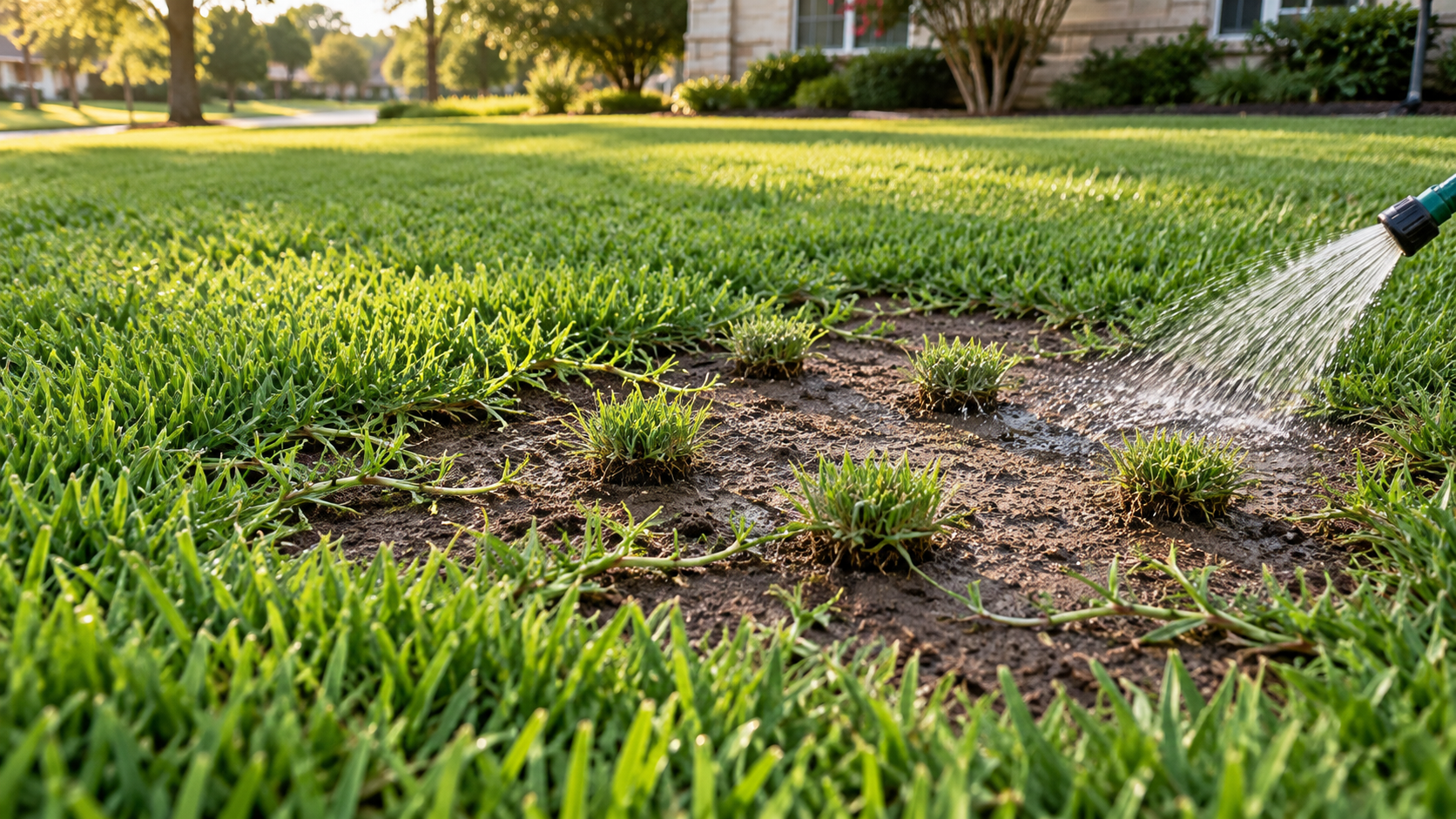
Bermudagrass spreads through stolons, which run across the soil surface, and rhizomes, which spread below it. Those lateral stems are a big reason Bermuda has such good recuperative ability.
If you've ever watched a Bermuda runner crawl across a driveway or into a flower bed, you've already seen the same mechanism we're trying to use here.
Except this time, we actually want it to happen.
A bare spot surrounded by healthy, actively growing Bermuda has multiple fronts from which the turf can advance. Stolons can creep across the exposed soil and root at their nodes. Meanwhile, there may already be viable plant material below the surface that isn't obvious when you're standing over the spot looking at brown dirt.
That's an important distinction between bare on top and completely devoid of living Bermuda.
It also explains why my default strategy isn't necessarily to tear everything apart and start over. If I've eliminated the cause of the damage and still have healthy Bermuda surrounding the spot, I want to give that grass an opportunity to do what Bermuda is incredibly good at doing.
Spread.
Before you buy seed, figure out what Bermuda you have
This matters more than a lot of homeowners realize.
There are common and improved Bermuda varieties that can be established from seed. But many of the fine-textured hybrid Bermudas used in sodded lawns are vegetatively propagated because they don't produce usable seed.
So if your lawn was originally installed as hybrid Bermuda sod, grabbing a bag of Bermuda seed and throwing it into the bare spot can create a different-looking patch instead of restoring what was there.
The repaired area may differ in texture, density, color, seedhead production, or overall appearance.
WATCH OUT
Don't assume that a product labeled “Bermuda grass seed” is the same Bermuda that's already growing in your yard. If your lawn was installed as sod, especially a fine-textured hybrid cultivar, identify what you have before introducing seed.
This is one reason I like repairing an established Bermuda lawn with the Bermuda that's already there.
If the surrounding turf is healthy, it's already the right grass.
And for many bare spots, you may not need to add any grass at all.
Nitrogen, water, and growing weather do most of the work
Once the original problem has been corrected, I want to shift from stopping damage to supporting growth.
Bermuda responds strongly to nitrogen when it's actively growing. That doesn't mean I automatically dump fertilizer onto every bare spot. It means I want to know whether the lawn already has enough fertility to push lateral growth.
That's an important difference.
If you've already made a substantial fertilizer application, don't pile another full application on top just because one area looks bad. More nitrogen isn't automatically better, and excess fertility can create its own problems.
But if the lawn is actively growing and the fertility program has been light, nitrogen can be one of the tools that helps drive the growth needed for recovery.
I like the convenience of a liquid fertilizer through a hose-end sprayer for this kind of targeted work. It lets me feed an area while I'm already paying close attention to it. The actual nutrient rate still matters, though. Read the analysis and label, know approximately how much nitrogen you're applying, and account for fertilizer that's already been put down.
MY TAKE
I don't think of fertilizer as something that magically fixes dead grass. I'm using it to support the living Bermuda that's going to repair the dead area. That's why I want the original insect, disease, or other stress under control first. Then I can focus on encouraging healthy growth.
Water is the other half of this.
An irrigation system may be doing a perfectly good job across the lawn while a particular damaged spot still dries faster than you'd like. Bare soil is exposed directly to sun and wind, and plugs or stolons trying to establish in that area don't have the same buffered environment as dense turf.
This is one of those situations where I'm perfectly willing to grab the hose.
Established Bermuda is normally better managed with deeper, less-frequent irrigation. A repair area is different. Newly moved plugs and sprigs need consistent moisture while they're establishing, so supplemental hand watering can make sense until they've rooted and begun spreading.
The goal isn't swampy soil.
It's making sure a spot you're actively trying to repair isn't drying out while the rest of the lawn gets enough water.
For a big bare spot, shorten the distance Bermuda has to travel
This is probably my favorite trick for speeding up a Bermuda repair.
Use a plugger to remove small plugs from good areas of the lawn and transplant them into the damaged area.
Think about what you're actually accomplishing.
If a bare circle is two or three feet across and you do nothing, Bermuda has to work inward from the outside perimeter. But put several healthy plugs throughout the middle and you've created new growing points inside the bare area.
Instead of this:
Healthy Bermuda → → → → bare center ← ← ← ← Healthy Bermuda
you've created something more like this:
Healthy Bermuda → → Plug → → Plug ← → Plug ← ← Healthy Bermuda
You haven't changed the way Bermuda grows.
You've changed how far it has to grow.
PRO TIP
Don't necessarily pack all your plugs along the outside edge. The surrounding lawn is already supplying Bermuda from that direction. For a larger damaged area, distributing healthy plugs through the interior creates additional places for stolons and rhizomes to spread from.
Set the plugs at roughly the same soil level they were growing at originally, firm the surrounding soil so the roots have good contact, and water them immediately.
You're essentially transplanting little pieces of the finished lawn into the repair zone.
There's another advantage here if you have hybrid Bermuda: those plugs are genetically the same turf you're taking from the established lawn. You're not introducing a potentially different seeded Bermuda into the middle of a uniform sodded lawn.
Don't smother the Bermuda you're trying to save
Bare areas sometimes need a little soil to level depressions, improve plug-to-soil contact, or give exposed stolons somewhere to root.
Just don't turn a repair into a burial.
Green Bermuda leaves need light. If living turf or runners are present, I want them remaining exposed enough to continue photosynthesizing rather than disappearing underneath a heavy layer of dirt.
Light topdressing is very different from dumping several inches of soil over actively growing grass.
If I'm adding soil around a repair, I'll water it in and watch the area closely. I want to continue seeing green tissue working through the surface. If I've covered existing Bermuda so heavily that the canopy stays buried, I've worked against the grass I'm trying to encourage.
There's also a bigger point here: don't repair the symptom while ignoring the cause.
A spot damaged by caterpillar feeding may recover quickly once feeding stops because healthy Bermuda has excellent recuperative ability. Other problems aren't so simple. Spring dead spot, for example, damages crowns, roots, and stolons and can recover slowly from the margins.
Shade, compaction, drainage problems, recurring disease, or an active insect infestation can keep producing the same bare spot no matter how much fertilizer or water you throw at it.
Fix the reason the grass disappeared first.
Then push recovery.
How I'd approach a Bermuda bare spot
I want to see progress during active Bermuda growing weather, but I wouldn't put every bare spot on an exact 30-day clock.
Under warm, sunny conditions with healthy surrounding turf, adequate fertility, and good moisture, Bermuda can make surprisingly visible progress over several weeks. A relatively small damaged area may look dramatically better in around a month.
A large spot, severe root or rhizome damage, poor soil, shade, or marginal growing weather can take longer.
So I treat a month as a useful checkpoint—not a deadline.
MY PROCESS
- Figure out why the spot went bare. Look for insects, disease, irrigation problems, compaction, shade, chemical injury, scalping, or another identifiable stress.
- Correct the problem first. I don't want to push new growth directly back into the same untreated problem.
- Check the surrounding Bermuda. If it's healthy and actively growing, I've already got my source material for the repair.
- Make sure fertility is adequate. I account for nitrogen that's already been applied before adding more. If additional feeding makes sense, a measured liquid application can be an easy way to support active growth.
- Keep the repair area supplied with moisture. I'll hand water when necessary, especially after installing plugs, rather than assuming the normal irrigation schedule is keeping that exposed area moist enough.
- Plug larger areas. I'll move healthy Bermuda from elsewhere in the lawn into the interior of a big bare spot to shorten the distance the grass needs to spread.
- Use soil carefully. I'll maintain good soil contact without burying living green tissue under a thick layer.
- Watch the edges and plugs. New runners, rooted stolons, and expanding green areas tell me the repair is working even before the entire spot looks finished.
KEY TAKEAWAYS
- Bermuda repairs itself through above-ground stolons and below-ground rhizomes.
- Don't automatically reseed a bare spot, especially if you have a vegetatively propagated hybrid Bermuda lawn.
- Eliminate the original cause of the damage before trying to push aggressive regrowth.
- Adequate nitrogen and reliable moisture help actively growing Bermuda close damaged areas, but account for fertilizer you've already applied.
- Moving healthy plugs into the middle of a large bare area can dramatically shorten the distance Bermuda needs to spread.
- Give the lawn time. What looks bare from above may already have Bermuda working into the area from the edges, plugs, and below the soil surface.
Sometimes the hardest part is trusting the process.
Bermuda earned its reputation as an aggressive grass for a reason. Once the underlying problem is gone and growing conditions are right, that aggressiveness starts working in your favor.