QUICK ANSWER
If I'm trying to control crabgrass in Bermuda, I don't want my main battle happening in July with a sprayer in my hand. I want to win it before the crabgrass comes up.
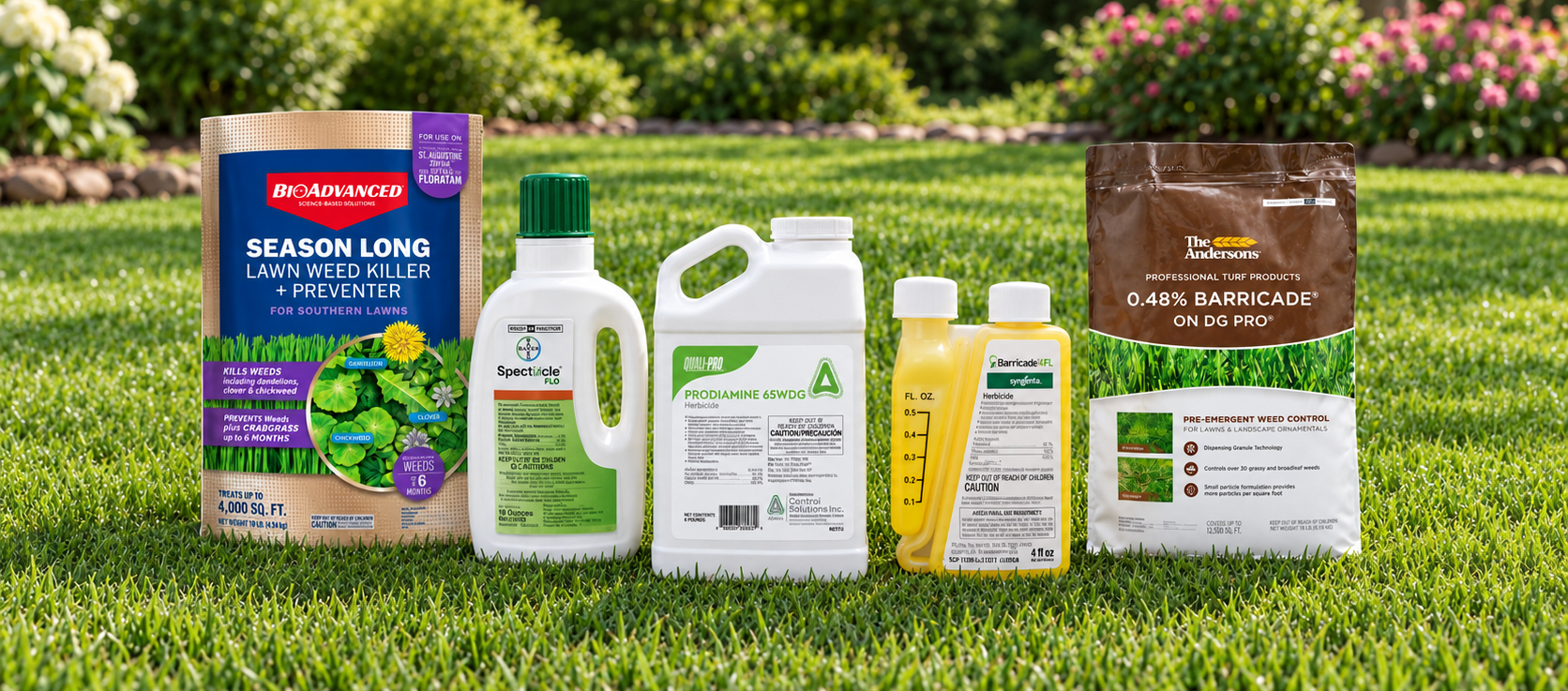
A properly timed pre-emergent herbicide is the foundation of the program. Prodiamine, dithiopyr, and other pre-emergent active ingredients labeled for Bermuda can prevent most crabgrass from ever becoming an established plant.
That's important because our post-emergent toolbox isn't as forgiving as it once was. Quinclorac is one of the primary options available for emerged crabgrass in Bermuda, but once crabgrass gets big and mature, control becomes more difficult.
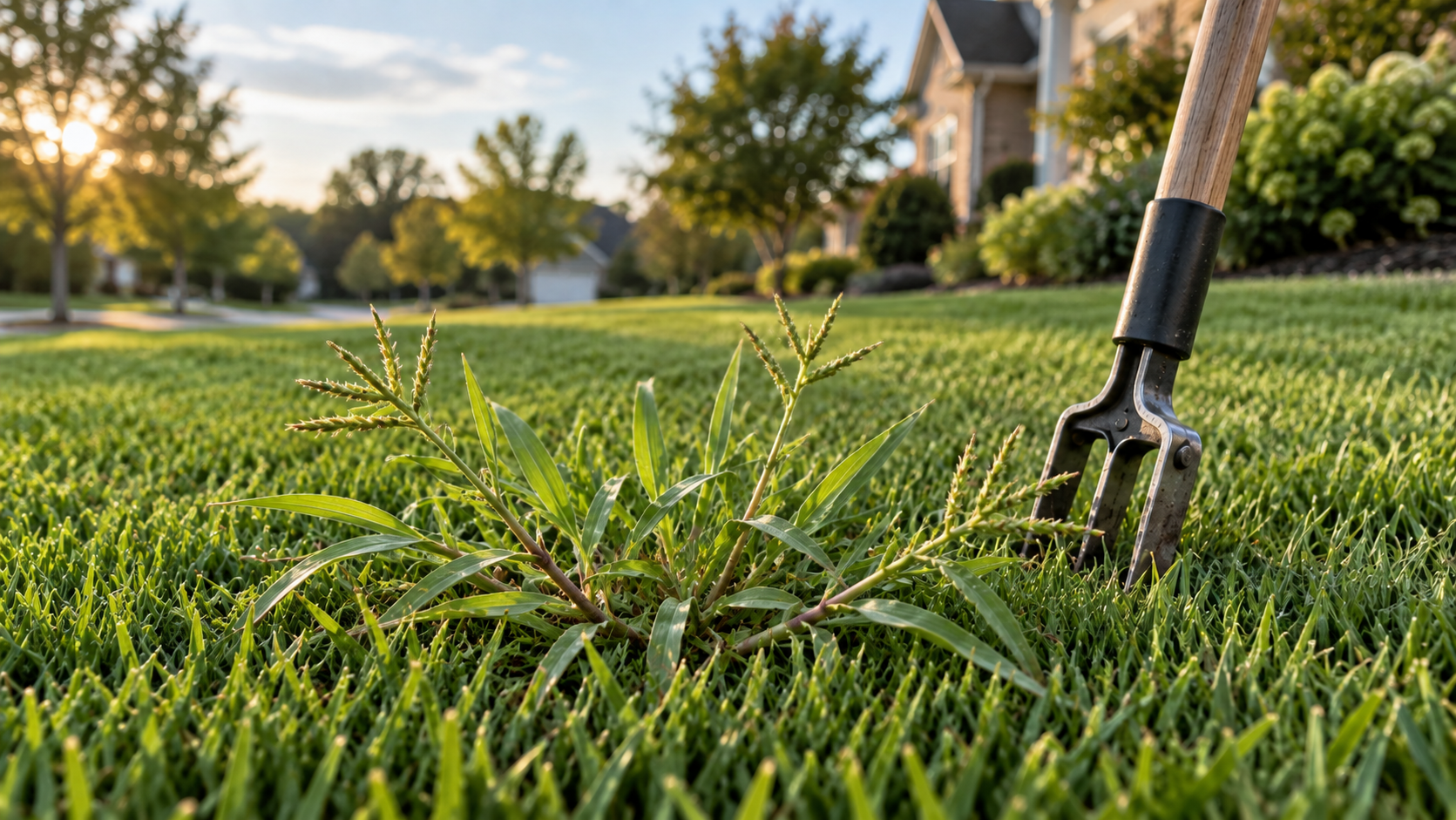
For isolated escapes, I'm also a big fan of the simple solution: pull the entire plant. A tool like Grandpa's Weeder makes that surprisingly easy.
The big idea is this:
Prevent 95% of the problem, then deal with the handful that escape.
Crabgrass is a lot easier to prevent than it is to kill
Crabgrass is a summer annual grass. Plants emerge from seed as conditions warm, grow aggressively through summer, produce seed, and eventually die as the season ends.
That life cycle gives us an opportunity.
Instead of waiting for a mature crabgrass plant and trying to selectively kill one grass growing inside another grass, we can intercept the weed around germination with a pre-emergent herbicide.
That's a much better fight.
Crabgrass germination is commonly associated with soil temperatures reaching roughly 55°F to 58°F near the surface for several consecutive days, although local conditions affect exactly when germination begins.
That doesn't mean I want to wait until I see 55°F and then start shopping for pre-emergent.
I want the herbicide down, properly activated according to its label, and ready before significant germination begins.
For Bermuda lawns, common pre-emergent active ingredients include:
Active ingredient
Crabgrass prevention
Important distinction
Prodiamine
Yes
Long-residual pre-emergent option
Dithiopyr
Yes
Also has some early post-emergent crabgrass activity
Pendimethalin
Yes
Another established pre-emergent option
Benefin combinations
Yes
Available in various lawn products
Texas A&M specifically lists prodiamine, dithiopyr, and pendimethalin among pre-emergent options for grassy weeds in Bermuda lawns. Dithiopyr has an interesting advantage if you're slightly late: it can control crabgrass shortly after germination, although that shouldn't become an excuse to intentionally miss the pre-emergent window.
PRO TIP
Don't manage spring pre-emergent entirely by a date on the calendar. Watch local soil temperatures and weather conditions. Spring arrives at a different time in Dallas than Atlanta, and certainly at a different time than Pennsylvania.
And remember that most pre-emergents need irrigation or rainfall to move the herbicide where it needs to be. Follow the specific product label for application and activation instructions.
Once crabgrass is up, the options aren't nearly as exciting
This is where homeowners can get frustrated.
Walk through a big-box lawn-care aisle and you'll see plenty of bottles with some version of "Crabgrass Killer" written on the front.
That doesn't necessarily mean the product is useless.
It does mean I want to turn the bottle around and figure out what active ingredient I'm actually buying.
For Bermuda, quinclorac is one of the important selective post-emergent options. Oklahoma State specifically lists quinclorac as a post-emergent crabgrass option used in place of MSMA, and UGA includes quinclorac among herbicides that may be used for escaped grassy weeds in Bermuda.
Commercial products such as Drive XLR8 use quinclorac, and quinclorac also appears in homeowner combination products alongside broadleaf herbicides.
There is a catch.
Post-emergent crabgrass control generally gets more challenging as the plant matures. A little crabgrass plant with only a few leaves is a very different target from the monster that has been growing beside the driveway for two months.
That's one reason post-emergent products sometimes leave homeowners disappointed. The bottle may say crabgrass. The active ingredient may legitimately control crabgrass. But weed maturity, environmental stress, application technique, adjuvant requirements, repeat-treatment provisions, and the specific label all matter.
With Drive XLR8, for example, the current label calls for applications to actively growing weeds and specifies methylated seed oil for consistent weed control. It also warns that stressed weeds and turf can affect results and injury potential.
WATCH OUT
Don't assume every product containing quinclorac has identical rates, surfactant requirements, Bermuda tolerance, temperature restrictions, or repeat-application instructions. Read the label for the exact product you own. The label—not somebody's lawn forum recipe—is the application instruction.
MSMA used to change this conversation
If you've been around Bermuda lawns for a while, you've probably heard somebody say:
"Just use MSMA."
There is some history behind that advice.
MSMA—monosodium methanearsonate—is an organic arsenical herbicide that was used for controlling troublesome grasses and broadleaf weeds. Older turf-management recommendations included MSMA for post-emergent crabgrass control, and it developed a reputation among warm-season turf enthusiasts as a valuable tool for grassy weeds.
But the regulatory situation changed substantially.
In 2009, EPA canceled MSMA uses on residential lawns, parks, and athletic fields, along with several other uses. EPA explains that organic arsenicals such as MSMA can convert over time in soil to inorganic arsenic, which is more toxic and can potentially contaminate drinking water through runoff.
MSMA wasn't completely eliminated.
As of EPA's July 2026 update, MSMA remains approved for certain uses on golf courses, sod farms, and highway rights-of-way, subject to significant restrictions. Golf-course use, for example, is generally restricted to spot treatments of no more than 100 square feet per spot and no more than 25% of total golf-course acreage annually, with a broadcast exception for newly constructed courses. Current EPA MSMA registrations likewise list golf-course turf, sod farms, highway rights-of-way, and cotton—not residential lawns.
So this isn't really a story about a great product simply disappearing from a store shelf.
Residential lawn use is no longer a legal labeled use.
And for Bermuda homeowners, that matters because one of the historically familiar post-emergent grassy-weed tools is no longer part of the residential toolbox.
MY TAKE
This is one of the reasons I think crabgrass prevention matters even more now. You can spend a lot of time trying to find a post-emergent solution that behaves like the grassy-weed herbicides people remember using years ago.
I'd rather not put myself in that position.
If I can stop crabgrass at germination, I don't need a miracle product in July.
Sometimes the best post-emergent herbicide isn't an herbicide
Here's where my strategy gets decidedly less sophisticated.
I pull it.
If I've done a good job with pre-emergent and there are three or four crabgrass plants scattered across the lawn, I'm not necessarily getting the sprayer out and treating a bunch of Bermuda just to eliminate four plants.
I've had good results using Grandpa's Weeder for this kind of post-emergent removal.
You center the tool over the plant, push it into the soil, use the leverage of the tool, and remove the plant mechanically. I'm after the crown and root system rather than just ripping off the foliage.
Penn State actually recommends essentially the same strategy for light crabgrass infestations: individual plants can simply be hand-pulled or removed with a handheld weeding tool.
There's also something satisfying about pulling a giant crabgrass plant out intact.
The downside is obvious. Mechanical removal isn't realistic if you've got 500 crabgrass plants.
But that's exactly the point.
Mechanical removal works beautifully as cleanup. It isn't a replacement for prevention in a heavily infested lawn.
You'll also leave a divot when removing a substantial plant. In actively growing Bermuda, I can live with that tradeoff because Bermuda's stolons and rhizomes give it an excellent ability to spread back into small openings when growing conditions and management are good.
The real crabgrass program starts before you can see crabgrass
I think homeowners sometimes approach weed control backwards.
We see weed. We buy weed killer.
For crabgrass, I want to move the decision several months earlier.
My primary control is the pre-emergent barrier. Post-emergent herbicide is the backup. Mechanical removal is cleanup.
That also means I need to think about why crabgrass keeps finding places to establish.
Crabgrass loves opportunity. Thin areas, disturbed soil, edges along hot pavement, weak turf, and openings in the canopy give seedlings room to establish.
A dense Bermuda lawn isn't a substitute for herbicide when you have serious crabgrass pressure, but good Bermuda management is absolutely part of the long-term weed-control program.
There's one other tradeoff that matters specifically with Bermuda.
Pre-emergent herbicides that interfere with seedling or root development can also complicate Bermuda seeding, sprigging, plugging, or major renovation plans. Product labels contain establishment and reseeding restrictions for a reason.
So I don't blindly apply pre-emergent because "it's February."
I ask what I'm trying to accomplish with that lawn during the upcoming growing season.
WATCH OUT
If you're planning to seed Bermuda or do significant establishment work, check the pre-emergent label before application. A herbicide designed to prevent grassy weed seedlings from establishing can also interfere with the grass you're intentionally trying to establish.
How I'd attack crabgrass in a Bermuda lawn
If I have an established Bermuda lawn with a history of crabgrass, I'm building the program around prevention.
If I catch a few young plants, a properly labeled quinclorac product becomes an option. I follow that exact product's label rather than treating "quinclorac" as a universal mixing recipe.
If I find a handful of established plants, I'm perfectly happy walking around with Grandpa's Weeder and pulling them.
If the lawn is covered in mature crabgrass, however, I'm thinking beyond the immediate problem.
I'll still use legal post-emergent options where they make sense, but I'm already planning how I'm going to prevent the next generation.
A mature crabgrass infestation didn't start in July.
It started when the seedlings were allowed to emerge in spring.
That's the shift in thinking that makes crabgrass management considerably easier.
MY PROCESS
- Identify the weed first. Make sure I'm actually dealing with crabgrass and not dallisgrass, goosegrass, or another grassy weed.
- Watch spring soil temperatures. I want the pre-emergent applied before significant crabgrass germination.
- Choose a Bermuda-labeled pre-emergent. Prodiamine and dithiopyr are two of the first active ingredients I'd evaluate.
- Apply and activate it according to the label. Uniform coverage and proper watering matter.
- Scout the lawn anyway. No weed-control program is perfect.
- Deal with escapes while they're small. If I use quinclorac or another herbicide, I follow the exact product label.
- Mechanically remove isolated plants. This is where Grandpa's Weeder earns a spot in my garage.
- Learn from the escapes. If one area repeatedly gets crabgrass, I want to understand whether I'm dealing with application coverage, disturbed soil, thin Bermuda, irrigation patterns, or another management issue.