
QUICK ANSWER
Before I calculate a fertilizer rate or start dialing in irrigation, I want to know how much lawn I'm actually managing.
For fertilizer, that means square footage. Most turf fertilizer calculations are based on pounds of nutrient or product per 1,000 square feet. If you think you have 5,000 square feet when you actually have 3,800, every calculation after that starts with the wrong number.
The good news is that measuring a lawn doesn't have to be complicated. For simple areas, a tape measure and some basic geometry work perfectly well. For irregular lawns, I like breaking the turf into smaller sections and adding them together.
And one of the easiest options is sitting right on your computer: satellite imagery from Google Maps or Google Earth can be a great way to estimate your lawn's square footage from above.
Once I have that number, I write it down. That's the number I use when calculating fertilizer, treatments, seed or sod quantities, and other applications.
Square footage is one of the most useful numbers in lawn care
A lot of lawn-care instructions eventually come back to area.
You might see a fertilizer recommendation expressed as pounds of nitrogen per 1,000 square feet. A granular product might say the bag covers 5,000 square feet. A liquid product may give an application rate per 1,000 square feet.
Those instructions only work if you know how many square feet you're treating.
Texas A&M AgriLife's Bermuda management guidance actually makes measuring lawn area the first step in calculating an appropriate fertilizer application. From there, you combine the lawn area with your target nutrient rate and the fertilizer analysis.
Here's the simple way I think about it:
NUMBERS / COMPARISON
If your lawn is 5,000 sq. ft.:
0.50 lb nitrogen / 1,000 sq. ft.
× 5,000 sq. ft.
= 2.5 lb of actual nitrogen for the entire lawn
If the lawn is actually 4,000 sq. ft.:
0.50 lb nitrogen / 1,000 sq. ft.
× 4,000 sq. ft.
= 2.0 lb of actual nitrogen
Same target rate. Same fertilizer program.
But a 1,000-square-foot error changes the total nitrogen requirement by 25% in this example.
That's why I don't want to estimate my lawn size by looking out the window and thinking, Yeah, that seems like about 5,000 square feet.
Measure it once and you've got a number you can keep using.
Start with rectangles, then deal with the weird parts
If you've got a fairly rectangular lawn, measuring it is easy.
Measure the length. Measure the width. Multiply them.
Length × Width = Square Feet
A 40-foot-wide lawn that's 60 feet long is:
40 × 60 = 2,400 sq. ft.
The problem is that most lawns aren't one perfect rectangle. You've got the driveway cutting through one side, landscape beds along the house, a sidewalk, maybe a curved section around a tree.
Don't make the geometry harder than it needs to be.
Break the lawn into manageable sections.
For example:
- Front left: 1,200 sq. ft.
- Front right: 850 sq. ft.
- Side yard: 600 sq. ft.
- Backyard: 3,100 sq. ft.
Total turf area: 5,750 sq. ft.
For triangular sections, use:
Base × Height ÷ 2
For circles:
π × radius²
For curved and irregular areas, I usually care more about getting a good practical measurement than pretending I know the area to the nearest square foot. Divide the area into smaller rectangles and triangles, estimate the odd edges reasonably, and add everything together.
PRO TIP
Keep the square footage of individual lawn sections in addition to the total. That becomes really useful if you ever fertilize the front and back differently, calibrate a spreader in one area, or have separate irrigation zones.
Google Maps or Google Earth can make this a whole lot easier
This is one of my favorite ways to measure a lawn, especially when the property has a bunch of irregular sections.
Pull up your property using satellite imagery. From above, you can see the driveway, sidewalks, house, landscape beds, fence lines, and most of the actual turf boundaries.
On a computer, Google Maps has a Measure distance tool that lets you place multiple points around a boundary. Depending on the current interface, closing that boundary may also provide the enclosed area. Google Earth is even more purpose-built for this: its measurement tool can create a polygon and report the enclosed area directly.
For Google Earth, the basic process is:
- Find your property.
- Switch to a clear top-down satellite view.
- Open the measurement tool.
- Place points around the perimeter of the turf.
- Close the shape.
- Read the calculated area and select square feet as the unit.
Repeat that for separate front, side, and back lawn sections and add them together.
This is especially handy when your lawn isn't shaped like something that came out of a geometry textbook.
WATCH OUT
Satellite measurements are still estimates. Google notes that its Earth measurements may not be 100% accurate and aren't a substitute for survey-grade measurements. Trees, shadows, outdated imagery, roof overhangs, slopes, and fuzzy turf boundaries can all introduce some error.
For fertilizer planning, though, I would much rather have a carefully traced satellite estimate than a completely guessed lawn size.
Measuring water is different from measuring fertilizer
Here's an important distinction.
Knowing that you have a 5,000-square-foot lawn doesn't automatically tell you to run your irrigation for 20 minutes.
Sprinklers don't all apply water at the same rate.
Water pressure, sprinkler type, nozzle, spacing, coverage, and system design all affect how much water reaches the turf. That's why irrigation recommendations are much more useful when you think in inches of water rather than minutes of runtime.
Oklahoma State gives a good illustration of just how much water an inch actually represents. One inch of water over an acre is about 27,154 gallons. Scale that down to a 5,000-square-foot lawn and one inch is roughly 3,117 gallons.
You don't need to stand at the meter trying to count 3,117 gallons, though.
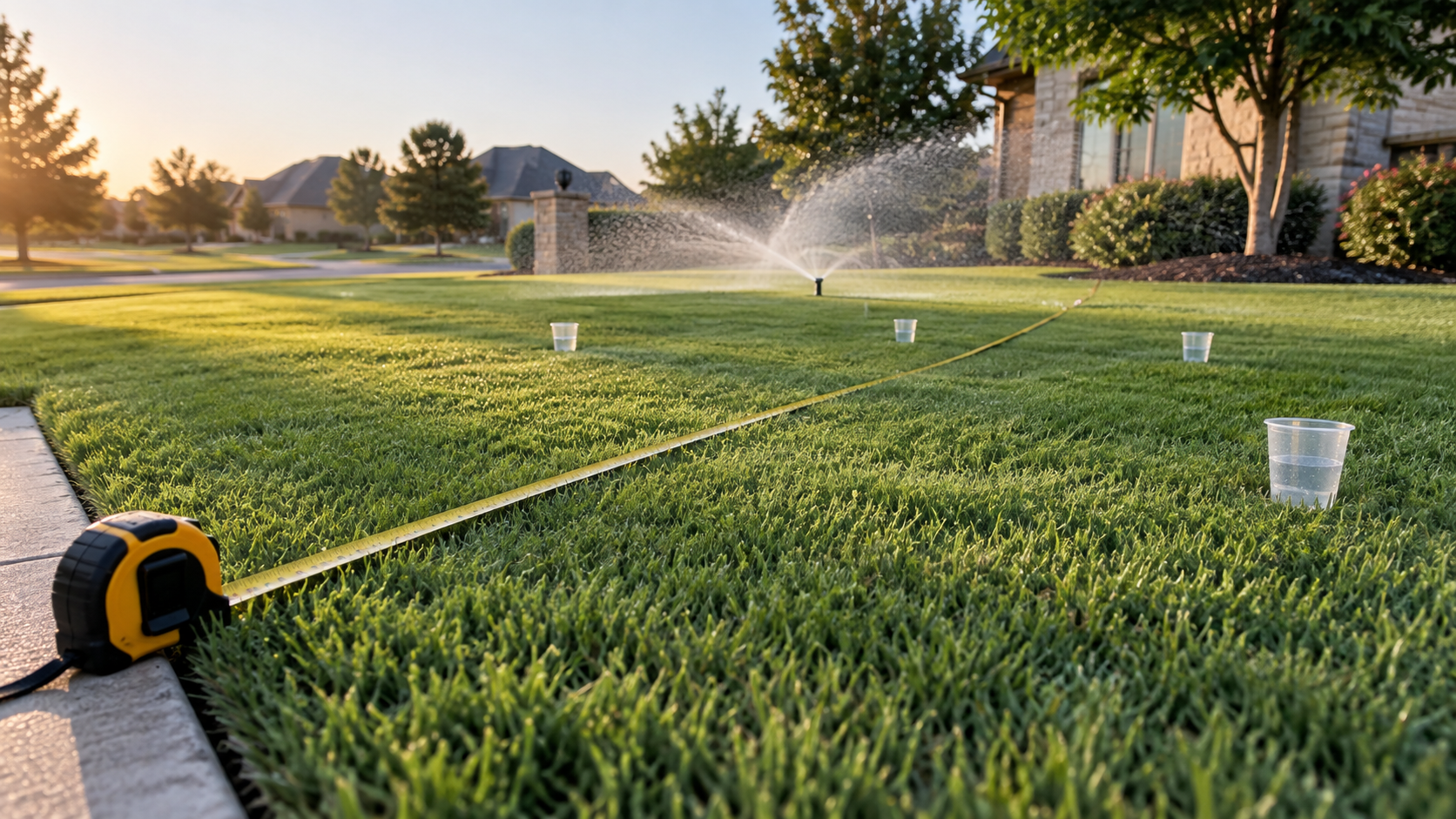
Use catch cups.
Texas A&M and Oklahoma State both recommend irrigation audits using multiple containers distributed through the sprinkler pattern. Run the zone for a known amount of time, measure the water collected in each container, and average those measurements.
For example, if your cups average:
0.25 inch in 15 minutes
then the approximate precipitation rate is:
1 inch per hour
Now you've converted an arbitrary controller setting into something meaningful.
Instead of saying, "I water for 20 minutes," you can say, "This zone applies about one-third of an inch in 20 minutes."
That's a much more useful number.
The catch cups tell you something else that's just as important
Average sprinkler output is only half the story.
Look at the individual cups.
Imagine you run a zone for 15 minutes and collect:
0.26"
0.25"
0.24"
0.27"
0.13"
0.25"
The average gives you an application rate, but that 0.13-inch cup should immediately get your attention.
Something in that part of the lawn isn't getting the same amount of water.
Maybe there's poor sprinkler overlap. Maybe a head is blocked. Maybe a nozzle is worn, misaligned, or different from the others.
This is why an irrigation audit is so useful. You're not only determining how long to water. You're seeing how evenly the system waters.
That can explain a lot of lawn problems that otherwise get blamed on fertilizer, soil, disease, or the grass itself.
PRO TIP
Run a catch-can test by irrigation zone rather than assuming every zone has the same precipitation rate. Different sprinkler heads, nozzles, spacing, and pressure can produce very different output.
Once you know these numbers, stop guessing
You don't need survey equipment and a spreadsheet with 47 tabs to do this.
I want a handful of useful numbers.
MY PROCESS
- Map the lawn. Separate the front, back, and side turf areas into logical sections.
- Measure the square footage. Use a tape measure for easy shapes or satellite imagery for irregular areas.
- Subtract areas that aren't turf. Don't count the house, driveway, patio, landscape beds, pool, or other areas you won't treat.
- Record each section separately. Keep the individual measurements as well as the total lawn area.
- Use the total when calculating fertilizer. Convert the product analysis and target nutrient rate into the amount required for your actual square footage.
- Audit irrigation separately. Put multiple catch cups throughout each irrigation zone and run the system for a known period.
- Calculate the precipitation rate. Average the collected depth and convert that into inches per hour or the runtime needed for your target application.
- Keep the numbers. Unless the landscape changes, you shouldn't have to measure the whole property again every time you fertilize.