
QUICK ANSWER
I don't automatically dethatch Bermuda just because I can see brown material underneath the green. Bermuda naturally produces stolons, rhizomes, stems, and roots, so some thatch is part of maintaining a dense, spreading turfgrass. A moderate layer can actually be beneficial. The problem is when that layer becomes excessive.
My first move is to actually look at the soil profile instead of diagnosing thatch from the top of the lawn.
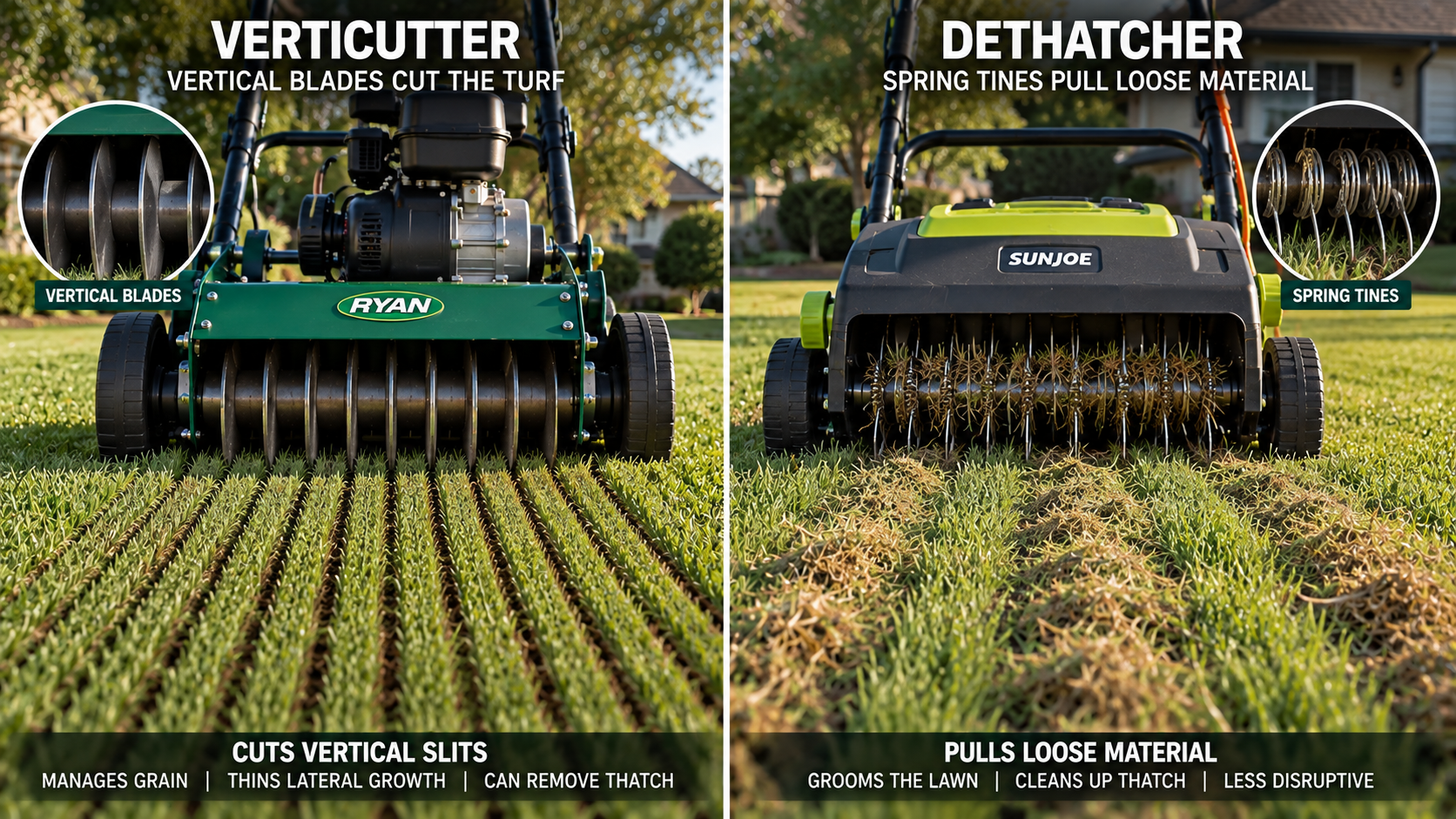
If I'm primarily cleaning up loose material and grooming the canopy, an economical electric dethatcher can do a surprisingly good job. That's what I use, and for a homeowner lawn I think it's a pretty useful tool.
Verticutting is different. Vertical blades actually slice through horizontal Bermuda growth and can penetrate the thatch layer. That makes it useful for managing grain, excessive lateral growth, and real thatch—but it can also be considerably more disruptive.
The more aggressive the job, the more important the timing becomes. I want Bermuda actively growing and capable of recovering before I really start cutting it up.
First, make sure you're actually looking at thatch
Thatch is always being produced in a Bermuda lawn.
That's not automatically a bad thing.
Bermuda spreads using aboveground stolons and underground rhizomes. Roots, stems, rhizomes, and stolons eventually die and decompose, while the plant continually produces new ones. Thatch develops when that plant material accumulates between the green vegetation and the soil surface faster than microorganisms can break it down.
And this is where I think homeowners can get a little too aggressive.
Seeing brown material after a spring scalp doesn't necessarily mean you have a serious thatch problem. Grass clippings aren't automatically thatch, either. Texas A&M describes roughly 1/4 to 1/2 inch of thatch as potentially beneficial, helping cushion traffic, reduce soil compaction at the surface, protect growing points from temperature extremes, and reduce moisture loss.
Once that layer gets beyond roughly 1/2 inch, the conversation changes. Excessive thatch can interfere with water, nutrient, and air movement into the underlying soil, contribute to shallower rooting, increase mowing problems, and create conditions favorable to some insects and diseases.
So instead of looking down and saying, "There's brown stuff—I need to dethatch," cut out a small plug.
Look at the profile from the side.
NUMBERS / COMPARISON
What you find
What it probably means
Less than about 1/4 inch
Very little thatch; don't create a problem trying to solve one
About 1/4–1/2 inch
Normal to moderate layer
More than about 1/2 inch
Excessive thatch is becoming a legitimate concern
Thick, spongy lawn with poor infiltration
Stronger reason to investigate and consider corrective cultivation
That little plug tells me a lot more than staring at the surface.
Dethatching and verticutting aren't exactly the same job
The terminology gets muddy because manufacturers, rental companies, homeowners, and even turf publications sometimes use dethatching, power raking, and vertical mowing somewhat interchangeably.
I think it's more useful to think about how aggressively the machine is interacting with the Bermuda.
The inexpensive electric dethatchers homeowners can buy are a good example. Mine plugs into an extension cord, isn't particularly exotic, and works pretty well for grooming the turf. Spring-tine-style machines can comb through the canopy and pull up a surprising amount of loose material.
That's useful—but pulling debris out of the canopy isn't necessarily the same thing as cutting through a measured 3/4-inch thatch layer.
A true vertical mower uses vertically oriented blades. Set shallow, those blades can work primarily in the canopy. Set deeper, they can slice through horizontal stems, penetrate thatch, and reach toward the soil surface. The deeper you go, the more aggressive the operation becomes. USGA guidance makes this same distinction: shallow vertical mowing can provide surface grooming, while deeper penetration becomes a much more aggressive dethatching operation.
PRO TIP
Before buying or renting anything, look underneath the machine. Spring tines, scarifier blades, and true vertical-mower blades don't interact with the turf the same way. The name printed on the box tells me less than what is actually spinning underneath it.
For a home lawn that mainly needs cleanup and grooming, I like starting with the least disruptive tool that accomplishes the job.
Why golf courses verticut Bermuda in the first place
This is where verticutting gets more interesting than simply "removing dead grass."
Bermuda wants to grow laterally.
Its stolons spread across the surface, root at nodes, and produce new shoots. That's one reason Bermuda can create such a dense lawn, but aggressive horizontal growth can also produce grain and a puffy, laid-over canopy. On intensively maintained Bermuda, those stems can start stacking over one another.
Vertical mowing physically cuts through some of that horizontal growth.
When performed at an appropriate shallow depth, it can stand up and thin laid-over growth, reduce grain, and encourage a more upright, uniform turf canopy. Frequent mowing also encourages lateral growth and turf density, so the combination of mowing and controlled cultivation is part of why highly managed Bermuda can become so tight and uniform.
But there's an important distinction here:
Verticutting isn't making the soil denser.
If anything, dense soil usually means we're talking about compaction, and verticutting doesn't penetrate deeply enough to meaningfully correct that problem. Core aeration is the tool for removing plugs, creating pore space, and improving air and water movement into compacted soil.
What verticutting can help create is a denser, more upright turf canopy by managing excessive horizontal growth.
That's a golf-course idea that translates pretty well to a dialed-in home Bermuda lawn—as long as we don't assume the golf course's cultivation intensity automatically belongs in the front yard.
Spring cleanup is a great time to see what you're dealing with
I already like removing the dormant material during my spring scalp, and I think that's a great starting point for evaluating what is happening underneath the canopy.
Scalping removes a lot of last year's dormant top growth. Once that material is gone, I can actually see the stems, runners, soil surface, and whatever organic layer has accumulated instead of guessing through a thick canopy.
But I separate spring cleanup from aggressive thatch removal.
Extension recommendations vary somewhat on exact timing. Oklahoma State recommends dethatching warm-season lawns before spring green-up, while Clemson recommends addressing problematic Bermuda thatch around spring green-up and warns about frost timing. Other turf guidance emphasizes active growth when aggressive vertical mowing is going to cause significant injury because the plant needs the growing conditions to recover.
For my approach, that makes recovery capacity the deciding factor.
If I'm lightly grooming during spring cleanup, that's one thing. If I'm going to aggressively slice into stolons and remove substantial material, I'd rather see the Bermuda awake, growing, and heading into favorable warm-season conditions than beat up a lawn that is barely capable of repairing itself.
MY TAKE
My electric dethatcher fits really well into this spring-cleanup mindset. It's economical, plugs into an extension cord, and does a pretty good job grooming the Bermuda and pulling loose material out of the canopy. I don't automatically treat everything it pulls out as proof that I had excessive thatch. Sometimes I'm simply cleaning up the lawn. If I suspected a real thatch problem, I'd cut a plug and measure before deciding how aggressive I needed to get.
The biggest mistake is being more aggressive than the problem requires
Bermuda is tough.
That's not the same thing as indestructible.
A machine that slices through stolons, removes leaf tissue, disturbs roots, and pulls out organic material is intentionally injuring the lawn. We're counting on Bermuda's aggressive warm-season growth to repair that injury.
So there needs to be a reason for doing it.
If the problem is loose dormant material sitting in the canopy, I don't need to perform surgery. If the lawn has a measurable layer of excessive thatch, that's different. If I'm maintaining very low-cut Bermuda and fighting grain or excessive horizontal growth, shallow verticutting may have a completely different purpose again.
WATCH OUT
Don't confuse thatch with soil compaction. If water infiltration and rooting are suffering because the actual soil is compacted, going deeper with a verticutter isn't the answer. That's where core aeration becomes the more appropriate tool.
I'd also be cautious about aggressive cultivation when the lawn is drought-stressed, struggling, or approaching dormancy. USGA guidance specifically warns against aggressive late-season dethatching that reduces Bermuda's opportunity to recover and store carbohydrates before winter.
Sometimes the best thing you can do with a turf tool is leave it sitting in the garage.
Here's how I'd choose between dethatching and verticutting
I start with the problem—not the machine.
If I just scalped the lawn and have loose dormant material everywhere, I'm probably looking for cleanup and grooming. That's where my electric dethatcher earns its keep.
If the lawn feels spongy, scalps easily, takes water poorly, and a soil plug shows more than about 1/2 inch of actual thatch, now I have evidence that more aggressive thatch management may be justified.
If I'm maintaining low-cut, highly managed Bermuda and my problem is grain, excessive stolons, or a puffy horizontal canopy, I'm thinking more about verticutting as a cultivation and canopy-management tool.
And if the problem exists several inches below the surface because the soil is compacted?
Neither one is my first choice. I'm looking at core aeration.
MY PROCESS
- Scalp and clean up appropriately in spring. Removing dormant top growth makes it much easier to see what's happening at the surface.
- Cut a turf plug. I want to see the green canopy, thatch layer, and actual soil separately.
- Measure the thatch. I don't diagnose excessive thatch by the amount of brown material a machine can pull out.
- Identify the real goal. Cleanup, true thatch removal, grain management, and soil compaction are four different problems.
- Start with the least disruptive method. For routine homeowner grooming, my electric dethatcher can accomplish a lot without immediately jumping to aggressive vertical mowing.
- Time aggressive work around recovery. The harder I'm going to hit the lawn, the more I want actively growing Bermuda and good conditions ahead of it.
- Clean up the debris. Once material is pulled or cut loose, get it off the turf so the Bermuda underneath can get back to growing.
KEY TAKEAWAYS
- Thatch is a normal part of Bermuda growth; excessive thatch is the problem.
- A roughly 1/4- to 1/2-inch layer can be beneficial, while more than about 1/2 inch deserves closer attention.
- Diagnose thatch by cutting and measuring a turf plug, not by how much brown material you see after scalping.
- An electric dethatcher can be a very useful homeowner tool for grooming and removing loose material.
- Verticutting uses vertical blades to manage horizontal growth and, when set deeper, can remove true thatch.
- Verticutting can help create a tighter turf canopy. It does not densify compacted soil—that's a core-aeration problem.
- The more aggressive the cultivation, the more important it is to give Bermuda warm, active growing conditions in which to recover.