QUICK ANSWER
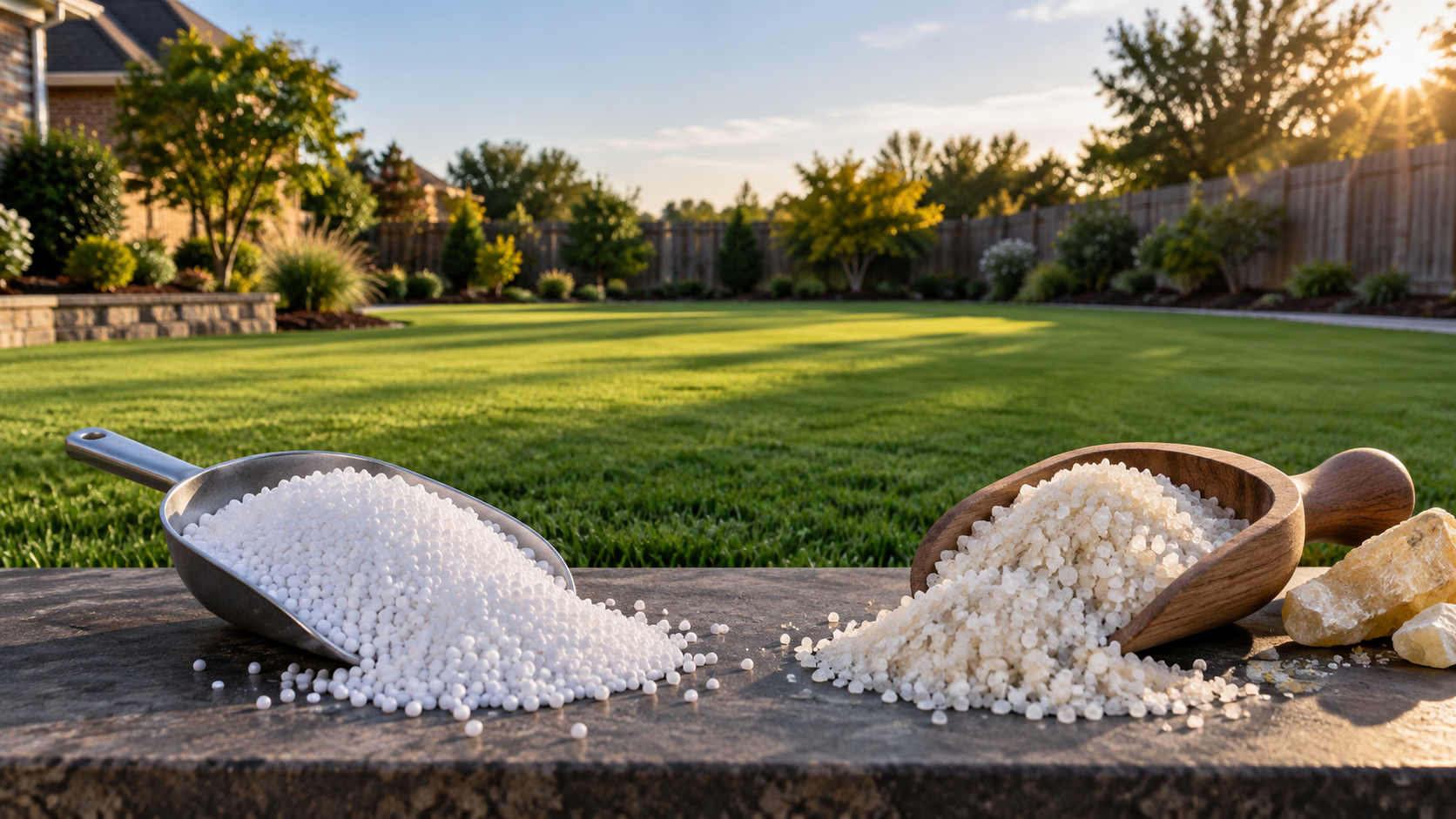
I don't really look at ammonium sulfate and urea as competing fertilizers. They're two quick-release nitrogen tools that can make sense for different reasons.
Urea is usually 46-0-0, meaning 46% of the bag is nitrogen. Ammonium sulfate is generally 21-0-0 and also supplies roughly 24% sulfur. So if I'm simply trying to deliver nitrogen efficiently, urea moves a lot more nitrogen with a lot less product.
Where ammonium sulfate gets interesting is when sulfur fits what I'm trying to accomplish. If I'm knowingly managing higher-pH soil, choosing ammonium sulfate for some nitrogen applications can make more sense than blindly using urea every time.
But there's an important distinction: ammonium sulfate can contribute to gradual acidification. It is not an end-all-be-all cure for alkaline soil.
For granular applications, both are soluble fertilizers with burn potential. Get the rate right, distribute them evenly, and water them into the lawn.
Start with what the numbers on the bag actually mean
The biggest mistake in comparing fertilizers is comparing pounds of product instead of pounds of actual nitrogen.
Urea is typically 46% nitrogen.
Ammonium sulfate is typically 21% nitrogen and about 24% sulfur. Penn State classifies both as soluble, quick-release nitrogen sources.
That difference in concentration is massive.
If I want to apply 0.50 pound of actual nitrogen per 1,000 square feet, the math looks like this:
NUMBERS / COMPARISON
Urea
Ammonium sulfate
Typical analysis
46-0-0
21-0-0
Sulfur
0%
~24%
Product for 0.50 lb N/1,000
1.09 lb
2.38 lb
Product in ounces
17.4 oz
38.1 oz
Sulfur supplied at that AS rate
—
0.57 lb S/1,000
The calculations are simple:
Urea:
0.50 ÷ 0.46 = 1.09 lb product
Ammonium sulfate:
0.50 ÷ 0.21 = 2.38 lb product
That's why bag price alone doesn't tell me which fertilizer is cheaper.
A $20 bag of ammonium sulfate isn't necessarily less expensive nitrogen than a more expensive bag of urea. I'm getting more than twice as much product to the lawn to deliver the same nitrogen rate.
PRO TIP
Compare fertilizer prices using cost per pound of actual nitrogen:
Bag price ÷ (bag weight × nitrogen percentage)
That puts both products on equal footing.
So why would I intentionally use more ammonium sulfate?
Sulfur.
Ammonium sulfate supplies sulfate sulfur along with ammonium nitrogen. A typical product is around 24% sulfur.
If a soil test, tissue information, local conditions, or the way I'm intentionally building my fertility program gives me a reason to supply sulfur, ammonium sulfate lets me bring nitrogen and sulfur together in the same application.
There is also the soil-pH discussion.
Ammonium-based fertilizers are acid-forming over time as the ammonium nitrogen is converted in the soil. University of Georgia guidance specifically includes ammonium sulfate and urea among ammoniacal nitrogen sources that can contribute to gradual acidification where high pH is a concern.
But this is where lawn-care conversations can get carried away.
Putting ammonium sulfate on an alkaline lawn does not mean you're suddenly fixing the entire soil profile.
Colorado State gives a good example of how modest this effect can be. Their guidance notes that even a substantial ammonium sulfate application may only move soil pH slightly, and soils containing free lime can be extremely resistant to meaningful pH change.
So I think of ammonium sulfate this way:
I'm already buying nitrogen.
If I consciously have a reason to prefer an acid-forming nitrogen source and I also want sulfur, ammonium sulfate can be a smart tool selection.
That's a much more realistic claim than treating it like a bagged cure for high pH.
MY TAKE
This is the part that would push me toward ammonium sulfate instead of urea in certain applications. If I knowingly have higher pH and I'm going to apply nitrogen anyway, I like the idea of choosing the nitrogen source that also contributes sulfur and nudges the program in the direction I'm trying to go.
I just wouldn't expect that decision by itself to completely reshape an alkaline soil.
For spoon-feeding, I still reach for urea
Both ammonium sulfate and urea are water soluble enough to be used in liquid programs.
I personally choose urea for spoon-feeding, and that's where I've seen my best results. It dissolves well, it's extremely nitrogen-dense, and the math works nicely when I'm applying small amounts of actual nitrogen.
For example, a light 0.10 pound N per 1,000 square feet spoon-feed requires only:
0.10 ÷ 0.46 = 0.217 pound of urea
That's roughly 3.5 ounces of urea per 1,000 square feet.
To deliver the same nitrogen using ammonium sulfate:
0.10 ÷ 0.21 = 0.476 pound
That's roughly 7.6 ounces of ammonium sulfate per 1,000 square feet.
Ammonium sulfate can absolutely be dissolved and applied through liquid systems, but you're handling more than twice the fertilizer mass for the same nitrogen dose. Oregon State, for example, lists ammonium sulfate as a soluble fertilizer while also showing that concentration and water volume become more important as you're dissolving larger quantities.
That doesn't make ammonium sulfate bad.
It just means that when my objective is straightforward, measured nitrogen spoon-feeding, urea is the cleaner tool for how I like to operate.
Granular fertilizer is where application discipline really matters
These are not slow-release homeowner fertilizers that you casually throw around and hope for the best.
They're soluble nitrogen sources.
Penn State notes that quick-release fertilizers can injure turf more readily than slow-release nitrogen, especially when rates and environmental conditions work against you. Their salt-index table lists both urea and ammonium sulfate as materials with meaningful burn potential.
Ammonium sulfate deserves particular respect when I'm spreading it granularly.
High rates, hot weather, concentrated granules sitting against the foliage, poor spreader calibration, or inadequate irrigation can all move you toward injury. Penn State specifically recommends low ammonium sulfate rates followed by irrigation when burn is a concern.
There are finer and greens-grade ammonium sulfate products available, and I like the idea of the smaller particle size when I'm chasing uniform coverage. Smaller, more uniform particles can make it easier to distribute the product evenly rather than leaving a handful of larger granules concentrated in individual spots.
But particle size doesn't cancel the chemistry.
WATCH OUT
If I'm applying granular ammonium sulfate to turf, I want it watered in thoroughly. Don't rely on a finer grind as your protection against burn. Measure the product, calibrate the spreader, keep the application even, and irrigate it off the foliage and into the root zone.
The same general discipline applies to urea.
Urea also introduces another major concern: ammonia volatilization.
When surface-applied urea begins hydrolyzing and isn't moved into the soil, some nitrogen can escape as ammonia gas. Warm temperatures, high pH, thatch and prolonged surface exposure can all increase that risk. Irrigation or rainfall after application sharply improves the situation by getting the nitrogen away from the surface.
So even though I think about burn when applying granular ammonium sulfate, I don't give granular urea a free pass.
Both benefit from having an irrigation plan before the spreader ever comes out.
And yes, DEF fluid really is urea—but that doesn't make it my fertilizer choice
This one comes up because chemically the connection is real.
Diesel exhaust fluid is 32.5% technically pure urea in purified water. That's the standardized solution used in diesel selective catalytic reduction systems.
Since dry urea contains roughly 46% nitrogen, that means DEF works out to approximately:
32.5% × 46% = 14.95% nitrogen by solution weight
So yes, there's nitrogen sitting in that jug.
I've never personally used DEF on the lawn. I've heard of people doing it, but I don't think that's where I'd start when actual fertilizer-grade urea is available.
DEF is manufactured and certified for diesel emissions equipment, not with lawn-fertilizer application directions. That makes it an interesting chemistry conversation, but not something I'm going to turn into a recommended LawnFluencer application rate without fertilizer-specific labeling and agronomic guidance.
Regular urea gives me a known fertilizer analysis and a much cleaner path for calculating and applying nitrogen.
Sometimes the lawn-care rabbit hole is useful.
Sometimes it ends with realizing the boring bag of fertilizer was the easier answer.
Here's how I'd choose between them
If my main goal is efficient nitrogen, I lean toward urea.
It's 46% nitrogen, so I handle less product, the application math is easy, and it fits the spoon-feeding approach I already prefer.
If I'm applying nitrogen and deliberately want sulfur as part of the fertility program, ammonium sulfate becomes much more attractive.
If I'm managing a higher-pH situation, that can give ammonium sulfate another reason to make the rotation. I'm using an acid-forming nitrogen source rather than expecting a single fertilizer application to somehow remake the soil.
If I'm spreading either one granularly, irrigation capability matters to me.
And if I'm comparing cost, I'm never comparing bag price alone.
MY PROCESS
- Decide how much actual nitrogen per 1,000 square feet I want to apply.
- Calculate the product rate using either 46% N for urea or 21% N for ammonium sulfate.
- If considering ammonium sulfate, decide whether I intentionally want the accompanying sulfur.
- Compare products by cost per pound of nitrogen, not bag price.
- For granular applications, make sure irrigation is available before spreading.
- For spoon-feeding, I personally reach for urea because it fits my process and dissolves well.
- Track the lawn and soil over time instead of expecting one nitrogen-source decision to fix soil pH.
KEY TAKEAWAYS
- Urea contains about 46% nitrogen; ammonium sulfate contains about 21% nitrogen plus 24% sulfur.
- At the same nitrogen rate, you'll apply more than twice as much ammonium sulfate by weight.
- Ammonium sulfate can make sense when sulfur and gradual acidification fit the plan.
- Neither ammonium sulfate nor urea should be treated as a magic correction for strongly alkaline, highly buffered soil.
- Granular applications need accurate rates, uniform distribution, and dependable watering-in.
- I prefer urea for liquid spoon-feeding; ammonium sulfate is the tool I'd consider when I intentionally want sulfur along with nitrogen.