QUICK ANSWER
Bermuda grass turning brown doesn't automatically mean it's dying—and it definitely doesn't automatically mean you need a fungicide.
Bermuda is a warm-season perennial grass with excellent heat and drought tolerance. When conditions get rough, the visible leaves can decline while crowns, stolons, rhizomes, roots, and dormant buds remain capable of producing new growth when conditions improve. That's a big part of what makes Bermuda so resilient.
The trick is figuring out why the canopy is declining.
Summer heat combined with inadequate soil moisture can push Bermuda toward drought stress and eventually summer dormancy. Falling temperatures naturally trigger winter dormancy. Disease is different: you have a susceptible plant, a pathogen, and environmental conditions—often including extended moisture or leaf wetness—that allow infection to develop.
Those three situations can all produce brown grass.
The response shouldn't be the same.
Bermuda is built to survive more than its leaves suggest
One of the most useful things to understand about Bermuda is that the green leaf blade isn't the whole plant.
Bermuda spreads through stolons above the soil and rhizomes below it. It also has protected growing points and an extensive root system. Those structures give established Bermuda a pretty impressive ability to survive stress and rebuild its canopy when favorable growing conditions return.
That's why a brown lawn and a dead lawn are two very different things.
Under drought, Bermuda can reduce growth and eventually lose green color while living plant structures remain. Oklahoma State notes that the crown or base of drought-dormant Bermuda can remain alive and the grass can resume active growth after moisture returns.
Winter dormancy works differently, but the survival strategy is similar. Cold conditions kill or discolor exposed leaf tissue while protected buds on nodes, stolons, and rhizomes can remain dormant. Spring green-up comes from those surviving structures.
There isn't a useful universal answer to, "How many days can Bermuda survive without water?" Soil depth, root development, temperature, wind, humidity, mowing height, cultivar, previous management and the condition of the turf before the stress started all change the answer.
A deeply rooted established lawn in decent soil has a much larger survival buffer than Bermuda growing over a few inches of compacted soil in full Texas sun.
MY TAKE
This is why I wouldn't diagnose Bermuda from color alone. Brown is a symptom. I'm much more interested in the pattern, soil moisture, recent weather and whether I can find living stolons, crowns or rhizomes. Before I start throwing products at the lawn, I want to know whether the plant is protecting itself or actually being damaged.
Heat stress and drought stress aren't exactly the same thing
Bermuda loves heat. That's one of the reasons we grow it across the South.
So I wouldn't use something like 95°F or 100°F as a magic line where Bermuda suddenly develops "heat stress." A 100°F afternoon with adequate root-zone moisture can be a very different situation from several 100°F afternoons combined with dry soil, hot nights, wind and a shallow root system.
The homeowner-visible problem is often water stress occurring during extreme heat.
As soil moisture becomes limiting, you'll typically see the canopy lose some of that healthy, vibrant appearance. Turf may become dull or blue-gray, leaf blades can wilt or fold, and footprints or mower tracks may remain visible longer because the leaves aren't springing back normally.
If the shortage continues, Bermuda can turn brown and enter drought-induced dormancy.
That's a survival response—not permission to assume it can remain bone dry indefinitely.
Oklahoma State recommends occasional irrigation during prolonged dry periods because dormant turf still needs enough moisture to keep crowns and other living tissues alive. Extremely dry conditions can cause desiccation and actual plant death.
WATCH OUT
Don't respond to a stressed lawn by immediately hammering it with nitrogen. Fertilizer doesn't substitute for water. Trying to force additional shoot growth while the plant cannot support that growth can work against what the Bermuda is trying to do.
PRO TIP
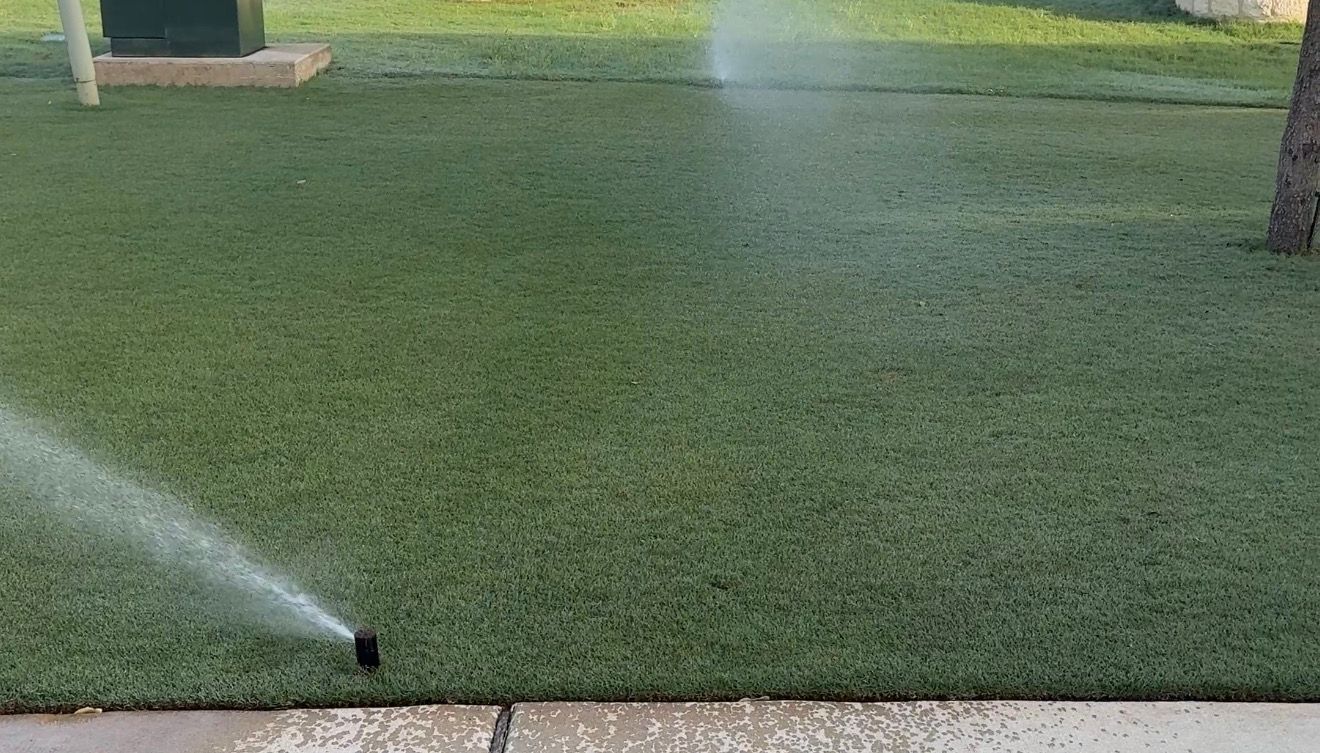
Before changing the irrigation controller, put a screwdriver or soil probe into several locations and actually inspect the soil. Better yet, perform a catch-can irrigation audit. A dry-looking canopy doesn't tell you whether the problem is insufficient irrigation time, poor sprinkler distribution, runoff, hydrophobic soil, shallow soil or simply one hot area drying faster than the rest.
Winter dormancy has a much clearer temperature signal
Cold dormancy is where temperature becomes a much more useful diagnostic tool.
Bermuda begins losing color as temperatures and day length decline. Oklahoma State reports loss of dark-green color as soil temperatures fall below roughly 55°F, while another OSU educational resource describes dormancy around soil temperatures below approximately 50°F.
Those aren't contradictory enough that I'd obsess over a five-degree difference.
The important point is that dormancy is a gradual physiological transition—not an on/off thermostat.
Green-up works the same way in reverse. Oklahoma State reports that Bermuda generally begins spring green-up when nighttime air temperatures remain consistently above about 60°F or 4-inch soil temperatures reach approximately 65°F. Cultivar and winter injury can shift how quickly that happens.
A practical temperature framework
Condition
Useful temperature clue
What it means
Active warm-season growth
Warm soil and sustained warm weather
Bermuda has the environmental conditions to grow aggressively if water, sunlight and nutrition are adequate
Fall color loss
Soil temperatures approaching/below ~55°F
Growth slows and Bermuda begins transitioning toward winter dormancy
Winter dormancy
Commonly associated with soil temperatures around/below ~50°F
Brown top growth can be completely normal
Spring green-up
Nights consistently >~60°F or 4-inch soil ~65°F
Surviving buds and growing points can begin producing active growth
The mistake is expecting one warm February afternoon to wake up the lawn.
Bermuda responds to sustained conditions. If soil is still cold and nights keep dropping, a couple of 75°F afternoons don't mean the lawn should suddenly be growing like it does in June.
And if the lawn doesn't return uniformly when sustained growing conditions arrive, that's when I start asking a different question.
Is it merely late coming out of dormancy—or did something happen to it?
Disease usually leaves clues that weather stress doesn't
Disease diagnosis gets tricky because fungus can also produce yellow, tan or brown turf.
But disease tends to give us patterns.
Spring dead spot is a great example. It affects Bermuda and becomes obvious as surrounding turf greens up while circular or arc-shaped areas remain bleached and dead. Oklahoma State notes that infected crowns, roots, stolons and rhizomes may be dark and rotted.
The frustrating part is that what you see in spring reflects disease activity that can begin the previous fall. In Oklahoma, spring dead spot infection begins around 70°F soil temperatures in fall and can continue while soil temperatures remain above approximately 50°F.
So spraying the brown circle after it appears in spring isn't necessarily solving the problem at the correct point in the disease cycle.
Dollar spot gives us another clue. It can produce relatively small straw-colored areas that merge under severe pressure, and individual leaves may develop tan lesions with darker reddish-brown margins. High humidity, moderate temperatures and extended leaf wetness favor the disease. Research cited by NC State indicates the pathogen can require roughly 10–12 continuous hours of leaf wetness.
Large patch is associated more strongly with cooler, wet conditions in warm-season turf and commonly appears around spring or fall rather than during the hottest part of a normal Bermuda summer.
That's why "brown grass = fungus" isn't good enough.
Start with the pattern
Heat/drought stress often follows irrigation coverage, shallow soil, slopes, reflected heat or areas that dry faster.
Normal dormancy generally develops broadly with seasonal temperature changes.
Disease often produces recurring circles, arcs, spots, lesions, expanding margins or other patterns that don't line up neatly with sprinkler coverage.
Pattern isn't a laboratory diagnosis, but it's one of the best places to start.
Moisture can save stressed Bermuda and increase disease pressure
This is where lawn care gets interesting.
Water is exactly what drought-stressed Bermuda needs.
Water sitting on leaves for long periods can also help create an environment favorable to certain fungal diseases.
Those statements aren't contradictory.
The root zone and the leaf surface are two different environments.
The goal is to put enough water into the soil to support the plant without unnecessarily extending the amount of time the foliage stays wet.
That's one reason early-morning irrigation makes sense. You're supplying needed soil moisture around a time when the grass may already be wet from dew, rather than starting another long leaf-wetness period late in the evening.
Heavy dew deserves more attention than most homeowners give it.
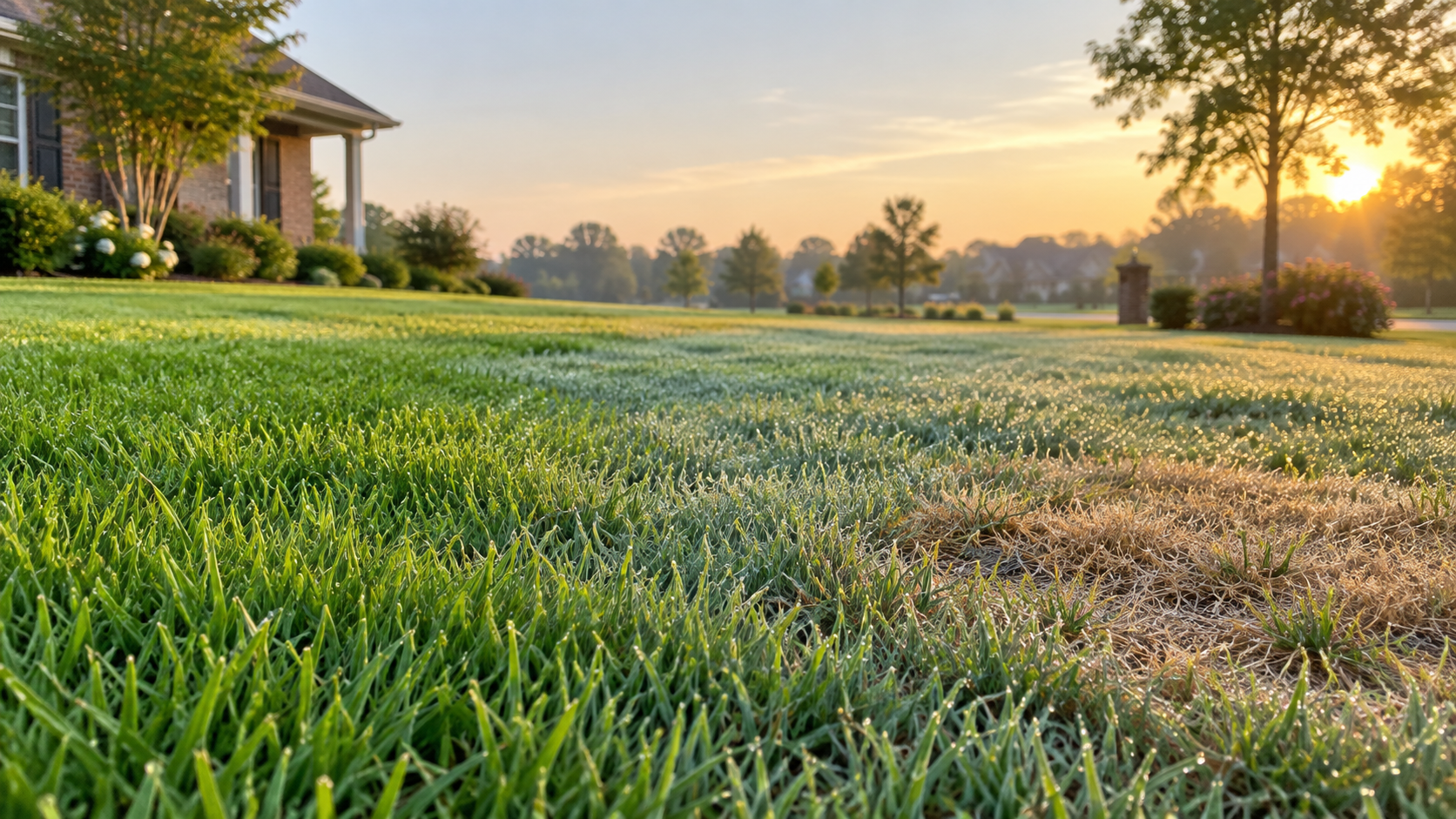
Research on dollar spot has shown that mechanically removing morning dew can reduce disease severity by shortening continuous leaf wetness. On professional turf, managers use mowing, rolling, hoses, brushes and actual dew whips.
For a homeowner who enjoys being dialed in, dew pushing is basically the same idea.
Run a dew whip, hose, brush or other appropriate tool across the canopy in the morning and physically knock the droplets off the leaves. Regular morning mowing can accomplish some of the same thing.
I wouldn't sell this as a magic disease cure. Much of the strongest dew-removal research is on intensively managed golf turf and dollar spot, not every disease in a residential Bermuda lawn.
But the principle is solid: if prolonged leaf wetness favors a disease, shortening that wet period can remove one piece of the disease-friendly environment.
PRO TIP
Pay attention to how long the lawn stays wet, not just whether it gets wet. A lawn covered in dew at sunrise but dry soon afterward is a different disease environment from a shaded, humid lawn that stays wet deep into the morning.
Fungicide isn't the first step—correct diagnosis is
Preventive fungicides absolutely have a place in high-quality Bermuda management.
But "fungus prevention product" isn't really one category.
Different diseases respond to different active ingredients, application timing and placement. Some fungicides are better suited to certain pathogens than others, and repeatedly relying on the same fungicide mode of action can contribute to fungicide resistance.
That's why I would work backward:
- Identify the likely disease.
- Determine when that pathogen is actually active.
- Correct the cultural conditions contributing to it.
- Choose a fungicide specifically labeled for that disease and turf site if chemical control is warranted.
- Follow the current product label for rate, interval, watering instructions and annual limits.
- Rotate appropriate FRAC groups when repeated applications are required rather than repeatedly leaning on one mode of action.
Active ingredients homeowners may encounter in turf fungicide products include compounds such as azoxystrobin, propiconazole and thiophanate-methyl, among others. That list isn't a recommendation to buy all three or apply them interchangeably.
The disease and the label determine the tool.
Spring dead spot shows why timing matters so much. OSU recommends preventive DMI fungicide applications in fall before soil temperatures drop through approximately 70°F in situations where chemical control is appropriate, with integrated cultural management still necessary. By the time those dead circles become obvious during spring green-up, you've largely missed the most important preventive window.
Dollar spot can be different again. Maintaining appropriate fertility, avoiding drought stress, reducing extended leaf wetness and removing dew can all become pieces of the management program.
WATCH OUT
Don't spray a fungicide just because the lawn turned brown after a week of 100°F weather. Fungicides treat susceptible fungal pathogens. They don't correct drought, poor sprinkler coverage, compacted soil, scalping, winter dormancy or dead turf.
Here's how I'd diagnose a struggling Bermuda lawn
When Bermuda starts looking bad, I want to eliminate the simple explanations before reaching for a product.
MY PROCESS
- Look at the calendar and recent weather. Is this peak summer heat, normal fall transition, spring green-up or a cool/wet disease window?
- Check the soil moisture. Don't judge irrigation from the top half-inch. Probe several inches down and compare healthy and stressed areas.
- Check irrigation coverage. If damage follows sprinkler patterns or appears consistently along pavement, slopes and high spots, investigate water distribution before assuming disease.
- Look at the shape of the damage. Broad uniform browning suggests something different from circles, arcs, small spots or expanding margins.
- Get down to leaf level. Look for lesions, discoloration and early-morning fungal growth rather than diagnosing the lawn from the patio.
- Inspect the living structures. Part the canopy and examine crowns and stolons. During questionable winter recovery, plugs can even be brought into warm, bright conditions and kept moist to test whether living Bermuda will resume growth.
- Think about moisture duration. Heavy dew, nighttime irrigation, poor airflow, shade and persistent humidity can keep leaves wet much longer than you realize.
- Only then decide on treatment. Water stress gets water-management corrections. Dormancy gets patience. Disease gets disease-specific cultural management and, when justified, a properly labeled fungicide program.