
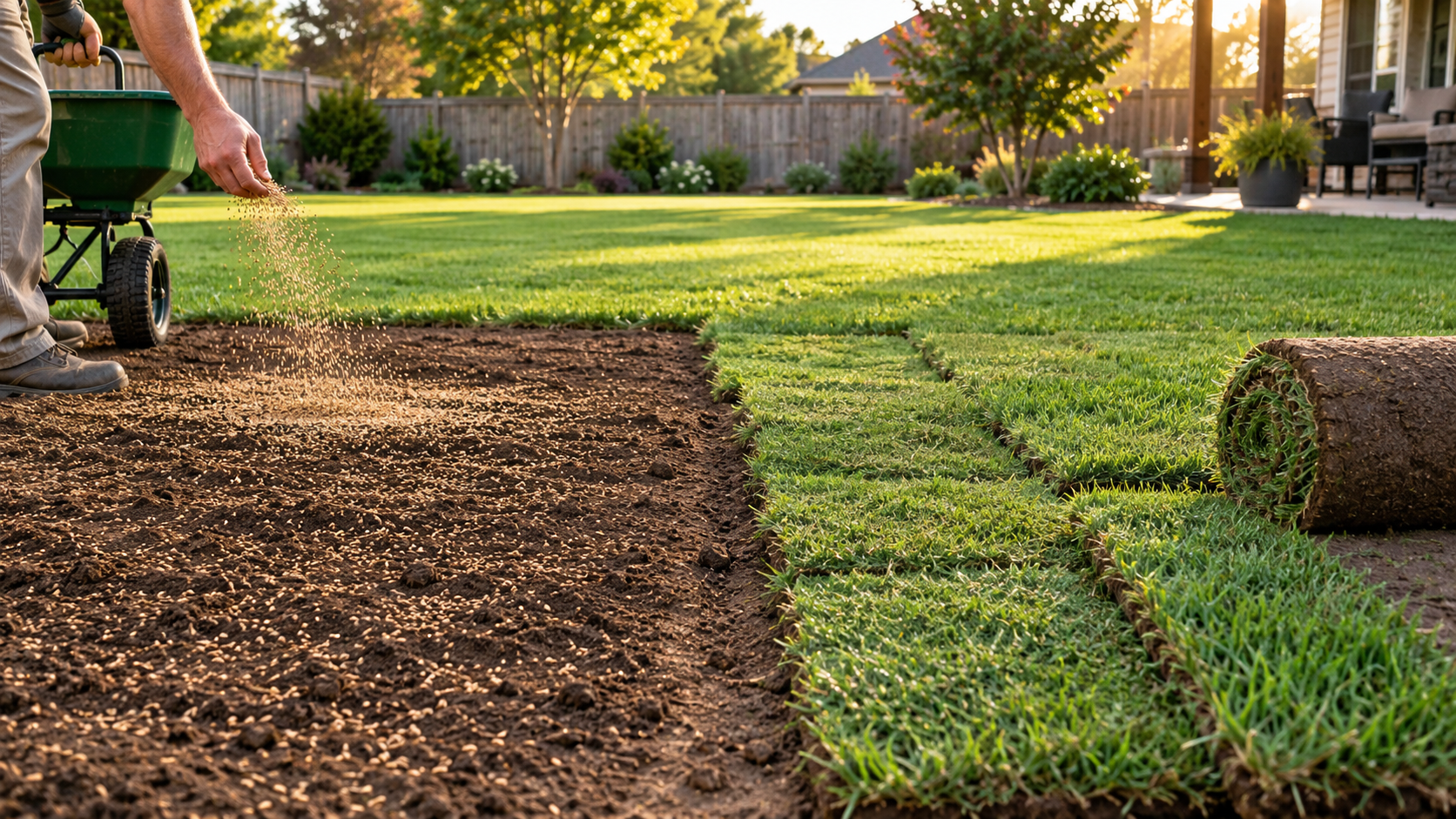
QUICK ANSWER
If I were choosing between Bermuda seed and sod, I would not start with price.
I would start by deciding which Bermuda grass I actually want to own for the next several years.
That matters because many common and improved common Bermudas can be established from seed, while many of the fine-textured hybrid Bermudas homeowners recognize from sports fields and high-end lawns have sterile seed and must be established vegetatively through sod, sprigs, or plugs.
Seed is usually the lower-cost way to cover a large area, but you are accepting a slower establishment process, exposed soil, more weed pressure, and a period when moisture management really matters.
Sod costs more, but it gives you immediate coverage and access to cultivars you simply cannot grow from seed.
My basic decision would be this: choose seed when budget and flexibility matter more than instant results. Choose sod when cultivar, speed, uniformity, or erosion control matter more than upfront cost.
Seed and sod may not give you the same Bermuda grass
This is the first thing I would want a homeowner to understand.
“Seed versus sod” sounds like a choice between two installation methods.
With Bermuda, it can also be a choice between two different categories of turf.
Common Bermuda is Cynodon dactylon. Traditional common types can be somewhat coarse and lighter green, although improved seeded cultivars have gotten much better in texture, density, color, and cold tolerance.
Then there are hybrid Bermudas, many of which are crosses involving common Bermuda and African Bermuda. These are often finer textured, denser, and selected specifically for higher turf quality.
The catch is that many true interspecific hybrid Bermudas produce sterile or nonviable seed.
So if you want a cultivar like Tifway, Latitude 36, TifTuf, or another vegetatively propagated hybrid, buying a bag of “Bermuda seed” is not an alternate way of getting that same lawn.
It is a different grass.
That is why I would choose the cultivar first and the establishment method second.
NUMBERS / COMPARISON
Question
Bermuda Seed
Bermuda Sod
Upfront material cost
Lower
Higher
Immediate coverage
No
Yes
Typical grass types
Common and improved seeded cultivars
Common, improved common, and many hybrids
Establishment risk
Higher
Lower if installed and watered correctly
Weed pressure during establishment
Higher
Usually lower
Irrigation precision
Very high early on
High early on
Erosion control
Limited initially
Immediate
Visual uniformity
Develops over time
Immediate if sod is pure and matched
Planting season flexibility
Narrower
Broader
The biggest difference is what happens during establishment
Sod gives you a lawn surface almost immediately.
That does not mean the sod is immediately rooted, but from day one you have grass covering the soil. That reduces mud, limits erosion, and leaves much less open ground for weeds to occupy.
Seed is different.
You are putting tiny Bermuda seeds into prepared soil and asking them to germinate, survive, spread, and eventually knit themselves into a lawn.
Bermuda is a warm-season grass, and soil temperature matters. Oklahoma State notes that Bermuda seed does not begin germinating until soil temperatures are around 65°F and places its optimum seeded establishment window in late spring into early summer for Oklahoma conditions.
The exact calendar dates move depending on where you live, but the principle travels well:
seed Bermuda when the soil is truly warm and there is enough growing season left for the stand to mature.
Sod gives you more seasonal flexibility because you are transplanting mature turf rather than waiting on seed germination. Even then, active growth and warm soil usually make rooting easier and faster.
This is one reason I would be cautious about a homeowner deciding in late summer that seeding is the cheap way to get a lawn finished before fall.
Cheap seed that never fully establishes is not cheap.
Seed saves money, but it asks more from the homeowner
The material-cost advantage of seed is real.
For a large bare area, seed can be dramatically less expensive than buying pallets of sod and paying for delivery and installation.
But I would not compare those two prices without also comparing the work required after planting.
A newly seeded lawn needs the upper soil surface kept consistently moist while germination and early seedling development occur. Texas A&M notes that newly seeded or sprigged lawns may require several light irrigations per day in hot, windy weather during the critical early period.
That is very different from normal deep-and-infrequent irrigation on an established Bermuda lawn.
With sod, the watering is still intensive at first. The existing turf has very little functional root system in the underlying soil immediately after installation, so frequent irrigation is required while roots peg down.
The difference is that seed gives you much less margin for error.
A sod piece that begins drying gives you something obvious to see.
A germinating seed can fail before you ever had much lawn to look at.
PRO TIP
Before choosing seed because it is cheaper, make sure your irrigation setup can actually keep the entire seedbed uniformly moist. A lawn with dry edges, weak sprinkler overlap, or areas you cannot reach reliably can turn inexpensive seed into repeated reseeding.
Weed pressure is one of the hidden costs of seed
Open soil is an invitation.
While Bermuda seedlings are trying to establish, weed seeds already in the soil are trying to do exactly the same thing.
That does not mean a seeded lawn will automatically become a weed patch. A dense Bermuda stand can eventually become extremely competitive.
But there is a vulnerable period before you get there.
Sod skips much of that stage because the ground is immediately covered by mature turf.
This is one of the reasons sod can be worth the premium on difficult sites, newly graded yards, slopes, or areas where soil erosion and weed pressure are already concerns.
There is another wrinkle with Bermuda: controlling weeds in very young turf is not always as simple as reaching for whatever herbicide you would normally use on an established lawn.
Product labels can include establishment restrictions, timing requirements, or turf-safety limitations.
So I would rather prevent as much weed competition as possible through seedbed preparation than assume I can spray my way out of the problem afterward.
That means starting with a clean site matters more with seed than a lot of homeowners realize.
Do not contaminate a hybrid lawn just because Bermuda seed is convenient
This is the mistake I would most want people to avoid.
Suppose you already own a fine-textured hybrid Bermuda lawn and have a large thin or damaged area.
It is tempting to buy Bermuda seed, spread it over the spot, and assume Bermuda plus Bermuda equals Bermuda.
It does not necessarily work that way.
The seeded grass may have a different leaf texture, color, density, growth rate, cold response, or seedhead habit than the hybrid surrounding it.
And because Bermuda spreads through both stolons and rhizomes, once another type becomes established inside the lawn, separating the two can be extremely difficult.
Common Bermuda can act as a contaminant in higher-quality turf for exactly this reason.
If maintaining cultivar uniformity matters to me, I would repair a hybrid lawn with matching sod, plugs, or sprigs, not random Bermuda seed.
The source of sod matters too.
University turf programs have documented cultivar contamination and mislabeling in established Bermuda production. Certified sod programs exist specifically to protect genetic identity and varietal purity.
WATCH OUT
If you have a named hybrid Bermuda, do not overseed thin areas with generic Bermuda seed unless you are comfortable creating a mixed stand. The repair may turn green quickly, but the difference can become much more obvious once both grasses mature.
Hybrid does not automatically mean better for your house
This part gets overlooked because high-end Bermuda is fun.
A dense hybrid mowed low with a reel mower can look unbelievable.
But the question is not whether a hybrid can produce a better lawn.
The question is whether you will maintain it like the lawn you are picturing.
Texas A&M describes Bermuda generally as a grass that tolerates close mowing and responds well to management, while also noting that hybrid types can require greater mowing, fertility, and thatch management for maximum performance.
The University of Arkansas makes the homeowner version of this point even more directly: one of the biggest problems homeowners have with hybrid Bermuda is maintaining it correctly.
That does not mean every hybrid needs golf-course treatment.
A hybrid Bermuda can still make a very good residential lawn under moderate maintenance.
But I would be honest with myself before choosing one.
Am I willing to mow frequently?
Do I want to mow low?
Am I prepared to keep blades sharp, manage growth, fertilize intelligently, and stay ahead of thatch if the cultivar and mowing height demand it?
Or do I really want a durable Bermuda lawn that I can mow around 1½ to 2 inches with a rotary mower once a week?
There is absolutely nothing wrong with that second lawn.
An improved seeded Bermuda may fit that homeowner better than an expensive hybrid installed because it looked amazing in somebody else's reel-mowed backyard.
How I'd make the seed-versus-sod decision
I would choose seed when most of these are true:
- I am establishing a large area and budget matters.
- I am happy with common or an improved seeded Bermuda cultivar.
- I am planting during a reliable warm-weather establishment window.
- I have irrigation coverage good enough to keep the seedbed consistently moist.
- I am willing to tolerate several weeks of establishment and unevenness.
- I can manage weed pressure while the stand fills in.
- Perfect cultivar matching to an existing hybrid lawn is not required.
I would choose sod when most of these are true:
- I want a specific hybrid cultivar that is not available from seed.
- I want immediate ground coverage.
- I am dealing with erosion, mud, pets, kids, or a high-traffic property.
- I want fewer opportunities for weeds to colonize bare soil.
- I am repairing an existing named hybrid and want to maintain uniformity.
- I can afford the higher upfront cost.
- I can provide frequent irrigation during the initial rooting period.
MY TAKE
For a completely bare yard, I would not automatically pay for sod if an improved seeded cultivar matched the lawn I actually wanted. Bermuda is aggressive once it gets established, and seed can make a lot of financial sense when the homeowner has good irrigation and enough warm growing season left.
Where I become much more willing to pay for sod is when I care about a specific hybrid, need immediate coverage, or am trying to preserve the uniformity of an existing hybrid lawn.
At that point, the extra money is buying more than speed.
It is buying the cultivar itself.
KEY TAKEAWAYS
- Bermuda seed and Bermuda sod may represent completely different cultivars, not merely different installation methods.
- Many true hybrid Bermudas have sterile seed and must be established with sod, sprigs, or plugs.
- Seed usually costs less, but establishment requires warmer conditions, consistent surface moisture, patience, and more weed management.
- Sod costs more but gives immediate coverage, rapid erosion protection, and a more predictable starting stand.
- Avoid introducing generic seeded Bermuda into a named hybrid lawn if cultivar uniformity matters.
- Choose the grass based on the maintenance you will realistically provide, not the lawn you imagine maintaining on your best Saturday of the year.