
QUICK ANSWER
When Bermuda starts developing ugly brown or thinning areas, don't automatically assume you've got fungus.
Disease becomes a much stronger suspect when the pattern lines up with weather conditions that favor it—especially extended moisture, high humidity, heavy dew, poor drying conditions, and wet soil or turf. But insects, irrigation problems, mowing damage, nutrient stress, and chemical injury can produce symptoms that look frustratingly similar.
I've had disease issues, so moisture awareness and recent weather are two of the first things I consider.
If disease pressure is predictable, proactive fungicide protection can make sense. There are granular products and homeowner-friendly hose-end options available at big-box stores. But when insects are also a legitimate possibility, that's where diagnosis matters—and one reason I've used Syngenta Caravan G, which combines a fungicide and insecticide in one application.
Diagnosis starts with the whole pattern
The hardest part about a struggling lawn is that brown grass is a symptom, not a diagnosis.
A patch might be fungal disease. It might also be an irrigation problem, scalping, fertilizer injury, herbicide damage, grubs, another insect, or simply turf that's been stressed enough that it can't recover normally.
That's why I don't want to diagnose the lawn by color alone.
Start by backing up and looking at the pattern. Are you seeing circles? Small spots that are beginning to run together? One large irregular area? Damage along an irrigation boundary? Is the turf thinning from the leaves down, or does the entire plant feel loose because something has damaged the roots?
Then add timing and weather.
University of Georgia Extension notes that warm-season turf diseases such as large patch are encouraged by excessive moisture in the soil, thatch, and lower canopy. Poor drainage and excessive irrigation can make the problem worse. Dollar spot is also favored by conditions that produce extended leaf wetness, including high humidity and heavy dew.
In other words, the weather is part of your diagnostic kit.
MY TAKE
Having dealt with disease issues, I've become much more aware of moisture. I'm looking at how much I've irrigated, how much rain we've received, how humid it's been, whether we're getting heavy dew, and how long the grass is staying wet.
A suspicious patch appearing after a stretch of disease-friendly weather gets my attention differently than the same patch appearing during hot, dry weather.
Conditions don't prove you have a particular disease, but they can make the rest of the evidence fit—or not fit.
Fungus isn't the only thing that can make Bermuda look terrible
There are recognizable disease patterns worth learning.
Dollar spot can produce small straw-colored or white patches that eventually merge together. Large patch produces much larger circular areas and tends to become problematic when warm-season turf is entering or leaving dormancy. Spring dead spot is particularly relevant to Bermuda and shows itself as dead areas during spring green-up.
But this is where lawn diagnosis gets annoying.
An irrigation problem can make turf brown. Scalping can make it brown. Chemical injury can make it brown. Root-feeding insects can make it brown.
Before treating, check the simple stuff. Look at irrigation coverage. Think about what you've recently sprayed or applied. Consider whether the mower was set unusually low or whether the turf got scalped. Look closely at individual leaves instead of only looking across the yard.
And then look below the grass.
If the lawn is declining because something is eating the roots, staring at the leaf blades isn't necessarily going to give you the answer.
WATCH OUT
A fungicide isn't a general-purpose cure for brown grass. It targets specific labeled diseases, and even a correctly selected fungicide doesn't instantly replace turf that's already been damaged.
University turf guidance emphasizes cultural management alongside fungicides: correcting excess moisture, improving drainage and irrigation timing, managing fertility appropriately, and reducing other conditions that favor disease.
Sometimes the problem is hungry bugs—and grubs are easy enough to check
White grubs are beetle larvae that live in the soil and feed on turf roots and other underground plant material.
And yes, they're hungry little bugs that suck.
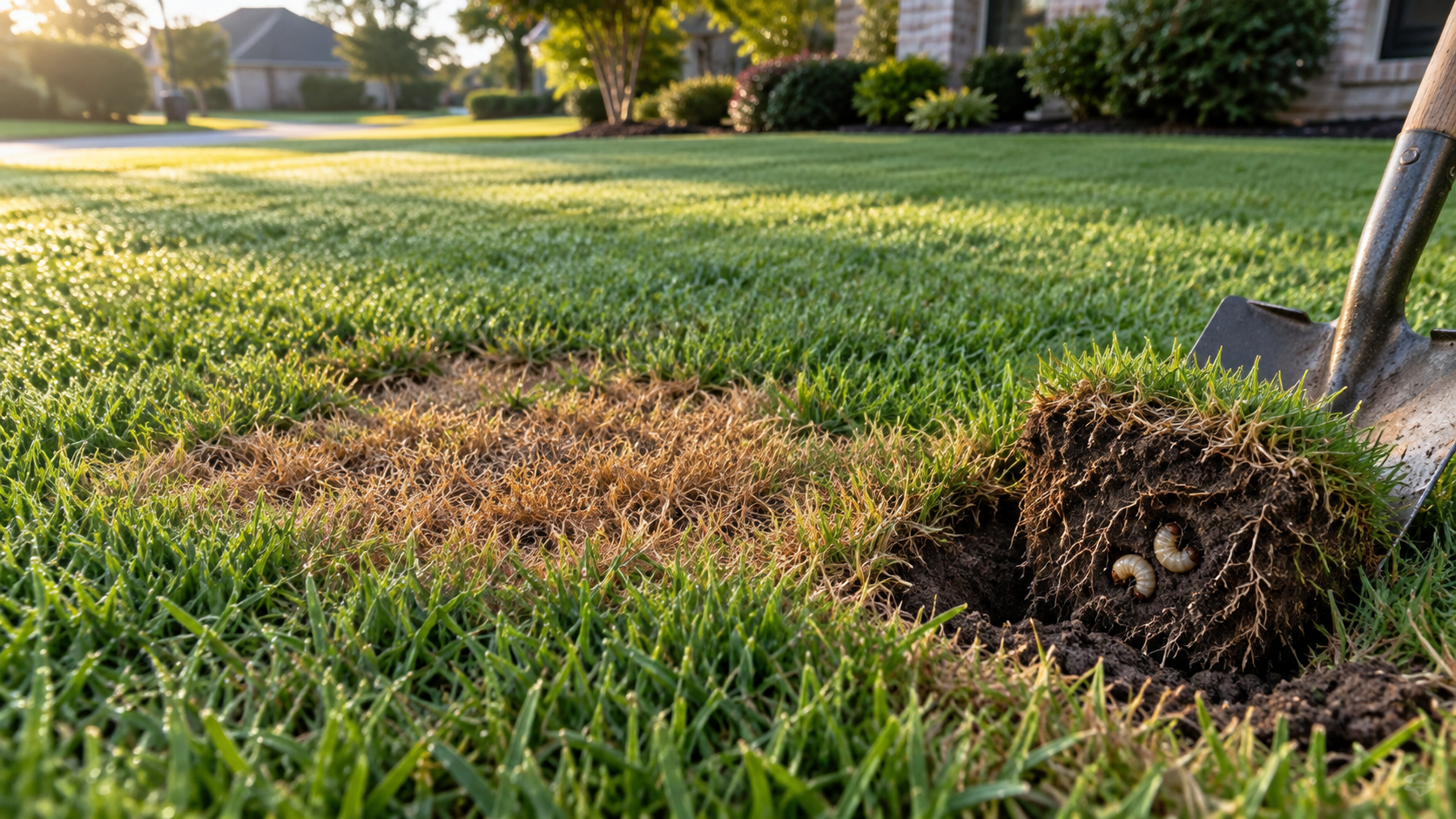
Enough root feeding can cause turf to lose vigor, turn brown, and eventually become loose enough that severely damaged grass can lift almost like carpet. Bermuda is among the turfgrasses they can attack.
This is one diagnosis where a shovel can tell you a lot.
Cut into the turf near the edge of an actively damaged area, lift a section, and inspect the soil and root zone underneath. Texas A&M describes white grubs as creamy-white, C-shaped larvae and recommends checking several soil sections rather than relying on a single tiny hole.
NUMBERS / GRUB CHECK
What to check
What I'm looking for
Location
Edge of the damaged turf
Depth
Roughly 4 inches; deeper in sandy soil
Sampling
Several areas, not one random hole
Grubs
White/C-shaped larvae below the turf
Treatment threshold
More than about 5 grubs per sq. ft. according to Texas A&M guidance
The threshold matters.
Finding one grub doesn't mean that grub caused a giant dead patch. Texas A&M notes that even lawns with relatively high populations don't always show damage. The goal is to connect insect presence + population + root damage + lawn symptoms before deciding you've found your culprit.
When fungus and insects are both on my suspect list
Disease and insect damage require different active ingredients, which creates an interesting problem when the symptoms aren't giving you an obvious answer.
That's one reason I've used Syngenta Caravan G.
Caravan G combines two active ingredients: azoxystrobin, a fungicide, and thiamethoxam, an insecticide. The label covers specific turf diseases and insects, so it provides both types of control in a single granular application when those labeled problems are part of what I'm trying to address.
This isn't permission to stop diagnosing lawn problems. It also doesn't mean Caravan controls every possible disease or insect.
The label still determines what it controls and how it can legally be used.
Caravan is interesting because rainfall or irrigation releases the active ingredients from the granule. According to Syngenta's label, they're then absorbed through turf foliage and roots and move within the plant. Thiamethoxam acts on labeled insects through contact/ingestion and feeding on treated plants, while azoxystrobin provides systemic preventative and curative activity against labeled diseases.
PRO TIP
With any pesticide, check the current label for your specific location and turf situation before applying it. Syngenta itself warns that online specimen labels may not reflect every current state or local requirement.
There are also plenty of homeowner fungicide options if insects aren't part of the equation. Granular preventative treatments can be convenient, and hose-end fungicides available at big-box stores can make liquid application approachable without owning dedicated spray equipment.
The important part isn't whether the product comes from a professional distributor or the shelf at a home-improvement store.
It's whether the active ingredient is labeled for the disease you're actually trying to control.
Don't expect a damaged lawn to turn green overnight
This is where expectations matter.
Pest control and turf recovery are two different timelines.
For insects controlled by Caravan G, Syngenta's label says feeding can stop within minutes to hours after exposure, with insect death following. That doesn't mean a brown patch suddenly becomes green that afternoon.
The fungicide side works differently as well. Azoxystrobin can help prevent or suppress further activity from susceptible labeled diseases, but existing dead tissue is still dead tissue.
What you're really watching for after treatment is progression first, recovery second.
Is the damaged area continuing to expand? Is new turf tissue looking healthier? Are stolons beginning to move back into the area? Is the Bermuda finally gaining ground instead of losing it?
Recovery then depends on how badly the turf was damaged, whether the underlying problem has actually been corrected, and whether the Bermuda is actively growing.
That last part matters a lot.
If grubs have eaten roots, killing the grubs solves the pest problem—it doesn't instantly rebuild the root system. The surviving Bermuda still has to recover.
MY TAKE
Once I've identified and addressed what's causing the damage, I want the remaining Bermuda in a position to grow back into the spot. That means appropriate water and nutrition once the disease situation and time of year make that sensible.
I don't look at the pesticide as the thing that "grows the grass back." Its job is controlling the target pest or disease. The Bermuda has to do the rebuilding.
And Bermuda is pretty darn good at that when it's healthy and actively growing.
My process when a mystery patch shows up
MY PROCESS
- Look at the entire pattern. I don't diagnose the lawn from one brown blade of grass.
- Think about recent weather and moisture. Rain, irrigation, humidity, dew, drainage, and how long the canopy stays wet all matter.
- Rule out the obvious lookalikes. I check irrigation coverage, mowing/scalping, recent fertilizer or chemical applications, and other stress.
- Inspect the turf closely. I look at individual leaves, the edge of the damage, and how the patch is progressing.
- Get the shovel if insects are suspicious. I lift turf near the edge of the damage and inspect the roots and soil for grubs rather than guessing.
- Match treatment to the actual problem. Fungus needs an appropriate labeled fungicide. Insects need an appropriate labeled insecticide. When both are legitimate concerns, a combination product such as Caravan G can be useful when its label fits the situation.
- Watch progression before expecting recovery. Stopping the problem comes before filling the spot back in.
- Help healthy Bermuda recover. Once the cause is controlled and conditions are appropriate, I want adequate water, nutrition, and active growth so the surviving turf can rebuild roots and spread.
KEY TAKEAWAYS
- Brown Bermuda doesn't automatically mean fungus.
- Moisture, weather, timing, and the pattern of damage provide important diagnostic clues.
- Insects can create damage that looks surprisingly similar to disease or environmental stress.
- A shovel and a few soil samples are much better evidence of grubs than guessing from the surface.
- Fungicides and insecticides do different jobs; Caravan G combines labeled disease and insect control through azoxystrobin and thiamethoxam.
- Don't confuse stopping the problem with healing the lawn. Damaged Bermuda needs time and favorable growing conditions to recover.