
QUICK ANSWER
Bermuda grass can tolerate some shade, but if you're trying to grow thick, high-quality Bermuda, sunlight is one of those inputs you simply can't replace with more fertilizer, more water, or another lawn product.
And I think that's an important distinction.
The question isn't really, “Can Bermuda stay alive in this spot?” It's, “Can Bermuda grow densely enough here to produce the lawn I actually want?”
Research gives us a much better way to answer that than simply counting hours of sunlight. It's called Daily Light Integral, or DLI, and it measures the total amount of photosynthetically active light reaching an area over the entire day.
For several hybrid Bermuda cultivars studied at Texas A&M, acceptable turf quality during summer required roughly 24–26 mol/m²/day at a 0.75-inch mowing height. That gives us a useful benchmark, but it's not a universal magic number. Cultivar, mowing height, season, traffic, tree competition and the type of shade all matter.
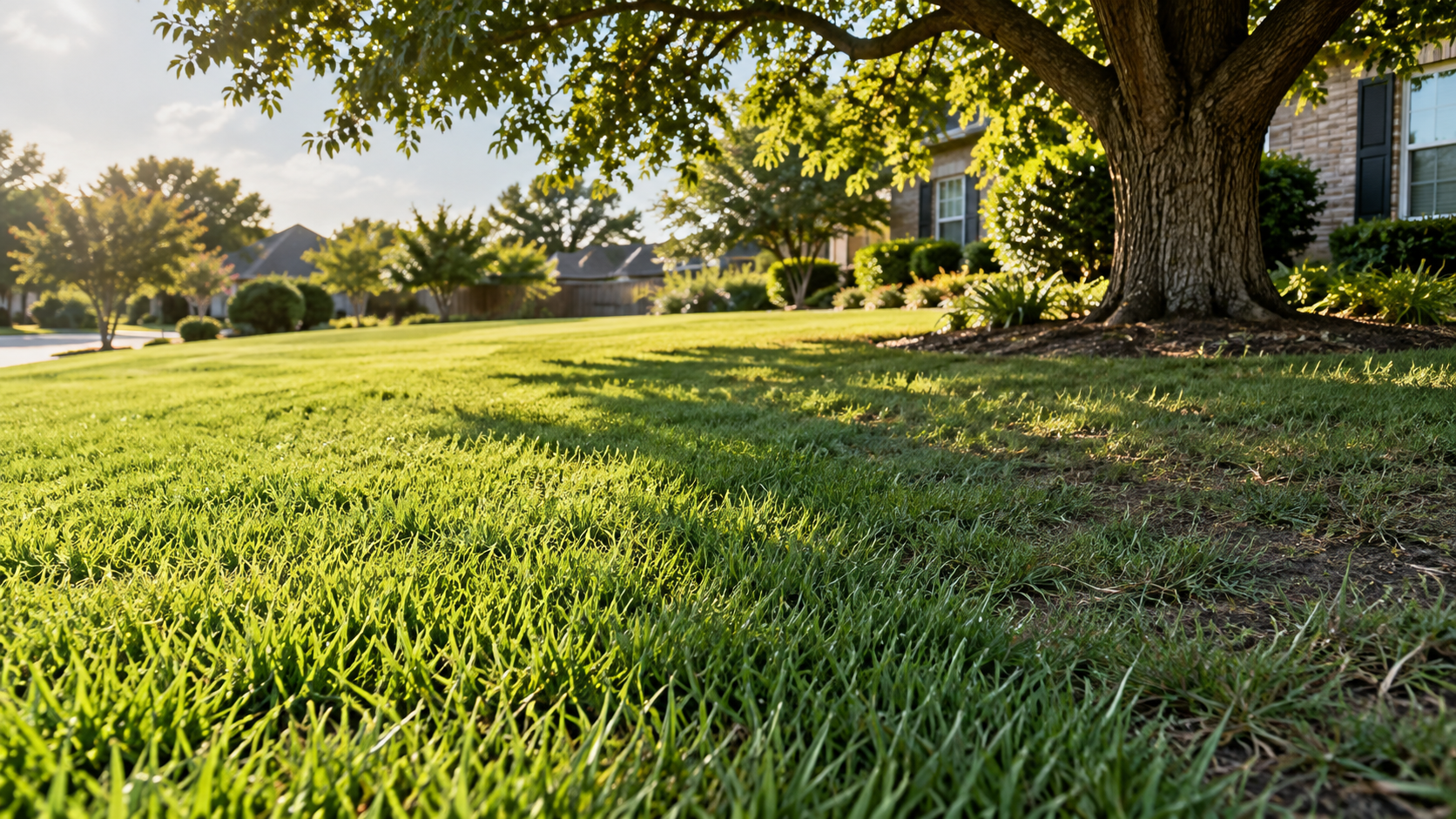
If your Bermuda consistently looks thin underneath a tree while the exact same grass is thick 20 feet away in the sun, I would put sunlight near the top of the suspect list.
Hours of sunlight only tell part of the story
You'll commonly hear recommendations like “Bermuda needs eight hours of sunlight.”
That's useful as a homeowner rule of thumb. Oklahoma State, for example, suggests Bermuda may work where a site averages at least eight hours of sunlight during the growing season. NC State goes even further in describing Bermuda as the least shade-tolerant of the common turfgrasses and recommends alternatives for heavily shaded areas.
But eight hours doesn't tell the whole story.
Four hours of intense midday sunlight isn't equivalent to four hours early in the morning. Dappled sunlight moving through a tree canopy isn't equivalent to unobstructed direct sunlight either.
Plants respond to photons, not the number on your watch.
That's where Daily Light Integral becomes useful. DLI adds up the photosynthetically active radiation, or PAR, received over the course of the day and expresses it as moles of light per square meter per day (mol/m²/day).
Think of instantaneous sunlight as the flow rate and DLI as the total gallons accumulated by the end of the day.
PRO TIP
Check the DLI shown in LawnWeather on this page. I use that number as an estimate of the full-sun DLI available for the day. A Bermuda lawn sitting underneath a tree isn't necessarily receiving that amount. The tree, house, fence or other obstruction can substantially reduce what actually reaches the turf canopy.
So if LawnWeather shows a DLI of 45, that doesn't mean the Bermuda underneath your oak tree received 45. It gives you a useful reference for what an unobstructed area could receive that day.
The Bermuda DLI numbers give us a much better benchmark
This is where the research gets interesting.
A two-year Texas A&M study evaluated four bermudagrass cultivars—Tifway, TifGrand, Celebration and Latitude 36—under progressively greater levels of shade. Researchers continuously measured PAR beneath the shade structures and calculated DLI while evaluating turf quality.
At a 0.75-inch fairway mowing height, the minimum summer DLI associated with acceptable quality was remarkably tight among the four Bermudas.
NUMBERS / COMPARISON
Bermuda type
Approx. minimum summer DLI
Celebration
24 mol/m²/day
Latitude 36
24 mol/m²/day
TifGrand
24–25 mol/m²/day
Tifway
26 mol/m²/day
TifEagle ultradwarf*
About 30–33 mol/m²/day
*TifEagle research involved putting-green management and shouldn't be treated as the requirement for a normal homeowner Bermuda lawn. It is included because it shows how management and mowing height can change the amount of light Bermuda needs.
There's another important detail: the threshold changes with season and management.
In the Texas A&M study, spring minimum DLI values for the Bermudas ranged roughly from 16–25, summer increased to about 24–26, and fall generally ranged from 19–25. The study's full-sun summer plots averaged around 47 mol/m²/day.
That means I wouldn't turn 24 or 25 into some universal Bermuda commandment.
The useful takeaway is that high-quality Bermuda wants a lot of light, and roughly the mid-20s DLI range is a legitimate research-backed reference point for several popular hybrid cultivars under the conditions studied.
Common Bermuda and every seeded cultivar haven't been individually validated at those exact numbers, either. Don't assign a cultivar-specific DLI threshold where we don't actually have the research.
Shade doesn't just make Bermuda grow slower—it makes it thinner
This is the part homeowners tend to experience before they ever know what DLI means.
You have beautiful Bermuda in the middle of the yard. Move toward the tree and it starts opening up. The canopy gets thinner. Eventually you're staring at dirt between runners wondering which fertilizer is going to fix it.
Maybe fertilizer isn't the limiting input.
Light drives photosynthesis. As the available light falls, Bermuda has less energy available to maintain the dense canopy we're asking it to produce. Shade can also bring additional problems: tree roots compete with turf for water and nutrients, air movement can decrease, leaf wetness can persist longer and the weaker turf becomes less capable of handling traffic and environmental stress.
This is why I think there's a difference between Bermuda existing in shade and Bermuda performing in shade.
You may absolutely have Bermuda growing underneath a tree.
But compare its density to the Bermuda in full sun.
That's usually where the answer becomes obvious.
MY TAKE
I wouldn't judge success by whether I can keep a few Bermuda runners alive underneath a tree. If I'm building a Bermuda lawn, I want Bermuda to behave like Bermuda—dense, aggressive and capable of creating a uniform canopy.
Shade always comes with a density penalty. How much of a penalty depends on the amount and timing of light, the cultivar, mowing height and everything else happening at that site.
At some point, fighting for another couple feet of mediocre turf underneath a tree stops making much sense to me.
You can improve the light, but you can't manufacture sunlight
If a shaded area is close to having enough light, improving the environment can absolutely be worthwhile.
Selective tree pruning can increase light penetration and improve air movement. Oklahoma State specifically recommends selectively pruning trees and shrubs where practical as part of managing shaded turf.
But there's only so much tree trimming you can—or should—do.
A mature tree is part of the landscape too. I wouldn't butcher a good tree just because I'm determined to force Bermuda underneath every square foot of its canopy.
And sometimes the shade isn't coming from a removable limb anyway. It's the north side of the house. It's the neighbor's tree. It's a fence. It's several mature trees overlapping. The geometry of the property has simply decided that this isn't a full-sun turf area.
WATCH OUT
Don't try to fertilize your way out of a sunlight problem. If light is the limiting factor, pushing more nitrogen doesn't create more photons. Diagnose the site first. A thin Bermuda area that consistently follows the shade pattern is telling you something.
If you're trying to quantify it, start with the full-sun DLI estimate in LawnWeather and compare the problem area with an unobstructed part of your lawn. For an actual site measurement, a PAR/DLI meter positioned where the turf grows is far more useful because it captures the light that really reaches that spot.
My answer isn't to start mixing grasses
One solution you'll hear is to put a more shade-tolerant turf underneath the trees.
There is legitimate science behind the idea that other turf species can tolerate less light. Zoysiagrass, for example, generally demonstrated lower minimum DLI requirements than Bermuda in the Texas A&M research, and Extension recommendations consistently rank Bermuda among the poorest warm-season turf choices for shade.
That still doesn't mean I want to mix a patch of zoysia into my Bermuda lawn.
The same goes for St. Augustine or throwing down some seeded grass blend in the shade.
Those grasses have different textures, growth habits, mowing preferences, seasonal behavior and management requirements. Bermuda is also an aggressive spreading grass. Personally, I'd rather have a deliberate transition from turf to landscape than create a mixed stand that I'm going to spend years trying to manage as one lawn.
To each their own. There are situations where somebody may be perfectly happy with mixed turf.
It's just not my recommendation.
If the area underneath the tree doesn't receive enough light to grow Bermuda at the quality I want, I'd rather stop asking it to.
Sometimes the best Bermuda decision is less Bermuda
My first choice around a heavily shaded tree is usually pretty simple:
Expand the landscape bed.
Let the thick Bermuda end where the environment stops supporting thick Bermuda.
That can mean enlarging the mulch or planting bed around the tree, creating a cleaner border, and using plants or materials that actually belong in that light environment. NC State makes essentially the same larger point in its shade guidance: where the site is too dark for quality turf, alternative ground covers or landscape materials are often better choices than continuing to fight thin grass.
I think that can actually make the lawn look better.
Instead of a beautiful green lawn fading into a thin, struggling patch of Bermuda and exposed dirt, you create an intentional edge. Dense turf ends. Landscape begins.
There's another option I really like in the right situation: artificial turf.
Normally the biggest knock against artificial turf is heat. Put synthetic turf in direct summer sun and that surface can get extremely hot.
But we're talking about the shady part of the property.
If you've got an area where natural turf simply can't get enough sunlight, that's one of the first places I'd consider artificial turf. The shade that was causing problems for Bermuda also reduces the direct solar load on the synthetic surface. That doesn't mean artificial turf can never get hot, but a shaded installation avoids the all-day direct sun exposure that can drive surface temperatures up.
You get a usable green surface where great natural turf wasn't realistic anyway, and the shade helps address one of artificial turf's biggest drawbacks.
That's a pretty good win-win to me.
How I'd decide whether to keep fighting for Bermuda
I wouldn't make this decision from one cloudy afternoon or because one section looks a little thinner in spring.
I'd evaluate it during active summer growth, when Bermuda should be doing its best work and its light demand is high. That's also when the Texas A&M researchers suggest DLI assessment makes practical sense because their measured minimum requirements were highest during summer.
MY PROCESS
- Look at the pattern. If thin turf closely follows the tree canopy, building shadow or fence line, suspect light before chasing fertilizer problems.
- Check LawnWeather. Use its DLI as an estimate of the full-sun light available that day—not as the DLI underneath the tree.
- Compare sunny and shaded Bermuda. The difference in density can tell you a lot.
- Measure actual DLI if the decision matters. A PAR/DLI meter at turf level can quantify how much light the problem area really receives.
- Use roughly 24–26 mol/m²/day as a research reference for several hybrid Bermudas in summer, not a universal pass/fail number for every home lawn.
- Improve light where it makes sense. Selective pruning may turn a marginal location into a workable one.
- Know when to quit fighting the site. If the area remains heavily shaded, expand the landscape bed rather than forcing Bermuda into a place where it will always be thin.
- Consider artificial turf for the right shaded space. If you need a durable green surface rather than a planting bed, shade is one of the places where synthetic turf makes the most sense to me.