QUICK ANSWER — Normal, Bold
Weed control in Bermuda grass gets a whole lot easier once you stop treating every unwanted plant like the same problem.
I put most weeds into three buckets: broadleaf weeds, sedges, and grassy weeds. That classification matters because the tool I reach for changes pretty dramatically between them.
Broadleaf weeds are usually the easy ones. A Bermuda-safe post-emergent can clean up a wide range of them. Sedges need their own specialized treatment and some patience. Grassy weeds like crabgrass and goosegrass are where things get harder.
Once grassy weeds are established inside Bermuda, selective control gets more complicated. That's where I lean heavily on prevention—and, for scattered weeds, sometimes a weed puller and a 5-gallon bucket.
The best weed to kill is still the one that never shows up.
Start by figuring out what kind of weed you're fighting
Before buying another bottle of weed killer, spend a minute figuring out what you're actually looking at.
For practical Bermuda lawn care, I like breaking weeds into three basic groups.
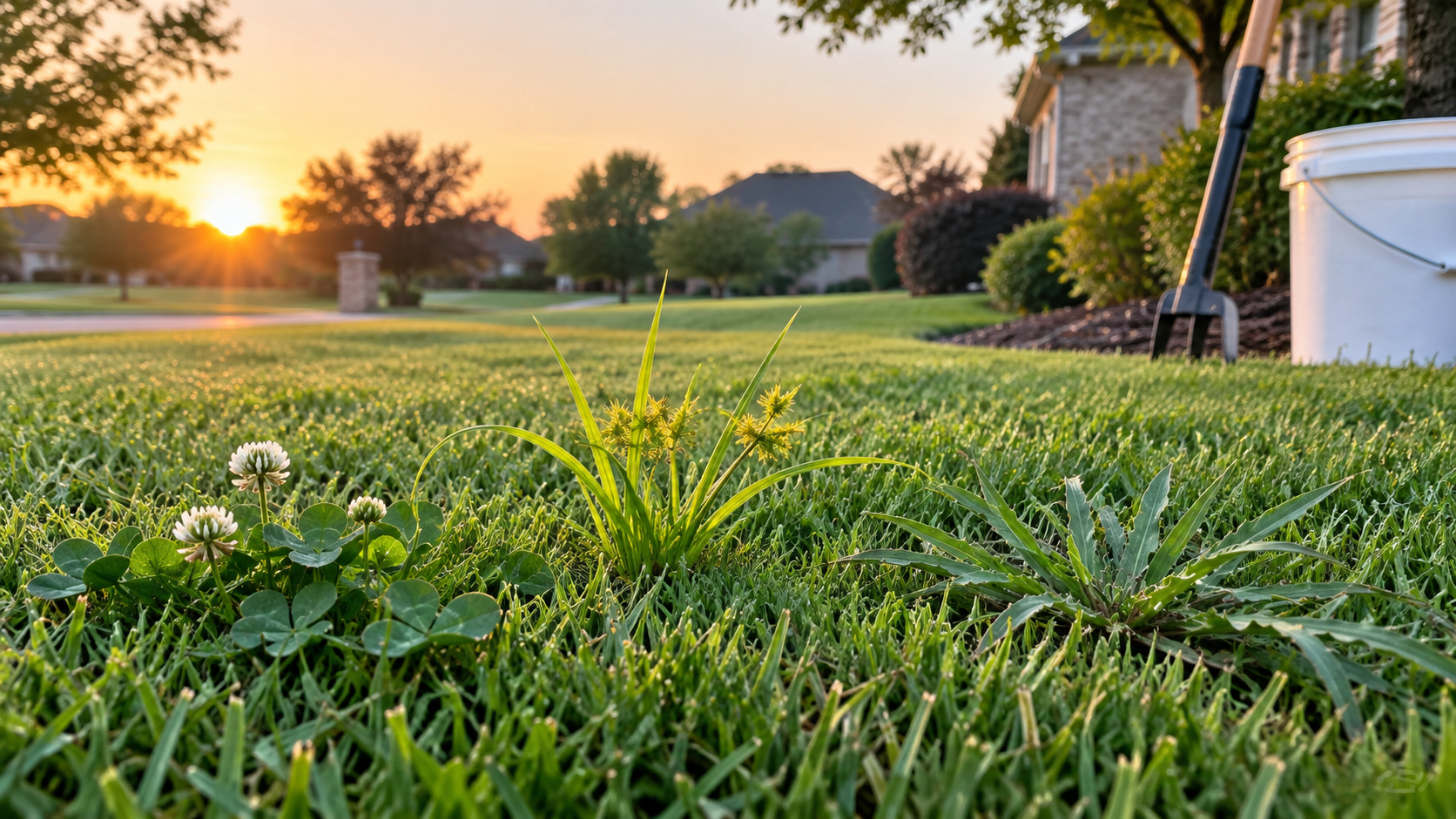
Broadleaf weeds look noticeably different from the surrounding turf. Clover, dandelion, chickweed, plantain, spurge, and similar weeds have broader leaves instead of narrow grass blades. They're generally the easiest category to identify and selectively control.
Sedges are trickier because they can look like grass at first glance. Yellow nutsedge is often lighter yellow-green than the surrounding Bermuda and tends to grow upright and faster than the turf around it. Sedges also have triangular stems, which is one of the classic ways to distinguish them from true grasses.
Then there are grassy weeds such as crabgrass and goosegrass.
These are where identification really starts to matter because now you're trying to remove one grass from another grass.
And that changes the difficulty considerably.
Three weed types, three different approaches
- Broadleaf weeds: Clover, dandelion, chickweed, plantain, spurge → Bermuda-safe selective post-emergent
- Sedges: Yellow nutsedge, purple nutsedge → Specialized sedge herbicide and spot treatment
- Grassy weeds: Crabgrass, goosegrass → Prevention first, then selective control or physical removal
Correct identification isn't just lawn nerd trivia. It determines what control method actually makes sense.
Broadleaf weeds are usually the easy part
If I've got common broadleaf weeds scattered throughout the lawn, this is usually the least complicated category to deal with.
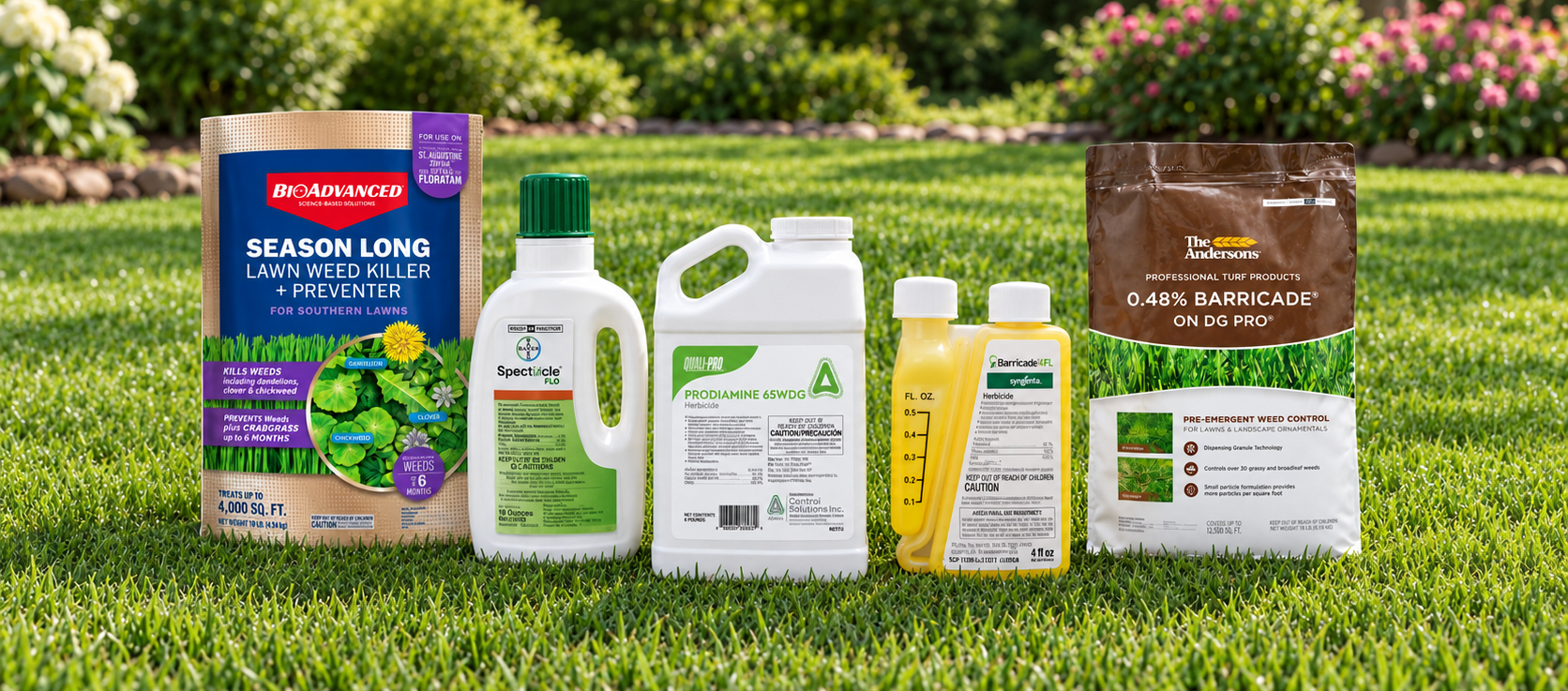
There are selective post-emergent herbicides labeled for established Bermuda that control a pretty wide range of broadleaf weeds. Common active ingredients include combinations of 2,4-D, mecoprop (MCPP), and dicamba.
For the homeowner who has no interest in mixing concentrates in a backpack sprayer, this can be as simple as finding a ready-to-spray hose-end product that's labeled for Bermuda and the weeds you're trying to control.
Hook it to the hose, follow the label, blanket spray the appropriate area, and let the herbicide do its job.
I also pay attention to whether a product offers pre-emergent activity in addition to post-emergent control. Combination products exist that can kill certain weeds that are already growing while providing residual control against certain weeds that haven't emerged yet.
Post-emergent control targets weeds that are already up.
Pre-emergent control targets susceptible weeds during germination.
A product that does both doesn't create an invisible force field around your lawn for the rest of the year. Which weeds it controls, how long that control lasts, when it can be applied, and whether it's appropriate for your Bermuda all come back to the specific label.
WATCH OUT — Normal, Bold
Don't buy something just because the front of the bottle says weed killer.
Check the label for Bermuda grass, the weeds you're targeting, temperature restrictions, application directions, and restrictions involving stressed turf or spring green-up.
That's especially important once temperatures start climbing. The actual product label—not the marketing on the front of the bottle—is what determines how that herbicide should be used.
Nutsedge looks grassy, but it needs a completely different strategy
Nutsedge is one of those weeds that can make you think your herbicide isn't working.
Yellow and purple nutsedge aren't actually grasses. They're sedges, and established nutsedge can spread through underground structures including rhizomes and tubers.
That's why I treat sedge as its own category.
When I see a small patch show up in my Bermuda, I'd rather spot-treat it with a product specifically labeled for sedge control than start randomly spraying it with whatever broadleaf herbicide happens to be sitting in the garage.
Products containing halosulfuron, such as SedgeHammer formulations, are one option. Certain IMAGE products are also labeled for nutsedge control in Bermuda.
This is where reading the exact product label matters. Brand families can contain different active ingredients and formulations, so I don't choose an application rate or method based solely on the brand name.
Then comes the hard part: wait.
Some systemic sedge herbicides aren't visually dramatic right away. With halosulfuron, symptoms may take around a week to become obvious, with the decline continuing afterward.
If you're used to watching broadleaf weeds curl up shortly after an application, that delay can make you wonder whether anything happened.
My take on nutsedge
Sedges are something I tackle throughout the year when they pop up in my lawn.
When I see a little patch emerge, I spot-spray it rather than waiting until I have nutsedge scattered everywhere. I also don't make a habit of pulling established patches.
Most importantly, I don't expect immediate fireworks after spraying.
I apply a sedge-specific product according to its label and give it time to work. What that patch looks like a couple of days later matters a whole lot less to me than what it looks like a couple of weeks later.
Grassy weeds are where weed control gets frustrating
This is the category I would much rather prevent.
Crabgrass, goosegrass, and other grassy weeds create an awkward problem in Bermuda because you're trying to selectively remove an undesirable grass that's growing inside a desirable grass.
There are herbicides labeled for controlling certain grassy weeds in Bermuda. Quinclorac, for example, is an active ingredient used for selective crabgrass control with appropriately labeled products.
But just because there's an herbicide for something doesn't automatically mean spraying it is my favorite answer.
Control depends on the exact weed, its growth stage, the herbicide, environmental conditions, and the condition of your Bermuda. Some post-emergent grassy-weed treatments can also cause temporary discoloration or turf injury even when they're labeled for the turf and used correctly.
That's why scattered grassy weeds have led me to a much less exciting piece of lawn-care technology:
A weed puller.
And I absolutely love it.
The weed puller was a gamechanger for me
My Grampa's Weeder and a 5-gallon bucket have become one of my favorite combinations for scattered grassy weeds.
I can walk the lawn early in the morning, pull the entire clump, throw it in the bucket, and keep moving. I'm not bending over for every plant, and I'm not spraying healthy Bermuda around an isolated grassy weed just because I can.
And yes, you'll get your steps in.
Going from spring into summer, that stand-up weed puller genuinely changed how I handle scattered grassy weeds.
If I stay on top of them and get the plant pulled, Bermuda's aggressive growth can start reclaiming those little openings pretty quickly when the lawn is actively growing.
I'm not saying you should attack a lawn completely overrun with crabgrass using nothing but a bucket and determination.
That's a different problem.
But if I'm walking around looking at 20 or 30 isolated grassy weeds?
Give me the weeder, the bucket, and a cool morning before the sun really gets going.
I can do some serious damage before breakfast.
The best time to fight crabgrass is before you can see it
Here's the frustrating thing about dealing with mature crabgrass in the summer:
You're solving a problem that started months earlier.
Crabgrass is a summer annual. It germinates, grows, produces seed, and completes its life cycle within the season.
A properly timed pre-emergent herbicide changes the entire fight by targeting susceptible annual weeds during germination—before they become established plants sitting in the middle of your Bermuda.
Common pre-emergent active ingredients used for annual grassy weeds in Bermuda include prodiamine, dithiopyr, and pendimethalin, among others.
Timing matters.
I don't like reducing pre-emergent applications to one magic calendar date because spring doesn't arrive at the same time everywhere Bermuda grows. Soil temperatures and seasonal conditions in Texas aren't necessarily going to line up perfectly with Georgia, Oklahoma, or the Carolinas.
The same overall strategy applies going into the cool season. A properly timed fall pre-emergent application can reduce susceptible winter annual weeds that would otherwise show up while the Bermuda is dormant or slowing down.
This is why my real grassy-weed strategy isn't built around finding the strongest post-emergent herbicide.
It's built around having fewer grassy weeds to kill in the first place.
If you've got a dialed-in pre-emergent program, you may miss out on all the fun of walking around your yard at sunrise carrying a weed puller and a bucket.
But seriously.
That's the goal.
Here's how I attack weeds in my Bermuda lawn
Once I know which category I'm dealing with, the decision gets pretty simple.
If I've got widespread common broadleaf weeds, I'm looking for a selective post-emergent that's labeled for Bermuda and the weeds I'm actually targeting. If I want simple, that may be a hose-end product that can blanket-treat the lawn according to its label.
If I find nutsedge, I'm switching strategies. I want a sedge-specific product, a targeted application, and patience. I spot-treat those little patches when they show up rather than waiting for them to become a bigger project.
If I find scattered grassy weeds, especially going from spring into summer, I'm surprisingly willing to go mechanical. If I can pull an isolated weed instead of spraying the Bermuda surrounding it, that's an easy decision for me.
And behind all three strategies is prevention.
My process
- Identify the weed first. Decide whether I'm dealing with a broadleaf weed, sedge, or grassy weed.
- Check the label. Confirm both Bermuda grass and the target weed are listed before applying an herbicide.
- Handle widespread broadleaf weeds selectively. Blanket-treat only when the product label and lawn conditions make that appropriate.
- Spot-treat sedges. Use a sedge-specific product and give slower systemic herbicides time to work.
- Pull scattered grassy weeds. I grab the stand-up weeder and bucket when physical removal makes more sense than spraying.
- Stay ahead with pre-emergent. Preventing annual weeds is a whole lot easier than selectively removing mature ones from Bermuda.
- Keep the Bermuda healthy. Dense, actively growing Bermuda is better positioned to compete and reclaim small openings.