
QUICK ANSWER
Spurge in Bermuda grass is one of those weeds where killing what you see is only half the battle. Spotted spurge is a summer annual that grows flat against the soil, develops from a central taproot, and can start producing seed surprisingly quickly.
For a few plants, I like physical removal because you can take out the entire plant—including the root—and remove its seeds from the lawn at the same time. Once there are too many plants to realistically pull, a selective post-emergent herbicide labeled for both Bermuda grass and spurge becomes the more practical option.
But the long-term play is prevention.
A good pre-emergent program, combined with dense, healthy Bermuda and quick removal of any spurge that escapes, can dramatically reduce how much you're fighting later in the summer.
And there's one thing I don't count on for spurge control: the mower.
Why spurge can get out of hand so quickly
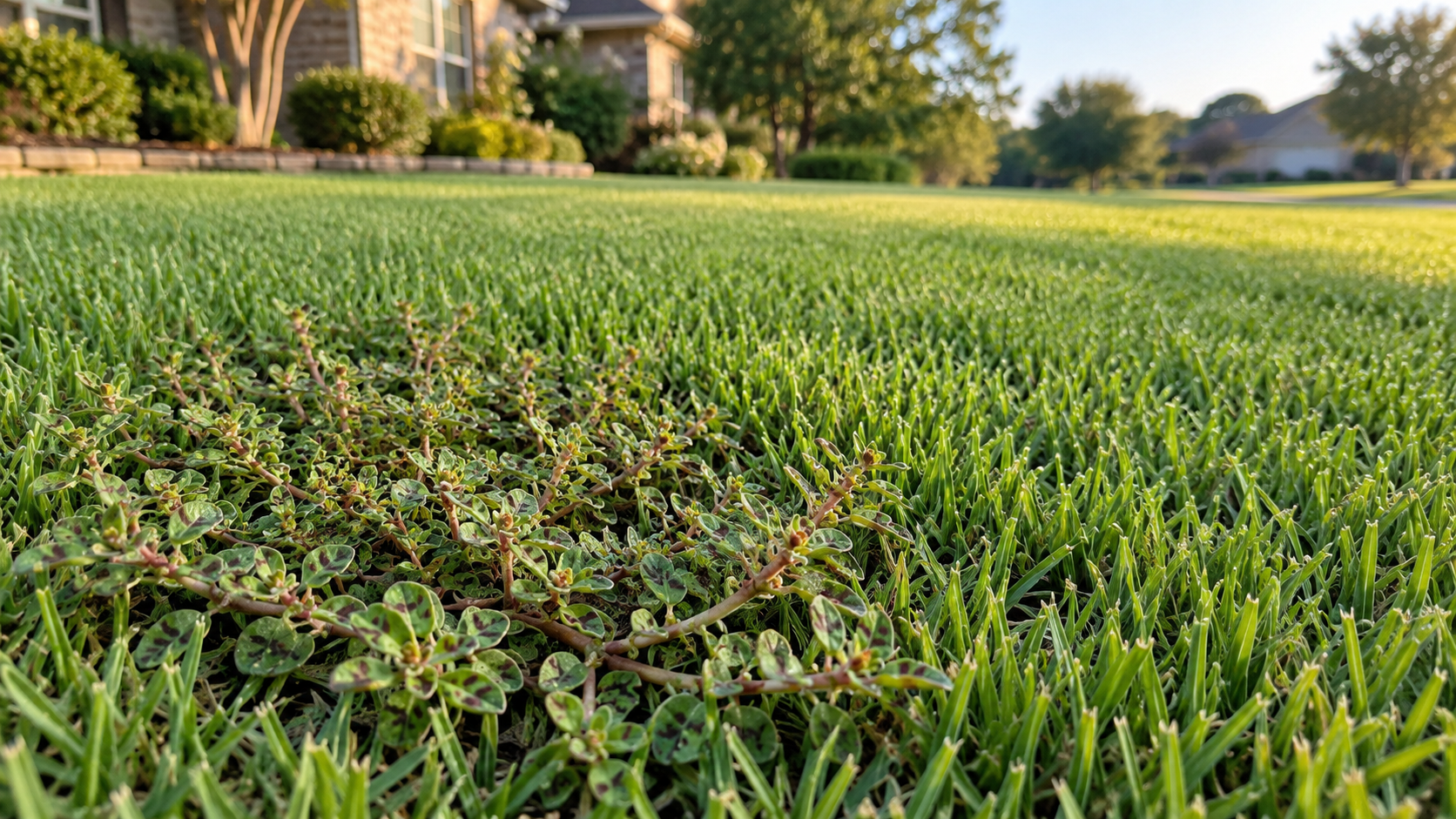
Spotted spurge is a summer annual broadleaf weed. Instead of growing upright where your mower can easily remove it, the stems radiate outward from a central point and hug the soil.
That's part of what makes it so annoying in Bermuda.
You can mow the lawn and come back to a beautifully cut stand of Bermuda with the spurge mat still sitting underneath the mowing height.
The bigger problem is reproduction.
Spurge can begin flowering and producing seed only a few weeks after emergence under favorable conditions. A mature plant can produce thousands of seeds. Those seeds are tiny, and they can move around on shoes, animals, tools, and even mower tires.
That changes the way I think about controlling it.
A big mature spurge plant isn't just one weed anymore. It's potentially a little seed factory sitting inside the lawn.
WATCH OUT
Don't assume mowing is eliminating your spurge just because you're regularly cutting the lawn. Spurge grows low enough to survive close mowing. Once plants are producing seed, mowing over an infestation can also put your mower and its tires in contact with seed that can be carried elsewhere. Cleaning equipment after working through a seed-producing infestation is a simple precaution.
Pulling spurge is more effective than it looks
If I have isolated spurge plants, hand pulling is one of the first options I'd consider.
Spotted spurge grows from a central taproot and generally doesn't root along all those sprawling stems. That means what looks like a huge mat of weeds can sometimes trace back to one central plant.
The trick is getting the root.
Grabbing a handful of stems and ripping them off isn't the same thing as removing the plant. The stems can break away and leave the crown or root behind, allowing regrowth. I want to locate the center of the plant, loosen the soil if necessary, and pull the root with it.
There's another reason I like pulling mature plants when the infestation is manageable: I can remove the entire seed-producing plant from the property instead of chopping it up in the lawn.
Wear gloves while doing it. Broken spurge stems release a milky latex sap that can irritate skin.
MY TAKE
If I only have ten or twenty spurge plants scattered through the lawn, I'm not automatically reaching for the sprayer. I'll seriously consider pulling them. I'm removing the weed, the taproot, and potentially a bunch of future seed from the lawn in one move.
The downside is obvious once you have hundreds of them. At that point, pulling turns into a Saturday project nobody asked for.
Why mowing and bagging aren't my favorite answer
It seems logical: if spurge is producing seed, mow it and bag the clippings.
The problem is the plant's growth habit.
Spurge stays extremely low. Much of the plant—and potentially flowers and seed capsules—can sit below the mower blade. Extension recommendations consistently describe mowing as ineffective for direct spurge control because the plant survives underneath the normal cutting height.
That also makes bagging less useful than it sounds.
You can only bag material the mower actually picks up. A flat spurge mat pressed against the soil isn't necessarily getting lifted, cut, and transported into the bag the way upright turf leaves are.
Meanwhile, mature seed can move on mower tires and other equipment.
So I don't want to repeatedly drive through a mature, seed-producing spurge patch and convince myself the bagger solved the problem.
PRO TIP
If you find a large mature plant before mowing, pull it first if practical. Get underneath the center, remove the taproot, carefully lift the entire mat, and dispose of it. Then mow. You're physically removing much more of the seed-producing plant instead of hoping the mower catches it.
For widespread infestations, though, physical removal stops being practical. That's where selective herbicides become useful.
Post-emergent herbicides handle the spurge that's already there
Once spurge has emerged, a pre-emergent isn't going to make that existing plant disappear. You need to pull it or control it post-emergence.
Several broadleaf herbicide active ingredients and combinations are used for spurge control in turf. University recommendations include combinations containing ingredients such as 2,4-D, dicamba, MCPP/mecoprop, fluroxypyr, triclopyr, carfentrazone, quinclorac, and related broadleaf herbicide combinations.
The important word there is combinations.
Extension guidance notes that larger, mature spurge can be difficult to control with some basic 2,4-D treatments. That's another reason I don't like letting the plants get huge before doing something.
For Bermuda lawns, there are selective products specifically labeled for warm-season turf and spurge. For example, SpeedZone Southern EW lists both Bermuda grass and spurge on its current manufacturer information. Celsius WG is another warm-season turf herbicide labeled for Bermuda grass and broadleaf weed control, but the exact weeds, rates, additives, temperature considerations, application intervals, and other restrictions need to come from the current label in your possession.
WATCH OUT
Don't choose an herbicide because somebody online says it "works on spurge." The product must be labeled for your turf species, application site, and intended use. Product formulations and labels change. Read the current label before mixing or spraying, and never exceed the labeled rate.
Young, actively growing weeds are generally a much better target than old, stressed plants. Good spray coverage also matters because you're trying to reach a plant that spreads horizontally underneath the turf canopy.
For scattered plants, spot treatment can make considerably more sense than spraying the entire lawn.
Pre-emergent is how you get ahead of next year's problem
Post-emergent control fixes what you can see.
Pre-emergent control attacks the part you can't see yet.
Spurge reproduces from seed, which makes preventing germination especially valuable. University turf recommendations list several pre-emergent active ingredients for spurge, including:
Active ingredient
Role
Prodiamine
Pre-emergent control of spurge and other annual weeds
Dithiopyr
Pre-emergent control
Pendimethalin
Pre-emergent control
Isoxaben
Broadleaf-focused pre-emergent option
Oryzalin
Pre-emergent option on appropriately labeled sites/turf
Which one makes sense depends on the lawn, other weeds you're targeting, whether you're planning to seed or establish turf, and the specific label.
The timing matters just as much as the chemistry.
Pre-emergents need to be in place before the target weed has already emerged. Spurge is a warm-season annual and germination can continue over an extended warm period, so this isn't necessarily a weed you solve by making one late application after plants are already everywhere.
There is another reason prevention matters: established spurge can produce thousands of seeds.
Think about the math.
If you kill 95% of the visible plants but allow the remaining mature plants to keep dumping seed into the lawn, you haven't really finished the job.
PRO TIP
Don't judge a pre-emergent program only by whether you see zero spurge. Treat escapes quickly. Every plant you remove before seed production is one less contributor to the seed bank you're fighting in future seasons.
The Bermuda itself is part of the weed-control program
There's a reason spurge often shows up in thin areas, edges, stressed turf, cracks, and places where sunlight reaches exposed soil.
It doesn't compete particularly well with dense turf.
That gives Bermuda grass a major advantage because properly managed Bermuda can create an extremely dense canopy.
Texas A&M recommends roughly a 1- to 2-inch mowing height for Bermuda home lawns with a rotary mower, although appropriate height varies with cultivar, equipment, and the type of turf you're maintaining. Bermuda also responds to appropriate fertility, irrigation, sunlight, and regular mowing during active growth.
I wouldn't fertilize a lawn simply because spurge appeared. Fertility should fit the Bermuda's actual needs.
But if the spurge infestation is concentrated in thin areas, I want to know why the Bermuda is thin.
Is it scalped?
Is irrigation coverage poor?
Is the area compacted?
Is there too much shade?
Is the turf being starved?
Did insects or disease open the canopy?
Herbicide can kill the spurge without fixing the reason the spurge had room to establish.
That's an important distinction.
A thick Bermuda canopy isn't a replacement for pre-emergent or post-emergent control, but it's another layer of defense.
How I'd attack a spurge problem in Bermuda grass
I wouldn't use exactly the same strategy for five plants that I'd use for five hundred.
For a handful of isolated plants, I'd pull them. I'd find the center, get underneath the taproot, remove the whole plant, and get it out of the lawn—especially if it's mature enough to be producing seed.
For a moderate infestation, I'd combine pulling obvious mature seed-producing plants with selective spot treatments on the remaining spurge.
For a widespread infestation, selective post-emergent treatment becomes much more practical. I'd identify a product currently labeled for Bermuda grass and spurge, follow that label precisely, and monitor for new germination or plants requiring a labeled follow-up treatment.
Then I'd start thinking about the next generation.
That's where pre-emergent control and Bermuda density become the long-term strategy.
MY PROCESS
- Confirm it's spurge. Look for the low, spreading growth habit, opposite small leaves, central root area, and milky sap from a broken stem.
- Pull isolated plants. Get the taproot instead of breaking off the stems, wear gloves, and remove the plant from the lawn.
- Don't rely on mowing. Spurge grows below normal mowing height, and mature seed can hitchhike on mowing equipment.
- Spot-treat manageable infestations. Use a selective post-emergent specifically labeled for your Bermuda grass and spurge.
- Treat widespread infestations appropriately. Follow the current product label for rates, timing, repeat applications, temperature restrictions, and other requirements.
- Use pre-emergent prevention. Build spurge into your annual pre-emergent strategy instead of waiting until summer mats appear.
- Keep the Bermuda dense. Correct the conditions creating thin turf so fewer spurge seedlings have open soil and sunlight to exploit.
- Keep scouting. A small plant removed early is dramatically easier to deal with than a mature seed-producing mat.