
QUICK ANSWER
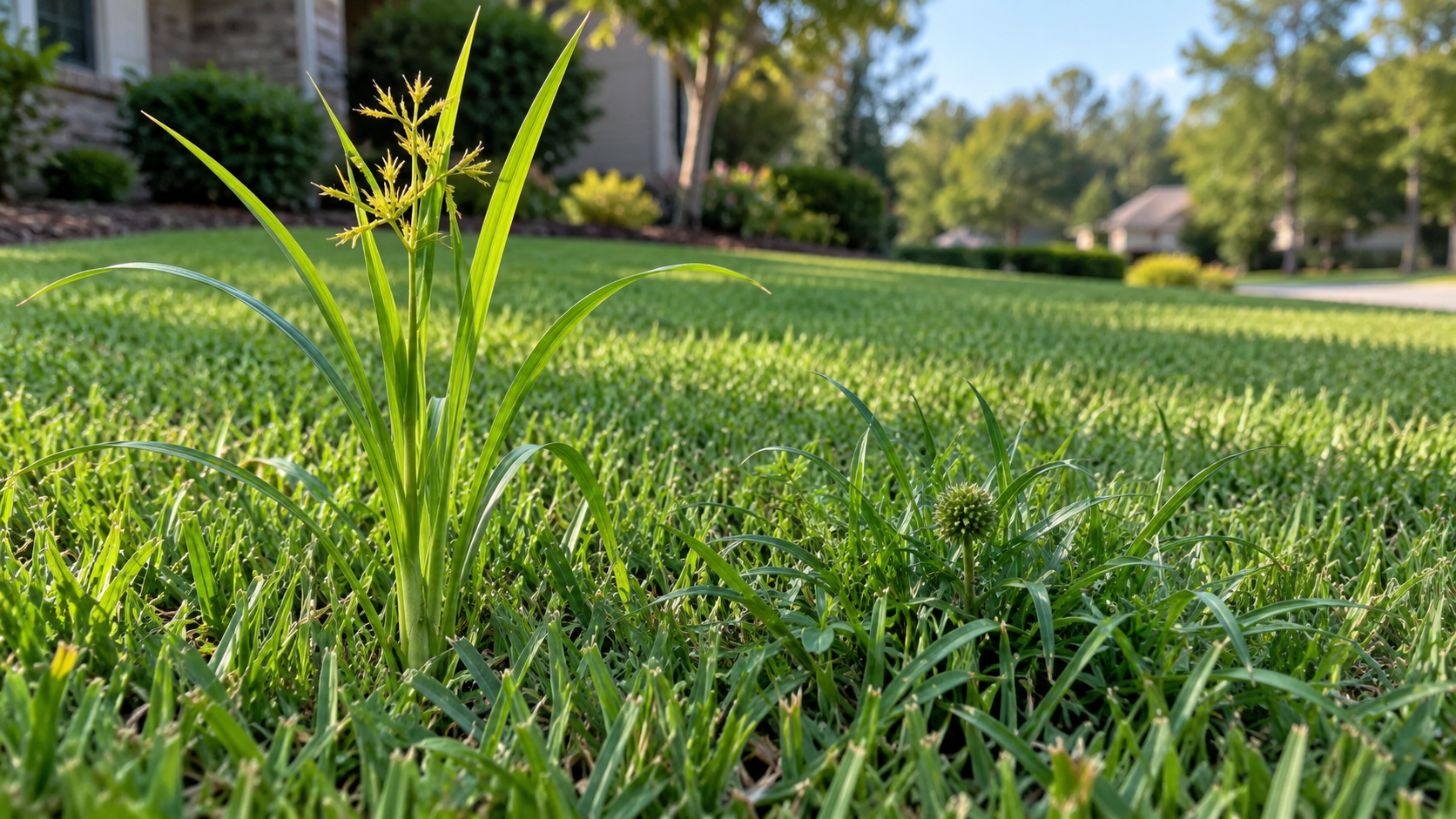
If I see nutsedge or kyllinga popping up in my Bermuda, I'm usually not thinking about spraying the entire lawn. These tend to be isolated enough in my lawn that I treat them as a spot-spray problem.
SedgeHammer and IMAGE Nutsedge Killer are the two products I keep around for this kind of work. The exact weeds controlled depend on the specific formulation and label, so don't assume every product with “nutsedge” on the front controls every species of sedge or kyllinga.
My bigger point is the process: identify it, catch it while it's actively growing, spot spray according to the label, and then be patient.
That last part matters.
Some sedge herbicides work slowly. With SedgeHammer, it can take roughly a week or two before the treatment really starts looking impressive. IMAGE Nutsedge Killer for Southern Lawns similarly says discoloration should appear in one to two weeks, with complete death potentially taking three to five weeks.
Spray it correctly and give the chemistry time to work.
First, make sure you're actually looking at a sedge
Nutsedge gets called “nutgrass” all the time, but it isn't actually a grass. Nutsedges and kyllingas belong to the sedge family, which is one reason your normal broadleaf or grassy-weed strategy isn't necessarily the right answer.
Yellow and purple nutsedge are perennial weeds that spread through underground structures. Yellow nutsedge produces tubers at the ends of rhizomes, while purple nutsedge can form interconnected chains of tubers. That underground system is a big part of what makes these weeds persistent.
Kyllinga is related, but it can look different in the lawn. Green kyllinga is a mat-forming perennial with rhizomes and a distinctive rounded seedhead. It can also tolerate lower mowing heights and work itself into the turf canopy rather than simply towering over it like nutsedge often does.
NUMBERS / COMPARISON
Nutsedge
- Usually grows noticeably faster and taller than the surrounding Bermuda
- Yellow and purple nutsedge are perennial sedges
- Spreads through underground rhizomes and tubers
- Yellow nutsedge has a more gradually pointed leaf tip
- Purple nutsedge has a blunter leaf tip
Kyllinga
- Can stay lower in closely mowed turf
- Can develop into dense, mat-like patches
- Spreads by rhizomes
- Often produces a small, rounded seedhead
- May require repeat treatment once established
That distinction matters because herbicide labels aren't interchangeable. A product labeled for yellow nutsedge isn't automatically labeled for every kyllinga species.
There's a reason I notice them after wet weather
I've noticed these weeds seem to show themselves after we get a lot of rain or moisture.
There's actually some science behind that observation.
Nutsedge and kyllinga are both strongly associated with wet or poorly drained areas. Texas A&M notes that sedges can indicate chronically excessive soil moisture, and Extension guidance on both yellow nutsedge and false green kyllinga describes them as thriving in moist, poorly drained soils.
That doesn't mean a big rainstorm magically created the nutsedge you see three days later.
The underground plant was probably already there.
But when soil moisture is favorable, these weeds can grow aggressively and suddenly become a whole lot easier to notice—especially when a bright, fast-growing nutsedge shoot sticks up through a tightly cut Bermuda lawn.
MY TAKE
This is why I don't panic when I see a handful appear. For me, it usually isn't some massive lawn-wide outbreak. I'll notice a few plants, especially when conditions have been wet, and deal with those individual spots.
If the same area continually stays wet and continually produces sedges, though, I'd start asking another question: Why is this part of the lawn staying wet?
Herbicide can kill the weed. Fixing drainage, irrigation coverage, or another source of chronically excessive moisture may help address the environment giving it an advantage.
My approach is to spot spray, not automatically blanket spray
This is one of those lawn problems where I like having the right tool sitting on the shelf.
I use SedgeHammer and IMAGE Nutsedge Killer for spot treatments in my Bermuda. Because I'm normally chasing individual plants or small patches, a little product can go a long way.
My pro move is having a dedicated sprayer for sedge treatments.
I don't mean keeping SedgeHammer mixed in the tank indefinitely. In fact, Gowan specifically says mixed SedgeHammer+ solution should not be stored because it degrades and becomes ineffective within 24 hours. I keep the sprayer dedicated and the herbicide stored separately according to its label, then mix what I need when it's time to spray.
That gives me a grab-and-go system without wondering what was previously in the tank.
PRO TIP
A small dedicated hand or pump sprayer makes a lot of sense when you're routinely spot treating isolated weeds. Label it clearly, keep it with your sedge-control products, and mix fresh solution according to the current product label when you need it.
With SedgeHammer+, the current single-use packet already contains a nonionic surfactant, so Gowan specifically says not to add another nonionic surfactant. One packet is mixed into one gallon of water and is intended to cover 1,000 square feet. Other SedgeHammer formulations have different mixing instructions, so check which one you actually own before mixing.
The same rule applies to IMAGE. IMAGE sells multiple herbicides with different formulations and directions. Read the exact label on your bottle rather than relying on the brand name alone.
Don't mistake slow herbicide activity for failure
This might be the most important part of the entire process.
Be patient.
I think it's easy to spray nutsedge, look at it a couple days later, see that it's still green, and assume the product didn't work.
That's not necessarily what is happening.
Texas A&M notes that results from halosulfuron-methyl—the active ingredient in SedgeHammer—may not be evident until around two weeks after application. Penn State observed visible injury beginning around a week after SedgeHammer treatment, with complete desiccation occurring later.
IMAGE Nutsedge Killer for Southern Lawns also isn't necessarily instant. The manufacturer says discoloration can take one to two weeks and complete weed death can take three to five weeks.
So if you spray on Saturday and the nutsedge is still standing there Tuesday, I wouldn't immediately hit it again.
Give the product time to do what it's designed to do.
WATCH OUT
Don't confuse “I can't see much happening yet” with “I need to spray more.”
Follow the retreatment interval on your specific label. Established sedges and kyllingas can require sequential applications, but more herbicide sooner isn't automatically better. Texas A&M recommends waiting for regrowth and sufficient shoot tissue before sequential treatment, which commonly occurs about four to six weeks after the first application. Product-specific label directions still control.
SedgeHammer and IMAGE aren't necessarily interchangeable
This is where I want to be careful with product names.
I keep both SedgeHammer and IMAGE Nutsedge Killer around, but I don't think homeowners should treat “sedge killer” as one universal category.
SedgeHammer contains halosulfuron-methyl. Texas A&M lists halosulfuron for yellow nutsedge and notes suppression of some kyllingas, while Gowan's current SedgeHammer+ information specifically lists annual kyllinga among the weeds it controls.
IMAGE is a brand with multiple formulations. IMAGE Nutsedge Killer for Southern Lawns is labeled for yellow and purple nutsedge in Bermuda and other listed southern turfgrasses. The current concentrate directions call for 2.5 fluid ounces per gallon for the labeled application and then 1/2 inch of irrigation within one to seven days because the product's activity includes root uptake.
Other IMAGE products use different active ingredients and include various kyllinga species on their labels. That's exactly why I wouldn't tell someone, “Just buy IMAGE and spray it.”
Read the exact bottle.
Identify the weed you're trying to kill, confirm that your exact product lists that weed and Bermuda as an acceptable turf species, and then follow that product's rate, watering, mowing, temperature, and retreatment directions.
Here's how I handle sedges when they show up
MY PROCESS
- Identify the weed first. I want to know whether I'm dealing with nutsedge, kyllinga, or something else before grabbing a herbicide.
- Pay attention to the location. If it keeps appearing in a wet area, I'll look at irrigation and drainage instead of treating the weed as the entire problem.
- Grab my dedicated sedge sprayer. Keeping one sprayer for this job makes small spot treatments easy.
- Mix fresh product according to the exact label. I use SedgeHammer or IMAGE Nutsedge Killer depending on what I'm targeting and the product label. I don't keep SedgeHammer mixed indefinitely in the sprayer.
- Spot spray the problem plants. If I've only got a few scattered weeds, I don't see a reason to automatically turn that into a blanket application.
- Leave it alone. This is the part people underestimate. I'm expecting the herbicide to take time rather than demanding an overnight response.
- Scout again later. If I get regrowth or new plants emerge, I'll evaluate whether another labeled treatment is warranted.