QUICK ANSWER
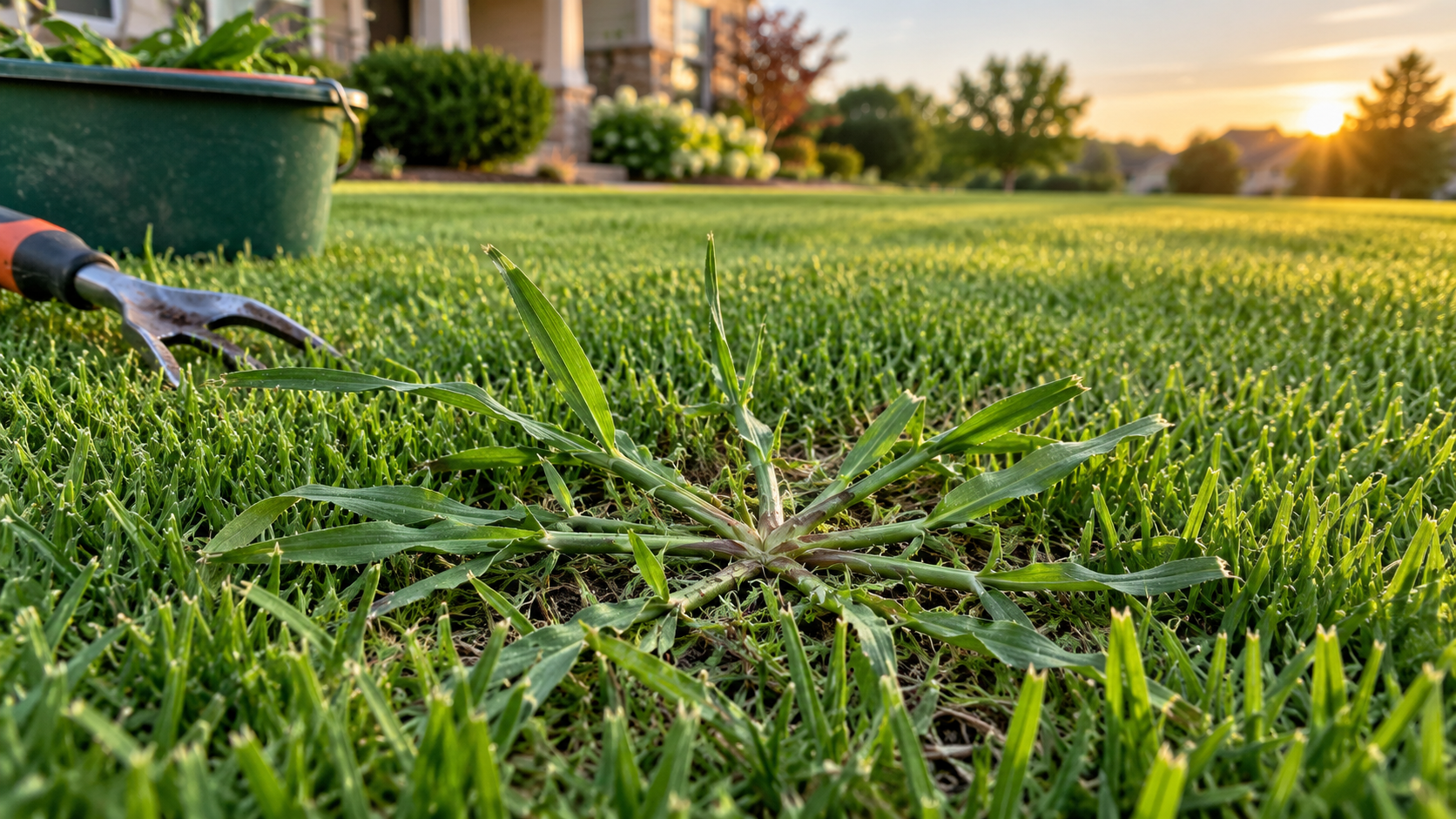
Goosegrass is a summer annual grassy weed that grows from a flattened central crown, with stems spreading outward almost like a wagon wheel. Mature plants often develop a noticeably white or silvery center. Once you learn that growth habit, it's pretty hard to unsee.
My approach in Bermuda is prevention first, then removal or selective post-emergent control for whatever gets through. But I also want the Bermuda itself doing some of the work.
That's especially important during summer. I personally treat temperatures in the 90s as my signal to be extremely conservative with post-emergent spraying. If the lawn and weed are already fighting heat and drought stress, I'd rather pull isolated goosegrass and keep the Bermuda growing than beat up good turf trying to kill one weed.
The goal isn't simply dead goosegrass.
It's dead goosegrass and Bermuda occupying the space where it used to grow.
That flattened white center is the giveaway
Goosegrass (Eleusine indica) and crabgrass get confused constantly, but once a goosegrass plant develops, its growth habit gives you some pretty good clues.
Goosegrass grows outward from a central point in a low, flattened rosette. The stems tend to hug the soil, and that center often develops a white or silvery appearance. Penn State even notes that goosegrass is sometimes called "silver crabgrass" because of those flattened, pale stem bases.
Look for:
- A low, flattened growth habit
- Tillers radiating outward from one central point
- A whitish or silvery center on mature plants
- Darker green, relatively coarse blades
- A finger-like seedhead on mature plants
- Seed arranged along the spikes in a zipper-like pattern
That last characteristic is useful when the plant has gone to seed, but I don't want to wait that long.
Goosegrass is a summer annual. It germinates, grows, produces seed and eventually dies after frost. The problem is what it leaves behind. One mature plant can produce a tremendous amount of seed, which gives you another crop to deal with later.
PRO TIP
If you're deciding between crabgrass and goosegrass, get down to soil level and look at the center instead of only looking at the leaves. That flattened, whitish central crown is one of my favorite goosegrass clues.
The best goosegrass treatment starts before you see goosegrass
Once I'm staring at mature goosegrass in July, I'm already playing defense.
Pre-emergent is the better place to start.
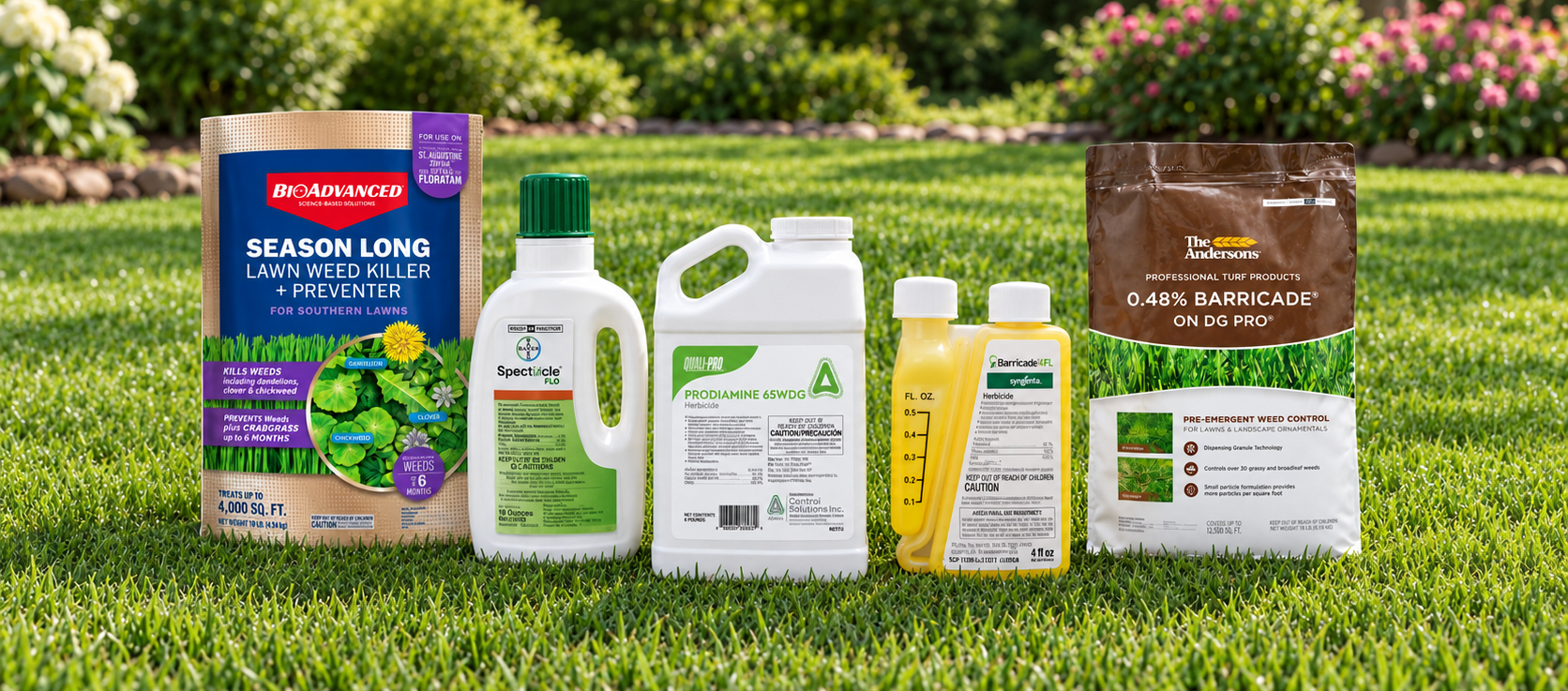
Texas A&M includes prodiamine among the pre-emergence options for annual grassy weeds, including the group that contains goosegrass. That's particularly relevant to my program because Quali-Pro Prodiamine 65 WDG is already in my Garage.
The important thing to understand is that pre-emergent doesn't magically kill a big goosegrass plant that's already sitting in the lawn. Its job is to interfere with newly germinating weeds before they become established.
That's why timing matters.
Texas A&M's homeowner guidance uses roughly 55°F soil temperatures for several days as a spring pre-emergence trigger for summer annual weeds in Texas. Goosegrass can emerge later than crabgrass and continue emerging into summer, so the residual life of the product and your complete pre-emergent program matter too.
Always follow the current product label for your turf, rate, annual maximum and watering requirements. Texas A&M notes that prodiamine needs irrigation activation after application.
MY TAKE
This is where I'd rather spend my effort. Every goosegrass plant that never establishes is one I don't have to fight in July when it's 95°F outside and my Bermuda is already dealing with summer stress.
Prevention isn't as satisfying as watching a weed curl up after spraying it.
It's usually a lot easier on the lawn, though.
Sometimes Grandpa's weeder is the right herbicide
Here's the part I think homeowners overlook.
You don't always need to spray.
Goosegrass is a great candidate for a good ol' Grandpa's weeder, especially when you've got scattered plants or a patch instead of goosegrass covering the entire property.
Get yourself a bucket, start pulling and remove the whole plant.
Because goosegrass grows from that central crown, you have a very obvious target. Get underneath it, pull the crown and roots out, throw the entire plant into the bucket and move to the next one. If it has seedheads, I definitely don't want to leave the plant lying on the lawn.
For a manageable infestation, I can cover a surprisingly decent area this way.
And there's another reason I like it during brutal summer weather: I'm not asking already-stressed Bermuda to tolerate an herbicide application just because I want a weed gone.
Pulling does leave a hole.
That's where the second half of the strategy starts.
MY TAKE
A big part of killing weeds is weakening or removing the weed while you've got strong grass ready to take its place. After I pull goosegrass, I don't consider the job finished. I want the Bermuda growing aggressively enough to run back across that opening and completely cover it.
The Bermuda is the cleanup crew.
If I'm spraying, I want the weed young and the Bermuda strong
There are label-approved post-emergent options for goosegrass in Bermuda, but this is where I slow down and read the actual label instead of grabbing whatever says "weed killer" on the front.
Texas A&M lists options including sulfentrazone and foramsulfuron for post-emergent goosegrass management in appropriate turf situations. Current labeling also includes products such as Revolver and Tribute Total for goosegrass in labeled Bermuda turf.
Growth stage matters.
Tribute Total's label specifically targets goosegrass through the early tiller stages and notes that weeds are harder to control once they're mature or environmentally stressed. Revolver's label also notes that multiple applications may sometimes be necessary.
In other words, the giant goosegrass plant you've ignored for two months is exactly the plant I don't want to make my first chemical-control experiment.
For spot applications, equipment matters too. In my Garage, I use the FlowZone Cyclone 3 and have personally tested the EGO 4-gallon backpack sprayer. For foliar work, my TeeJet XR11004VS is the kind of tip I reach for because I'm trying to get deliberate, repeatable coverage—not soak the lawn until product is running off the leaves.
WATCH OUT
Check the exact current label before selecting a product, rate, surfactant or application interval. A product being safe on one warm-season grass doesn't automatically make it safe on another, and products can have different directions for residential lawns, golf turf and sod production.
Summer heat changes how aggressive I want to be
This is probably the biggest practical difference between what looks good on a herbicide chart and what I'm willing to do to my actual lawn.
In a Texas summer, I'm not just asking, "Will this kill goosegrass?"
I'm asking, "What is this going to do to the Bermuda that's already sitting in heat and drought stress?"
Herbicide labels themselves recognize this issue. Tribute Total, for example, warns that weeds experiencing environmental stress from hot temperatures or drought become harder to control and that applications under those conditions can increase the risk of turf injury.
My personal threshold is simple:
When we're living in the 90s, I don't want to spray stressed Bermuda just to chase goosegrass.
That's my operating rule, not a universal 90°F restriction printed on every goosegrass herbicide label. Some products have very different temperature guidance, which is exactly why the label still wins.
When conditions and the label allow an application, I prefer getting away from peak afternoon heat. Dusk can give me a cooler application window and foliar product time on the weed overnight.
But there's an important catch.
Don't automatically run the sprinklers the next morning because that's what I do with another product. Rainfast periods and irrigation instructions vary by herbicide. Follow the specific label you're spraying. Even Revolver's label has detailed instructions governing rainfall, irrigation and morning dew after treatment.
Also watch nighttime spraying conditions. Calm air doesn't automatically mean perfect spraying weather; temperature inversions can increase drift potential.
WATCH OUT
Don't turn "spray at dusk" into "spray no matter what at dusk." I still want actively growing weeds, healthy Bermuda, acceptable wind, no temperature inversion, and enough rain-free or irrigation-free time to satisfy the product label.
Killing the weed is only half the job
Goosegrass tends to tell you something about the area where it's growing.
It handles compacted, disturbed and thin turf remarkably well. That's one reason it shows up along traffic areas and in openings where desirable turf isn't dominating.
So after I've killed or pulled it, I want to figure out why Bermuda wasn't already occupying that spot.
Is the soil compacted?
Is irrigation coverage weak there?
Did the Bermuda thin because I scalped it, drought-stressed it or otherwise lose density?
Am I mowing and feeding the surrounding Bermuda in a way that encourages it to recover?
A healthy, actively growing Bermuda lawn has one major advantage: it spreads.
Stolons and rhizomes allow Bermuda to reclaim openings when growing conditions support it. That's exactly what I want after removing a goosegrass crown.
This doesn't mean blindly dumping nitrogen on every hole. Fertility should still fit the lawn, season and soil program. But during active Bermuda growth, I'm trying to create conditions where the desirable grass—not the next weed seedling—wins the race into that open soil.
NUMBERS / COMPARISON
Situation
My first move
No goosegrass yet
Pre-emergent prevention
A few isolated plants
Hand pull into a bucket
Small young plants, good spraying weather
Consider a Bermuda-labeled post-emergent
Mature scattered plants
Strong candidate for mechanical removal
90°F+ summer stress
I personally favor pulling and turf health over spraying
Thin area after removal
Correct the underlying issue and encourage Bermuda recovery
Repeated infestation every year
Revisit pre-emergent timing, coverage and turf density
My goosegrass game plan
I'm not trying to win against goosegrass with one heroic spray.
I want several smaller advantages working together.
MY PROCESS
- Confirm it's actually goosegrass. I look for that low rosette, flattened crown and pale or silvery center.
- Look at the size of the infestation. A dozen scattered plants is a completely different problem from hundreds of seedlings.
- Pull what makes sense. For isolated mature plants, I grab the weeder and a bucket and physically remove them.
- Use chemistry selectively. If spraying makes sense, I choose a product specifically labeled for goosegrass and my Bermuda turf and follow its current directions.
- Respect summer stress. Once we're in sustained 90°F weather, my preference is to stop trying to force post-emergent applications onto stressed turf and use mechanical control until conditions improve.
- Help the Bermuda reclaim the opening. I keep mowing, watering and feeding according to the lawn's actual needs so healthy Bermuda can spread back into the disturbed area.
- Fix next year's problem now. If goosegrass keeps returning, I look hard at pre-emergent timing, compaction, weak turf and other conditions giving it an opening.
KEY TAKEAWAYS
- Goosegrass is easiest to recognize by its flattened rosette and characteristic pale or silvery center.
- Prevention is easier than trying to kill mature goosegrass during summer.
- Prodiamine is one pre-emergent option for annual grassy weeds in established Bermuda when used according to its label.
- Scattered mature goosegrass is an excellent candidate for mechanical removal with a weeder and bucket.
- I personally avoid forcing herbicide applications during sustained 90°F summer conditions when my Bermuda is already stressed.
- The real finish line isn't a dead weed. It's healthy Bermuda completely reclaiming the space.