
QUICK ANSWER
Bermuda grass is tougher than it looks. A lawn that turns brown during severe summer heat and drought may still have living crowns, stolons, and rhizomes capable of producing new growth when moisture returns. Texas A&M describes Bermuda as extremely drought-hardy with rapid recuperative potential, while Oklahoma State notes that established Bermuda can brown during drought and become actively growing again when moisture returns.
When I'm trying to bring a badly stressed section back, water is the first requirement—but I don't just turn the sprinklers on and wait.
If there's a heavy layer of dead material, I'll thin it by dethatching or carefully scalping and bag everything I remove. If compaction is part of the problem, core aeration can help. Then I restore moisture and, once I know the Bermuda is hydrated and actively growing, give it nutrition to help surviving grass spread.
I've seen that combination turn some surprisingly ugly Bermuda around.
Brown Bermuda isn't necessarily dead Bermuda
This is probably the most important thing to understand before tearing out a drought-damaged lawn.
Bermuda has an advantage that isn't obvious when you're looking at a patch of crispy brown grass: the leaves aren't the entire plant.
Bermuda spreads above the soil with stolons and below it with rhizomes. Texas A&M lists drought tolerance, heat tolerance, deep-rooting potential and rapid recuperative potential among Bermuda's strengths. Oklahoma State similarly describes its recovery from injury as rapid.
That matters because severe drought can make the top of the lawn look considerably worse than the surviving plant underneath.
Oklahoma State specifically notes that established Bermuda can tolerate considerable drought and recover when irrigation resumes. In OSU field research under extreme drought, common Bermuda reached roughly 92–95% brownout, yet later returned to complete green-up after milder temperatures, rainfall and supplemental irrigation. That's not a guarantee that every brown residential lawn will recover—the growing points can absolutely die under sufficiently severe stress—but it demonstrates how misleading Bermuda's appearance can be during drought.
So my first goal isn't immediately replacing the grass.
It's figuring out how much living Bermuda I can get moving again.
MY TAKE
I've had sections look bad enough that you'd think the grass was finished. Once I start seeing green leaves appearing throughout that brown area, my thinking changes completely. Now I know I've got living Bermuda to work with. Instead of replacing it, I'm trying to create the conditions that let those surviving plants take the ground back.
Water starts the recovery, but the lawn may need some room
The temptation with a brown lawn is to assume water is the entire solution.
Water absolutely matters. It is the foundation of the recovery.
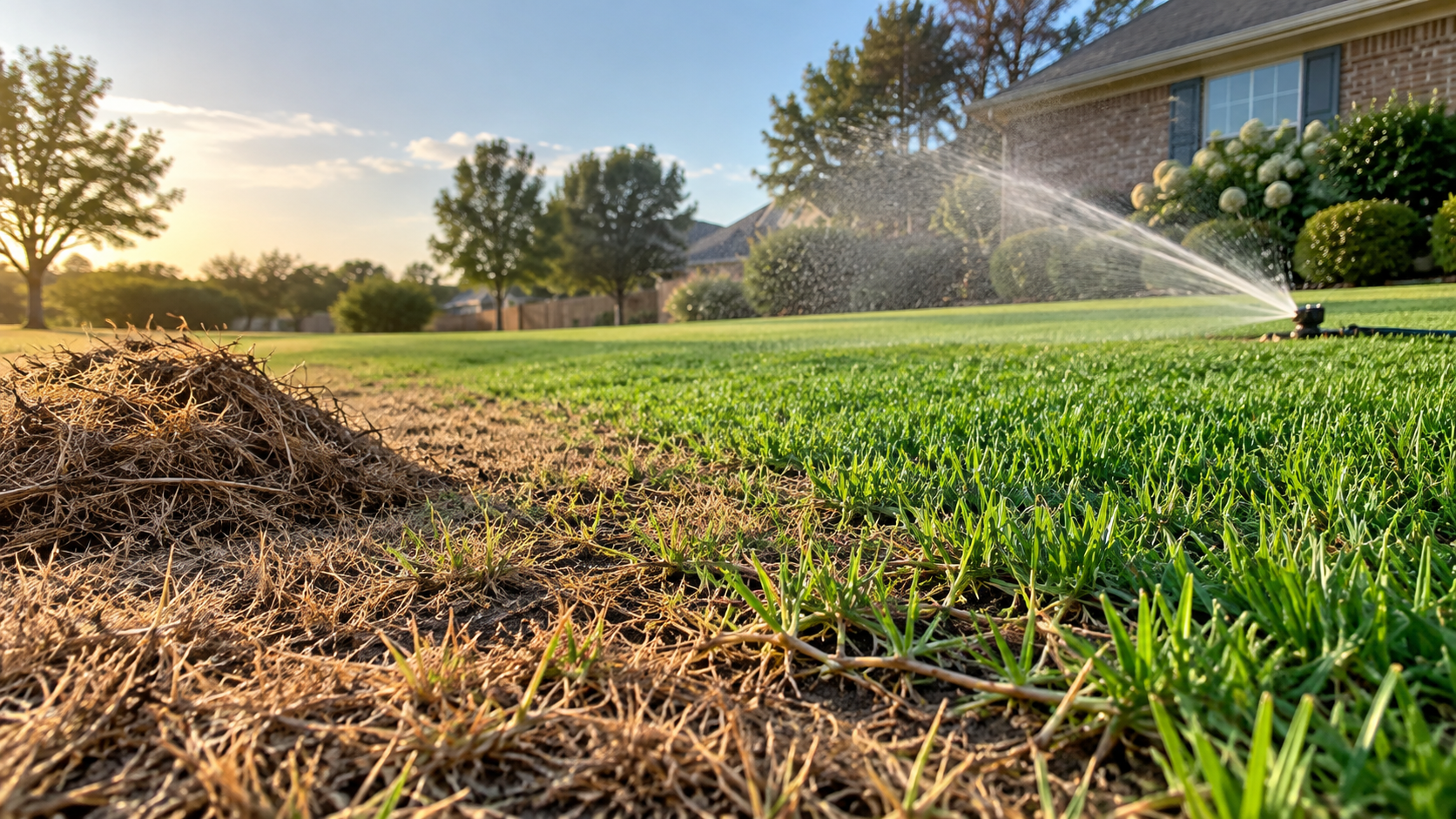
But on severely stressed areas, I've had better results when I also deal with the dead material sitting over and around the surviving turf.
There's an important distinction here. Brown leaves aren't automatically excessive thatch. True thatch is the layer of living and dead stems, roots and other organic material between the green canopy and soil. Texas A&M defines it similarly, and UGA recommends dethatching Bermuda when the actual thatch layer exceeds about ½ inch.
So I wouldn't automatically run a dethatcher across every lawn that turns brown.
But if a severely stressed area has a heavy mat of dead growth, I'll remove enough material to open it up. Depending on the lawn and mowing height, that might mean dethatching or a controlled scalp.
Then I bag it.
I'm trying to expose the surviving Bermuda, improve access to the surface and—just as importantly—create physical space for stolons to start running back across thin areas.
Bermuda's ability to spread laterally through stolons and rhizomes is exactly why this works so well when enough of the original stand survived.
WATCH OUT
Dethatching, scalping and aerating are stresses of their own. Don't aggressively renovate Bermuda that is still completely moisture-starved. UGA recommends dethatching and core aeration while Bermuda is actively growing, and its maintenance calendar calls for core aeration during active growth. Get moisture back into the system and make sure the grass has growing season left to recover.
Compaction can change how I approach the damaged area
If the surface is hard and compacted, removing dead material may not solve the whole problem.
Water still has to infiltrate the soil.
Texas A&M notes that compacted soils restrict water, air and root growth and are more susceptible to runoff. UGA describes core aeration as a tool for relieving compaction, and recommends doing it during the active growing season.
That's where I may bring out the aerator.
I'll admit that aerating an already ugly lawn can feel pretty destructive. You just cleaned up a stressed area and now you're punching thousands of holes into it.
But Bermuda is incredibly aggressive when it's actively growing.
If compaction is restricting the root zone, I would rather correct the physical problem and give the turf a better environment for recovery than repeatedly apply water to a surface where infiltration is poor.
This is also where I pay close attention to runoff. If water starts moving down the sidewalk before the soil has received what I intended to apply, running the irrigation longer isn't solving the problem. The application rate is outrunning the soil's ability to take in water. Texas A&M specifically identifies infiltration and runoff as important parts of efficient lawn irrigation.
PRO TIP
Before assuming your irrigation system is putting down enough water, measure it. Oklahoma State recommends an irrigation audit using catch containers so you can determine the system's actual precipitation rate and distribution instead of guessing from sprinkler run time.
This is the recovery sequence that's worked for me
Once I've opened up the stressed area, moisture becomes my obsession.
For severely damaged spots, I've used frequent watering during the initial recovery period because I don't want those areas drying back out just as surviving Bermuda begins producing new growth. I'll hand-water individual bare or stubborn areas when necessary.
That's different from saying an established Bermuda lawn should permanently be watered every day.
Under normal maintenance, deep and relatively infrequent irrigation encourages deeper rooting. Texas A&M recommends watering established lawns around the first signs of wilt rather than simply following a daily schedule, while Oklahoma State also recommends deep, infrequent irrigation.
NUMBERS / COMPARISON
Recovery phase
What I'm trying to accomplish
Initial rehydration
Restore moisture to drought-stressed soil and surviving turf
Dead-material removal
Open severely matted areas and expose surviving Bermuda
Core aeration, if needed
Relieve compaction and improve movement of water and air into the soil
Early regrowth
Keep recovering areas from becoming moisture-starved again
Active spreading
Support stolons and shoots with appropriate fertility
Established again
Transition toward deeper, less-frequent irrigation
Fertilizer comes into the picture too—but water comes first.
Putting nitrogen on severely drought-stressed Bermuda without adequate soil moisture isn't my recovery strategy. Oklahoma State's post-drought Bermuda guidance makes the same fundamental point: supplemental nitrogen can accelerate recovery, but nitrogen should be applied when soil moisture is present.
For actively growing home-lawn Bermuda, Texas A&M lists individual nitrogen applications in the range of 0.5–1.0 pound of actual N per 1,000 square feet, with total fertility adjusted for the lawn and growing season. A soil test should guide phosphorus, potassium and pH corrections rather than assuming a stressed lawn needs everything in the fertilizer bag.
The second push happens when I see leaves
This is one of my favorite parts of the process.
At first you're staring at what looks like dirt, straw and a handful of surviving runners.
Then green starts popping up everywhere.
In my own recovery work, I've seen that happen in roughly a week under aggressive summer growing conditions. Around the week-to-week-and-a-half point, if I've got plenty of new green leaf tissue, that's when I've sometimes moved to a foliar liquid fertilizer application.
The distinction matters.
I'm not spraying liquid fertilizer onto completely brown, dead material and expecting something magical to happen. I want actively growing green leaves before I'm thinking about a foliar application.
And when that Bermuda is hydrated, actively growing and ready to respond...
Oh man.
I've watched it light up dark and fast.
On my lawn, I've seen a day-and-night visual difference in roughly 12 days and severely thinned areas continue filling until the lawn looked recovered at around three weeks.
Those are my observations—not a universal recovery timetable. Temperature, cultivar, root survival, soil, irrigation, fertility, sunlight and the severity of the original damage can all change how quickly Bermuda comes back.
But the biological reason Bermuda can recover so aggressively is well established: those stolons and rhizomes give it tremendous recuperative ability when conditions support growth.
How I'd decide whether to recover it or start over
Before buying sod, I'd give stressed Bermuda an opportunity to tell me what is still alive.
If I'm seeing green shoots distributed through a damaged area after moisture has returned, that's encouraging. Those plants can become the starting points for recovery.
If I'm seeing living stolons creeping across bare soil, even better.
For isolated damaged spots, I don't necessarily renovate the entire lawn. I'll work that area specifically: thin excessive dead material, correct compaction if it's actually present, restore moisture, feed appropriately once growth resumes and hand-water stubborn spots when needed.
The situation changes when there simply isn't enough living Bermuda left to reclaim the area during the remaining growing season. That's when plugging, sprigging, seeding an appropriate seeded cultivar, or replacing the area with sod becomes a different conversation.
Timing matters here too. Bermuda needs active growing conditions to do this work. Aggressive late-season nitrogen or renovation right before dormancy isn't the same proposition as recovery during the middle of active summer growth. Clemson and Oklahoma State both caution against late nitrogen that can interfere with Bermuda's preparation for winter.
That's why I like getting drought-damaged Bermuda moving while there is still legitimate growing season left.
MY PROCESS
- Restore moisture first. I want to know the root zone has water before asking stressed Bermuda to do anything else.
- Look for life. Green shoots, living runners and new growth tell me there's Bermuda worth pushing.
- Remove excessive dead material. If the area is heavily matted, I'll carefully dethatch or scalp it and bag what I remove.
- Core-aerate when compaction justifies it. I don't add another stress just because I own an aerator.
- Feed actively growing Bermuda. Once moisture is present and recovery has started, I use appropriate fertility to support growth rather than trying to fertilize my way out of drought.
- Pay extra attention to thin spots. I'll hand-water stubborn areas so they don't repeatedly dry out during the initial recovery.
- Wait for leaves before foliar feeding. Once I've got meaningful green tissue, that's when a foliar application can become part of my program.
- Transition back to normal irrigation. As the stand reconnects and establishes, I move away from recovery-mode watering toward deeper, less-frequent irrigation.
And there's a payoff here that goes beyond getting the lawn green again.
Some of the lawns I've enjoyed the most have been the ones that looked absolutely hammered during a harsh drought. You spend weeks fighting the heat, wondering if certain areas are going to make it, and then fall finally shows up.
The Bermuda is green again. The temperature drops. The grass is still growing.
And suddenly I'm outside enjoying the lawn with my neighbors and kids instead of standing there staring at another crispy brown spot.
That's a pretty good reward for bringing it back.