The formula
Pounds of fertilizer product per 1,000 square feet equals the desired pounds of actual nitrogen per 1,000 divided by the product's nitrogen percentage written as a decimal.
Total pounds of product equals that per-1,000 result multiplied by the actual treated square feet divided by 1,000.
- Product lb/1,000 = target lb N/1,000 ÷ nitrogen decimal
- Total product lb = product lb/1,000 × treated sq ft ÷ 1,000
- Nitrogen decimal = first analysis number ÷ 100
Example: 32-0-4 on 5,000 square feet
To deliver 0.5 pound of nitrogen per 1,000 square feet with 32-0-4, convert 32 percent to 0.32. Divide 0.5 by 0.32 to get 1.5625 pounds of product per 1,000 square feet.
Multiply 1.5625 by 5 because the lawn is 5,000 square feet. The calculated total is 7.8125 pounds of product. Use a suitable scale and round only to a precision the equipment can apply while staying within the label rate.
Example: a small quick-release application
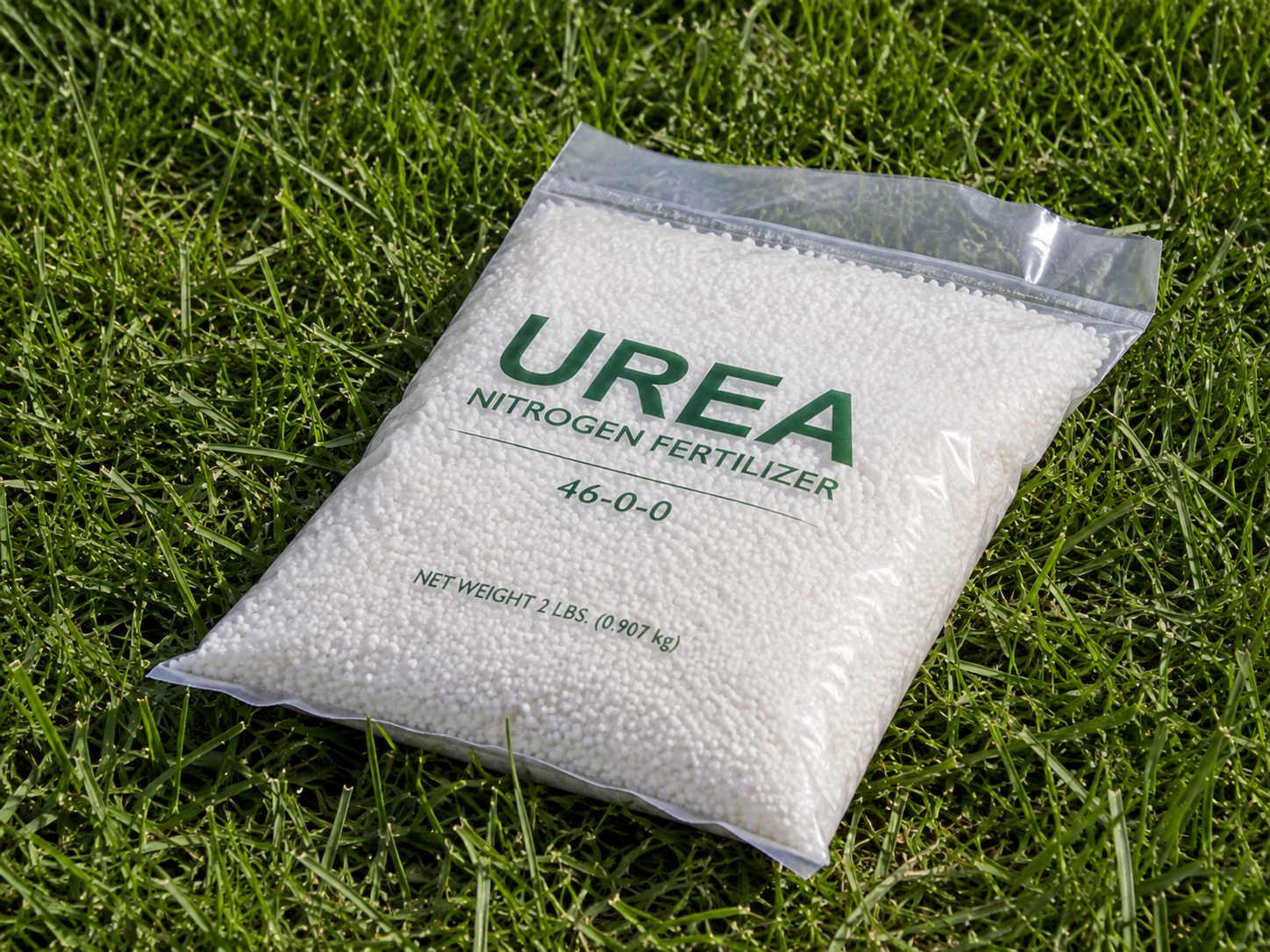
To deliver 0.25 pound of nitrogen per 1,000 square feet with 46-0-0 urea, divide 0.25 by 0.46. The result is about 0.543 pound of product per 1,000 square feet.
For 3,500 square feet, multiply 0.543 by 3.5 for about 1.90 pounds of total product. Confirm the label permits the intended use and rate before treating the lawn.
Measure the treated area
Do not calculate from the lot size. Measure each turf rectangle, triangle, or other section and subtract buildings, beds, pavement, and untreated areas. Add the turf sections together.
Separate zones can be useful when front and back lawns have different grass, soil, irrigation, or treatment plans. Record the area once, then verify it after landscape changes.
Understand what the three numbers mean
A 32-0-4 label means 32 percent total nitrogen, 0 percent available phosphate, and 4 percent soluble potash by product weight. The second and third numbers are conventional fertilizer forms, not direct elemental phosphorus and potassium percentages.
This guide calculates nitrogen from the first number. If a soil recommendation specifies phosphate or potash, calculate that nutrient separately and ensure no product causes another nutrient or label limit to be exceeded.
Calculation is not calibration
The math tells you how much product belongs in the entire measured area. Calibration tells you whether the spreader or sprayer distributes that amount evenly. Bag settings are starting points because granule size, density, equipment condition, walking speed, nozzle output, and swath overlap vary.
For granular products, weigh the required amount and use test passes or a known-area calibration. For liquids, calibrate the sprayer with water and follow the product label for carrier volume, agitation, nozzles, and application restrictions. Do not invent a universal gallons-per-1,000 rate.
Common mistakes
Do not divide by 32 when the formula requires 0.32, confuse pounds of product with pounds of nitrogen, or forget to scale for the full lawn. Do not count a product's coverage claim as a nutrient calculation without checking its analysis and labeled rate.
Write the calculation in the application log before loading equipment. A second check of area, analysis, target rate, and total product can prevent a tenfold error.