Quick answer
Texas Bermuda fertilizer calendar
These are planning windows, not fixed application dates. Soil temperature, active growth, rainfall, weather, and turf condition determine the actual timing. Use a soil test to guide what the lawn needs.
- JanuaryDormant lawn; plan and soil-test rather than feed.
- FebruaryWatch soil temperatures and prepare spring weed prevention.
- MarchGreen-up varies by location and weather. Do not push dormant turf with nitrogen.
- AprilFirst meaningful nitrogen window once Bermuda is actively growing.
- MayActive-growth feeding window; use soil results and measured nitrogen.
- JuneContinue only as growth, irrigation, and heat conditions support it.
- JulyAdjust for heat, rainfall, and actual turf growth.
- AugustFeed only while growth and conditions support it.
- SeptemberWeigh late nitrogen against location, turf condition, and approaching dormancy.
- OctoberWatch the fall pre-emergent window; avoid excessive late growth.
- November–DecemberDormancy approaches or arrives; minimal nitrogen activity.
Follow the Bermuda calendar for seasonal work and check LawnWeather for local conditions before deciding when to act.
QUICK ANSWER
I don't think the best Bermuda fertilizer schedule for Texas is a rigid January-through-December recipe.
The calendar gives me the windows. The grass tells me whether I should actually fertilize.
I want Bermuda fully green and actively growing before the first meaningful nitrogen application. From there, I work backward from an annual nitrogen goal, use the soil test to determine whether I need phosphorus or potassium, and adjust each application based on growth, mowing capacity, rainfall, irrigation, and summer stress.
Texas A&M's current Bermuda guidance recommends soil testing, keeping individual nitrogen applications at roughly 0.5 to 1 pound of actual nitrogen per 1,000 square feet, and avoiding nitrogen before full green-up or during hot, dry periods when moisture is limiting. A typical Texas home-lawn program may contain one to four fertilizer applications during the growing season.
That's the backbone of this calendar.
Start with an annual nitrogen goal, not a bag of fertilizer
Nitrogen is what drives Bermuda growth.
That's useful, but it also means every pound of nitrogen you put down creates work.
More nitrogen generally means more leaf growth, more mowing, more clipping production, and potentially more thatch and water demand. Texas A&M specifically warns that excess nitrogen can produce a rapid flush of growth that leads to scalping and heavy clipping accumulation.
So before deciding when to fertilize, I think it makes more sense to decide how much Bermuda you actually want to manage.
Texas A&M has historically published annual nitrogen ranges that vary with both Bermuda type and management level. Its Texas warm-season fertilization guidance lists common Bermuda at about 2 pounds of nitrogen per 1,000 square feet annually under lower management, 2–3 pounds under moderate management, and 4–5 pounds under high management. Hybrid Bermuda ranges higher, topping out around 5–6 pounds under intensive management.
That doesn't mean a homeowner should automatically chase the top of the range.
NUMBERS / COMPARISON
Management approach
Practical annual N target
What it usually requires
Lower-input Bermuda
Around 2 lb N / 1,000 sq ft
Less aggressive growth and mowing
Typical maintained lawn
Around 2–4 lb N / 1,000 sq ft
Regular mowing, adequate moisture
High-management Bermuda
4+ lb N / 1,000 sq ft
Frequent mowing, irrigation and closer management
Intensively managed hybrid Bermuda
Potentially 5–6 lb N / 1,000 sq ft
Very frequent mowing and consistently strong cultural practices
Those are planning ranges—not a quota you have to reach.
If July turns brutally dry and the lawn stops growing, I don't care that my spreadsheet says I'm "behind" on nitrogen. The lawn doesn't owe me four pounds of N just because I wrote down four pounds in March.
The soil test decides what goes with the nitrogen
This is where a fertilizer schedule starts becoming a nutrient plan instead of a bag-spreading plan.
Nitrogen is different from phosphorus and potassium because nitrogen drives growth and is normally supplied repeatedly through the growing season. Phosphorus, potassium, sulfur, lime, and many micronutrients shouldn't automatically ride along just because they're printed on the same fertilizer bag.
Texas A&M recommends soil testing to identify nutrient needs and notes that fertilizer selection should account for soil-test results, soil type, traffic, application rate, and the intended result. It also points out that secondary nutrients and micronutrients generally should be applied according to soil-test need, with iron being a notable consideration on high-pH soils.
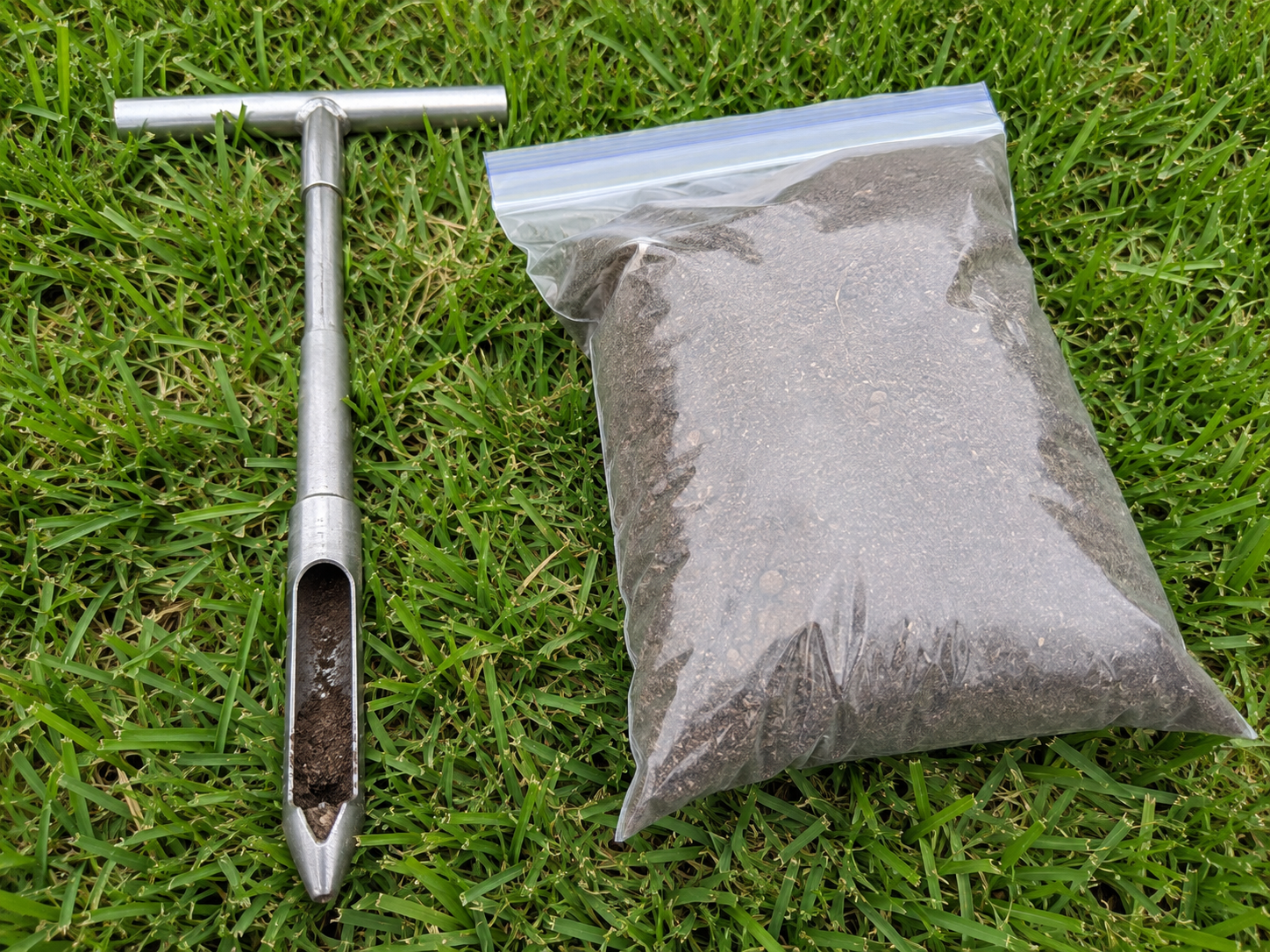
Texas A&M's Soil, Water and Forage Testing Laboratory provides current fertility recommendations and homeowner soil-testing services.
So if my soil already has plenty of phosphorus, I don't see any reason to repeatedly buy phosphorus just because a "Bermuda fertilizer" happens to contain it.
PRO TIP
Build the year's fertilizer plan in pounds of actual nitrogen per 1,000 square feet, then choose products that supply the other nutrients your soil test actually calls for.
For example, if the annual goal is 3 pounds of nitrogen:
- Spring: 0.75 lb N
- Early summer: 0.75 lb N
- Mid-summer: 0.75 lb N
- Late summer: 0.75 lb N
That's a 3-pound annual nitrogen program.
What fertilizer supplies those applications can change depending on the soil test.
My Texas Bermuda calendar follows growth more than dates
Texas is too big for one fertilization date to make sense everywhere.
Bermuda may be waking up in South Texas while a North Texas lawn is still mostly dormant. Clemson makes the same broader point in its Bermuda calendar: maintenance dates have to move with climate because green-up and frost timing can shift substantially even within one state.
So I think of this as a sequence of windows.
January through early spring: maintain the weed barrier, but don't feed dormant Bermuda
This is not nitrogen season.
In warmer portions of Texas, winter weeds can keep germinating for a surprisingly long time. Texas A&M specifically notes that southern Texas lawns may benefit from split fall pre-emergent applications, with part of the labeled rate applied around October and the remainder around December or January because warmer temperatures extend winter weed germination.
That's consistent with how I think about the calendar: establish the fall barrier before late October in a warmer southern location, then reinforce that coverage during winter according to the specific herbicide label.
I also like this part of the year for soil testing because it gives me time to make the season's fertilizer decisions before Bermuda starts demanding attention.
Spring green-up: don't confuse green grass with fertilizer readiness
My own green-up period is typically around the end of March, but I wouldn't publish that as a universal Texas date.
Texas A&M says nitrogen should not be applied to Bermuda before full green-up.
That's an important distinction.
A few green stolons aren't full green-up.
Once the lawn has transitioned into active growth, that's when the first nitrogen application starts making sense.
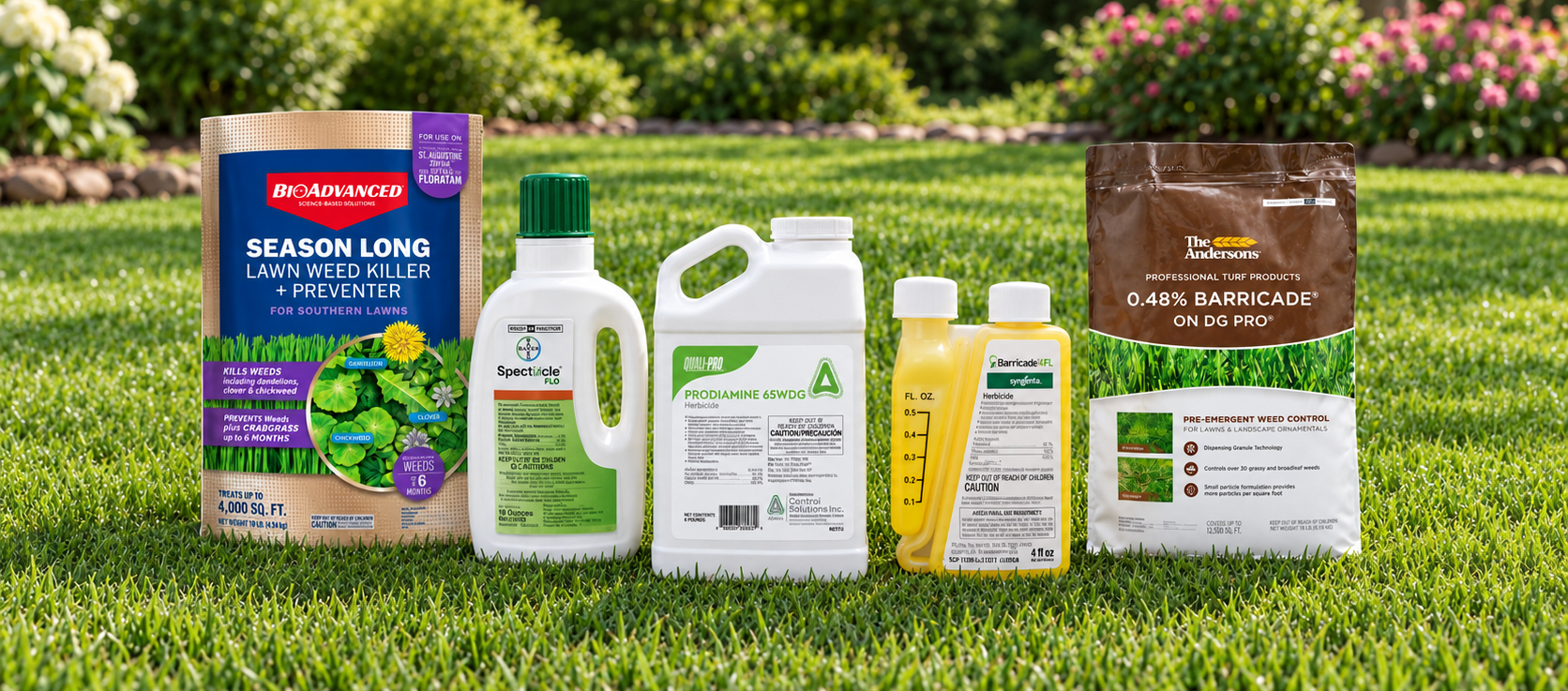
Spring pre-emergent timing is a separate decision. Texas A&M says spring pre-emergents are commonly timed around 50–55°F soil temperatures, when several summer annual weeds begin germinating. In South Texas, crabgrass germination can begin around mid-February, earlier than it does farther north.
That means a late-March half-rate application in a southern program makes the most sense as continued labeled coverage, not as the first attempt to stop crabgrass for the year.
WATCH OUT
Don't make green-up, spring fertilizer and spring pre-emergent one automatic "lawn day."
They solve different problems.
Nitrogen waits for actively growing Bermuda. Pre-emergent has to be in place before the target weed germinates, and application rates, intervals and annual maximums must follow the label of the exact product being used.
Late spring through early summer: this is where Bermuda earns the fertilizer
Once Bermuda is fully active, temperatures are warm, moisture is available, and mowing is consistent, I'm much more comfortable feeding it.
A typical application falls somewhere around 0.5 to 1 pound of actual nitrogen per 1,000 square feet. Texas A&M recommends staying within that range for a single application.
This is usually the easiest part of the year to follow the plan because Bermuda can actually use the nitrogen.
Oklahoma State's Bermuda maintenance calendar follows a similar pattern, beginning meaningful fertilization after spring green-up and continuing nitrogen through the active summer growing season. It also notes that reducing summer nitrogen applications can maintain good Bermuda while reducing mowing, dethatching and water demand.
That last part matters.
Your fertilizer schedule and your mower schedule are connected.
Your mower may be the best nitrogen-rate calculator you own
This is probably the part of fertilizer scheduling that gets overlooked most often.
If you fertilize Bermuda aggressively, it grows aggressively.
Texas A&M recommends mowing home-lawn Bermuda around 1–2 inches with a rotary mower and mowing frequently enough to avoid removing more than about one-third of the leaf tissue at once. Very low-cut hybrid Bermuda generally requires a reel mower and multiple mowings per week.
So let's say you're already barely keeping up with mowing every seven days.
Adding another heavy nitrogen application isn't automatically improving the lawn.
It might just create a lawn that grows beyond your ability to maintain the cutting height.
MY TAKE
I would rather run a nitrogen program I can actually support than chase the maximum amount Bermuda can physically consume.
The fertilizer bag doesn't know whether I can mow tomorrow.
If growth is already outrunning my mower, that's useful information. I can reduce the next application, spread my annual nitrogen over more manageable doses, or simply wait until the lawn catches up.
The goal isn't maximum growth.
The goal is controlled growth that produces the density and appearance I'm trying to maintain.
Summer is where rainfall and stress get a vote
Bermuda loves heat.
That doesn't mean I automatically fertilize through every Texas heat wave.
Heat tolerance and fertilizer readiness aren't the same thing.
The bigger issue is whether the turf has enough moisture to remain actively growing. Texas A&M says not to fertilize during hot, dry late-summer periods when moisture is limiting. Nutrients are used most efficiently when the lawn is actively growing and isn't under heat or drought stress.
Clemson similarly recommends changing Bermuda management under high-temperature or low-rainfall stress, including temporarily raising mowing height.
So my summer decision tree is pretty simple:
Is the Bermuda actively growing?
If no, I wait.
Can rainfall or irrigation support additional growth?
If no, I wait.
Can I keep up with the mowing that more nitrogen will create?
If no, I reduce or skip the application.
Am I trying to hit an annual nitrogen number simply because it's on the calendar?
If yes, I definitely reconsider it.
Texas A&M also advises against fertilizing immediately ahead of heavy rainfall because of nutrient movement and runoff risk.
A calendar should keep me organized.
It shouldn't talk me into a fertilizer application the lawn isn't ready for.
Fall is about finishing cleanly, not squeezing in one more growth flush
As the growing season winds down, I become less interested in forcing growth.
Oklahoma State warns that late nitrogen can produce lush fall growth and interfere with Bermuda's transition toward winter, while Clemson stops routine nitrogen during its September-through-December period. Those dates come from different climates, but the principle travels well: don't push Bermuda hard with nitrogen as active growth is shutting down.
In Texas, the exact cutoff moves with location and weather.
That's why I would rather watch growth, nighttime temperatures and the lawn's trajectory toward dormancy than publish one statewide "last fertilizer date."
This is also when the weed calendar comes back into focus.
Texas A&M says most Texas fall pre-emergent applications occur from late August through October, with northern areas generally applying sooner and southern areas potentially benefiting from the October plus December/January split approach.
For a warmer southern-Texas schedule, a target before Halloween fits naturally into that broader window.
Just don't automatically attach nitrogen to the pre-emergent.
Dormant or slowing Bermuda doesn't need to be pushed simply because a combination weed-and-feed product makes it convenient.
The calendar I would actually build
MY PROCESS
- Soil test before the growing season.
Use the result to decide whether phosphorus, potassium, pH correction or other nutrients actually belong in the program. - Choose an annual nitrogen target.
For a typical maintained Bermuda lawn, roughly 2–4 pounds of nitrogen per 1,000 square feet gives you a useful planning range. Higher-input hybrid Bermuda can justify more, but only when the mowing, irrigation and overall maintenance program can support it. - Handle spring pre-emergent before weed germination.
Watch soil temperatures and local conditions rather than waiting for Bermuda green-up. In warmer southern areas, a late-March reduced-rate application may extend an existing barrier if the product label supports that program—it should not be treated as the first spring crabgrass prevention application. - Wait for full Bermuda green-up before the first nitrogen.
Don't fertilize dormant grass simply because a calendar says "spring." - Feed through active growth.
Use approximately 0.5–1 pound N per 1,000 square feet per normal application, adjusting the number of applications to the annual target. - Let mowing, rainfall and irrigation control summer aggression.
If the turf is drought stressed or growth is already outrunning the mower, back off. - Stop chasing nitrogen as growth slows.
Let Bermuda transition toward dormancy instead of forcing one last flush. - Re-establish fall pre-emergent coverage.
In warmer southern Texas conditions, an October application with a winter follow-up can fit Texas A&M's split-application concept when it is permitted by the specific herbicide label.
KEY TAKEAWAYS
- A Texas Bermuda fertilizer calendar should follow active growth, not just month names.
- Build the season around an annual actual-nitrogen target instead of counting fertilizer bags.
- Let your soil test determine phosphorus, potassium and other nutrient needs.
- Your mowing capacity should influence how aggressively you feed Bermuda.
- Don't fertilize drought-stressed turf simply to stay on schedule.
- Treat pre-emergent and fertilizer as separate programs even though both belong on the same annual lawn calendar.
The calendar gets me organized.
The lawn still gets the final vote.